ArticlesEngineering7 min read
Slick Tires: Why Don’t F1 Cars Have Grooves?
On the road, grooves are reassuring. In F1, the FIA mandated them for eleven seasons to slow the cars down. What they do, in the dry and in the rain.
Published November 18, 2026 · Facts checked November 18, 2026
On April 18, 1971, in Barcelona, teams on Firestone, the American tire maker, discover a new tire in their allocation. Journalist Denis Jenkinson of Motor Sport magazine describes it as a pure drag-racing slick, the kind used by cars that race in a straight line: solid rubber with no tread pattern at all, pierced only by a few small holes to measure the remaining thickness. Most drivers find it very good, front and rear. At the Spanish Grand Prix, on the circuit laid out in Montjuïc park, Formula 1 runs on smooth tires for the first time, tires we have called slicks ever since.
Why smooth? Because a groove is a hole. On a dry track, every groove means less rubber where the tire meets the road, and so less grip. A road tire has grooves to clear water. A race car only needs them in the rain, and it changes tires then.
What Dunlop already knew
The industry knew it before 1971. In the mid-1960s, Dunlop’s P. D. Patterson put it in black and white:
“It is a well known fact that on a smooth dry surface tread patterns do not increase grip, and in certain cases, because less rubber is in contact with the surface, grip may well be reduced.” P. D. Patterson, Dunlop, quoted by Motor Sport in April 1997
He added that everything flips on a wet surface. Racing tires nonetheless kept their tread patterns until 1971.
The slick was born in American drag racing in the 1950s. According to RaceFans, drivers had noticed that their treaded tires got faster as the grooves wore away. Purpose-built racing tires with no tread followed.
In the rain, a smooth tire floats
On a wet road, the tire has to cut through the film of water to touch the asphalt. As it rolls, it pushes water ahead of it, and the pressure of that water grows with speed. When it equals the pressure of the tire on the road, the tire rides up onto a wedge of water and lifts off: that is hydroplaning.
Michelin puts a number on this threshold in “Grip,” its 2001 technical book. With no tread, a car tire inflated to 29 psi (2 bar) floats from 43 mph (70 km/h); a smooth truck tire inflated to 116 psi (8 bar) doesn’t float until 87 mph (140 km/h). NASA engineers had written as much as early as 1963, in a report on hydroplaning: inflation pressure seems to be the parameter that matters most.
The same report notes that ribbed tires, with grooves running around the circumference of the tread, tend to need higher speeds before hydroplaning than smooth tires. According to Continental, a new road tire can clear up to 8 gallons (30 liters) of water per second at 50 mph (80 km/h); the more the tread wears, the less it clears.
A slick has nothing to move the water away. Pirelli, which makes F1’s tires, offers an image: it can squash the water against the track, but it can’t make it disappear. It then turns into a water ski, and hydroplaning begins.
More rubber, more grip? Not so simple
In 1997, journalist Nigel Roebuck judged that, in hindsight, it seems obvious that a tire grips more the bigger its contact area is. Michelin’s book adds some nuance.
Rubber grips the road in two ways. It deforms to fit the roughness of the surface. And it sticks at the molecular scale, which requires direct contact between the rubber and the road. Yet that direct contact is tiny: according to Michelin’s measurements, on a new road only 5 to 10% of the surface of a block of rubber actually bears on the road’s high points.
The size of the contact patch, meanwhile, depends mostly on weight and inflation pressure. Michelin and NASA use the same approximation: under the tire, the average pressure on the road is the inflation pressure. So the area of the patch equals the weight the tire carries divided by its pressure. In this simplified calculation, width doesn’t appear: the same weight on a tire inflated the same way spreads over the same area, whether the tire is narrow or wide.
1998: grooves to slow F1 cars down
For the 1998 season, the Fédération Internationale de l’Automobile (FIA), which writes the rules, bans slicks in Formula 1. Its president, Max Mosley, wants to rein in cornering speeds that keep climbing; the FIA presents the measure as a matter of safety. Dry-weather tires must carry grooves of a set depth: three at the front, four at the rear. A fourth is later added at the front to slow the cars down even more.
The 2008 technical regulations give the dimensions: each front tire carries four grooves at least 0.55 in (14 mm) wide and 0.1 in (2.5 mm) deep. Another article provides that the FIA may, to reduce tire grip, set a maximum contact area.
In Melbourne, at the first race of 1998, Mika Häkkinen’s pole is only about six tenths slower than Jacques Villeneuve’s a year earlier on slicks, over a lap of a minute and a half: less than 1%. The gap stays small because the cars improved in other ways over the year; without grooves, according to RaceFans, Häkkinen would have been several seconds faster. The gap then closes. According to journalist David Tremayne, the tire war between Goodyear and Japan’s Bridgestone improved the compounds so quickly that by the end of the season the cars were as fast on grooved tires as they had been on slicks. Goodyear leaves F1 at the end of 1998.
2009: the return of slicks
For 2009, the FIA changes its approach. Bridgestone, by then the sole supplier, reports that the FIA presented the plan to it this way: cut aerodynamic downforce, the force of the air that presses the car onto the ground, in half, and bring slicks back to compensate. Mosley explained it to Autosport magazine as early as December 2007:
“The theory is: much less downforce and more mechanical grip should improve the racing and overtaking. […] If it turns out that the promised reduction in downforce hasn’t happened and the cornering speeds go up, we’ll just put the grooves back in.” Max Mosley, Autosport, December 13, 2007
Journalist Adam Cooper, in Motor Sport in April 2009, notes that with a single supplier, grooves no longer had a reason to exist: there was no longer any need to cap grip by cutting down the contact area. The 2009 regulations no longer mention grooves on dry-weather tires.
The slick forced Bridgestone to rethink its rubber. With the compound used on grooved tires, the slick would have been too hard; the maker moved to a softer compound. Temperature mattered too: according to Michelin, a tire’s rubber is designed to work in a precise temperature range, the one where its friction is high. Bridgestone therefore lowered that range, so that drivers could bring their tires up to working temperature faster.
When it rains, F1 changes tires
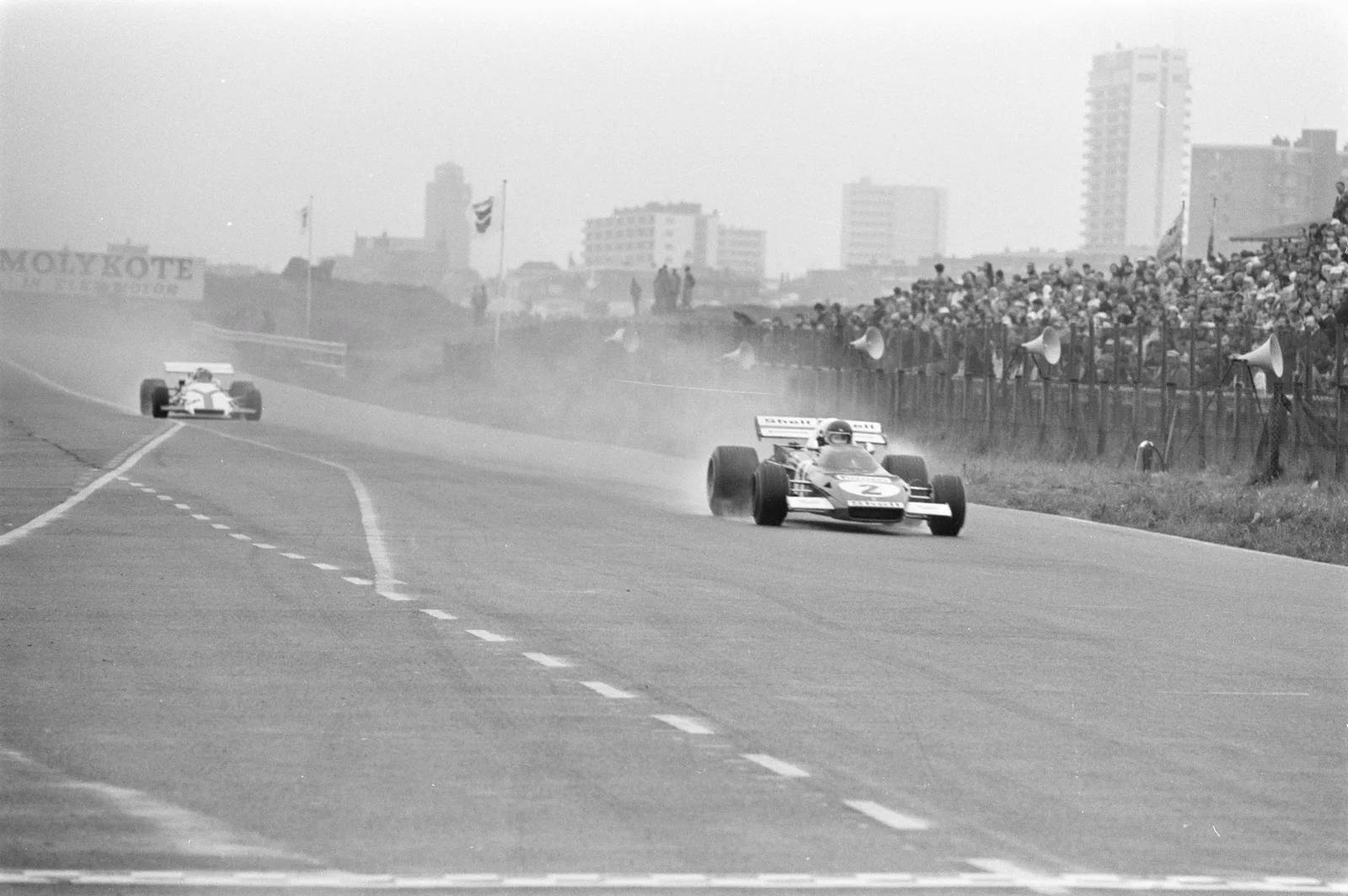
Rain produced its own winners as early as 1971. On June 20, two months after Montjuïc, heavy rain soaks the track at Zandvoort in the Netherlands. Jacky Ickx in a Ferrari and Pedro Rodriguez in a BRM, both on Firestone, leave everyone behind. The top three Goodyear drivers, including Jackie Stewart, whom Roebuck calls the master of the rain, finish ninth, tenth and eleventh, five laps down. Roebuck calls it the most famous “tire race” of the era.

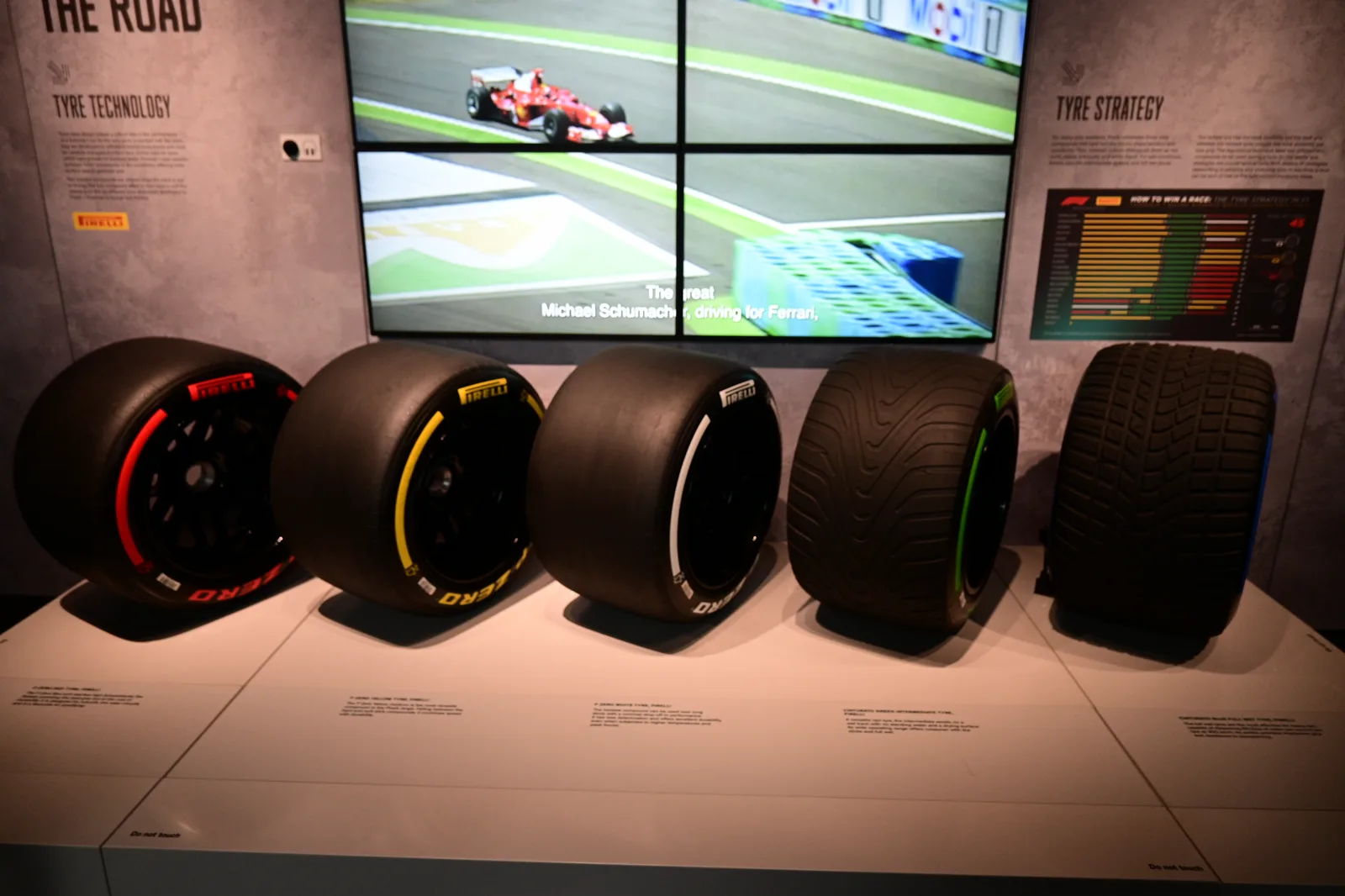
F1 therefore keeps treaded tires for the wet, and the regulations govern their design. In 2008 and 2009, they cap the rubber on the ground: on the measured squares of a wet tire’s tread, close to 30% of the surface must be voids at least 0.1 in (2.5 mm) deep, set aside for water. The extreme-wet tire has to leave even less on the ground.
Recent Pirelli tires, for their part, come with numbers. At 186 mph (300 km/h), an intermediate tire, made for a damp track, clears 9 to 10.5 gallons (35 to 40 liters) of water per second, and a full wet tire more than 22 gallons (85 liters). Those figures apply to the tires used through 2025; the narrower 2026 tires don’t have published figures yet, and Pirelli is preparing new wet and intermediate compounds for 2027. The maker also offers a rule of thumb: when lap times climb to 110 or 112% of the dry time, it’s time to leave slicks for intermediates. Switching too early is costly: a lap on intermediates when slicks were called for can cost five or six seconds.
In a heavy downpour, for the 2022 to 2025 cars, the limit was no longer the tire, according to Motor Sport: it was visibility, because of the cloud of spray the cars throw up. Pirelli’s Mario Isola acknowledged as much in 2025:
“We know that the issue with the extreme wet is visibility anyway.” Mario Isola, Pirelli, Autosport, 2025
FAQ
Who invented the slick tire?
It was born in American drag racing in the 1950s. M&H Tire, a family business in Massachusetts, is credited with the first purpose-built drag slick, in the early 1950s or in 1957 depending on the account. Mickey Thompson, often cited, founded his racing tire brand in 1963; nothing proves he invented the slick.
Did the first F1 slicks work right away?
Not without trouble. According to journalist Nigel Roebuck of Motor Sport, drivers on Firestones suffered from heavy vibrations in fast corners with the first slicks for a long time.
When does an F1 car switch from the intermediate to the full wet tire?
Late. In 2025, Pirelli’s Mario Isola put the tipping point at 118% of the dry lap time. According to Autosport, the previous generation of wet tire only became usable at 120%.
What is the minimum tread depth of a road tire?
Michelin and Continental give 1.6 mm (about 0.06 inch), the legal limit in most European countries according to Continental. A new tire has about 8 mm (about 0.3 inch), again according to Continental.
Keep exploring
Main sources
- Compound fractures (Nigel Roebuck, avril 1997) — Motor Sport
- Grip : Grip on road surfaces (2001) — Société de Technologie Michelin
- Phenomena of Pneumatic Tire Hydroplaning, TN D-2056 (1963) — NASA, Langley Research Center