How Can a MotoGP Rider Lean Over Without Falling?
A good road tire lets go around 45°; a MotoGP bike takes more than 60. The physics of cornering, the rubber and the riders’ technique: here is what holds it up.
Published November 18, 2026 · Facts checked November 18, 2026
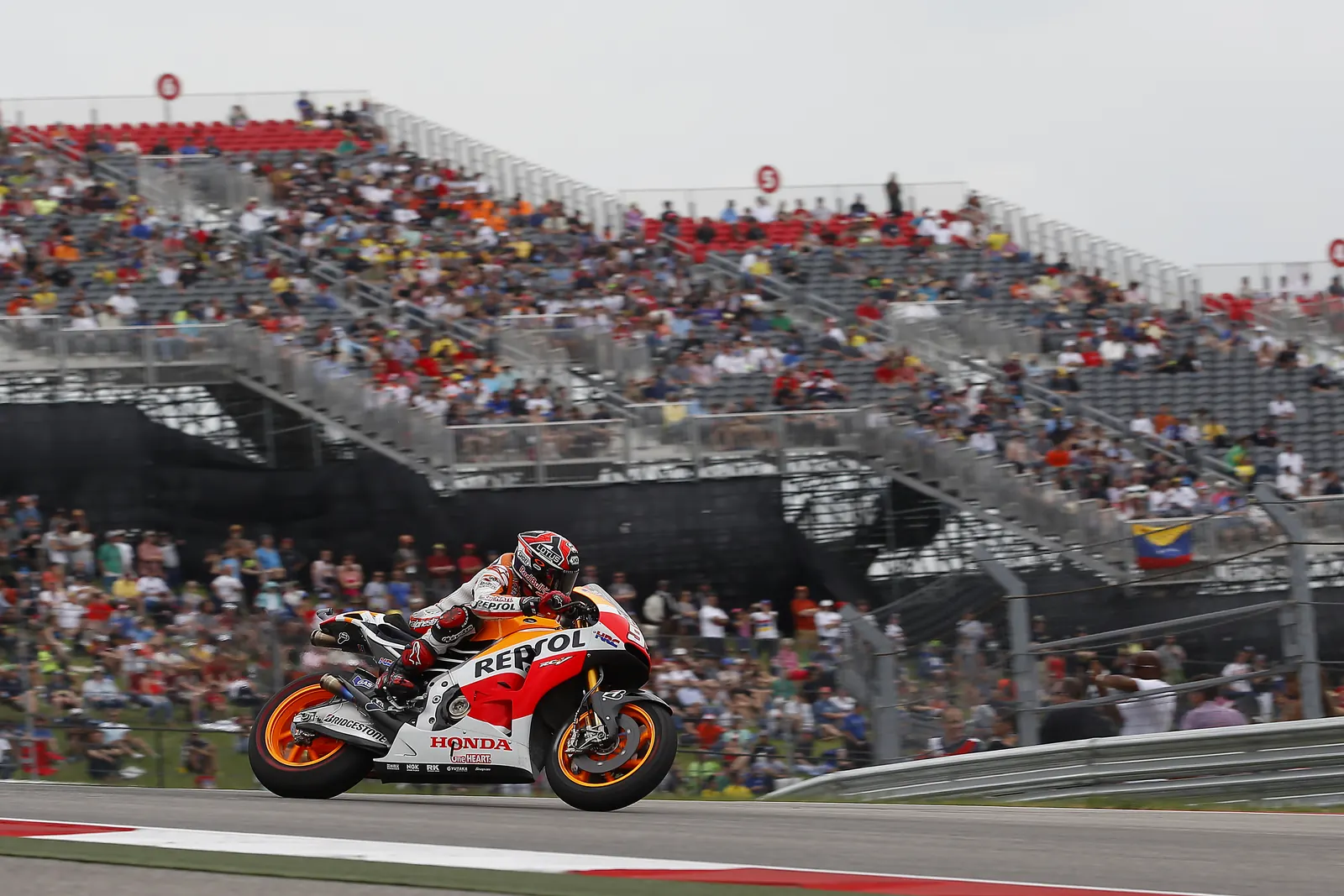
In September 2013, on the eve of the Aragon Grand Prix, the Yamaha YZR-M1 of Jorge Lorenzo, the reigning world champion, is put on display for the public. A special stand holds it tilted at 64° from vertical, the angle MotoGP riders now reach, the International Motorcycling Federation wrote at the time. Let go like that, the bike would fall. With a rider on it, in the middle of a turn, it stays up.
Three things hold it up: a tire with far more grip than a road tire, a rider who shifts his body so the bike leans less, and rubber designed for cornering.
What holds the bike leaned over
A bike that turns has to lean toward the inside, and the more so the higher the speed or the tighter the turn; the weight of the bike changes nothing about it. Two forces balance each other: weight, which would make the bike fall toward the inside, and centrifugal force, which pushes it toward the outside. At the right angle, they cancel out around the point where the tires touch the track.
You often hear that the wheels, as they spin, act like gyroscopes and keep the bike upright. A physics article from the University of California, Berkeley, published in 2000, cuts the idea down to size: the gyroscopic effect plays only a limited role. To lay the bike over, the rider most often uses countersteering: to turn right, he first steers left for a brief moment, and that flick of the handlebars starts the lean.
What does the turn demand? Engineers count it in g: 1 g is a sideways push as strong as the weight. In 1978, the American magazine Cycle World drew two benchmarks from it for the combined center of gravity of rider and bike: 0.75 g corresponds to a little under 37° of lean, and 1 g to 45°.
What holds the bike up is tire grip: the bike slides when the sideways push, in g, exceeds the coefficient of friction between the rubber and the track. According to Cycle World, a good road tire on dry pavement grips about as hard as the weight, a coefficient of 1: its limit is 1 g, so 45°.
At 60°, treating the bike and rider as a single leaning body, you need a tire that grips about 1.7 times harder than the weight. In 2015, physicist Rhett Allain, of Southeastern Louisiana University, calculated from the average speeds of two turns at the Jerez circuit in Spain that coefficients of at least 1.12 and 1.27 were already required.
An engineering study published the same year adds two more limits. One is geometric: a part of the bike, a footpeg for example, touches the ground, or the profile of the tire stops it from going any further. The other has to do with the rider, with what he dares.
The rider leans so his bike leans less
The 45° figure applies to the combined center of gravity, not to the bike. In 1978, Cycle World imagines a big four-cylinder with a wide crankcase and bulky exhaust that scrapes the ground at 37°. If the rider shifts far enough to the inside, he brings the combined center of gravity to 45° from vertical and can reach 1 g without laying the bike over beyond its 37°.
Vittore Cossalter, an engineer at the University of Padua, confirms this in his book Motorcycle Dynamics, in 2006: with torso to the inside and a leg stuck out, to the point of nearly touching the ground with the knee, the rider reduces the bike’s lean angle. Leaning toward the outside instead, he has to lay the bike over further.
The idea is not new. In the mid-1950s, rider John Surtees shifts his body to the inside of his four-cylinder MV Agusta, and his elders reproach him for it: they say a rider should ride “with the machine.” He explained himself this way:
“The idea is to keep the machine as upright as possible for maximum traction.” John Surtees, quoted by journalist Kevin Cameron, Cycle World, April 2013
Knee, elbow, shoulder: the body goes down to the track
Riders first brushed the ground with the tip of their boot. It was the American Kenny Roberts, 500cc world champion from 1978 to 1980, who popularized the knee down. In 1972, at Ontario, California, he had watched rider Jarno Saarinen shift his weight to the inside of turns, then pushed the move further until he was scraping the track with his knee. Saarinen, who died at Monza in 1973, did not see what came next. Geoff Duke and John Surtees, champions of the 1950s and 1960s, found this style aggressive and graceless.
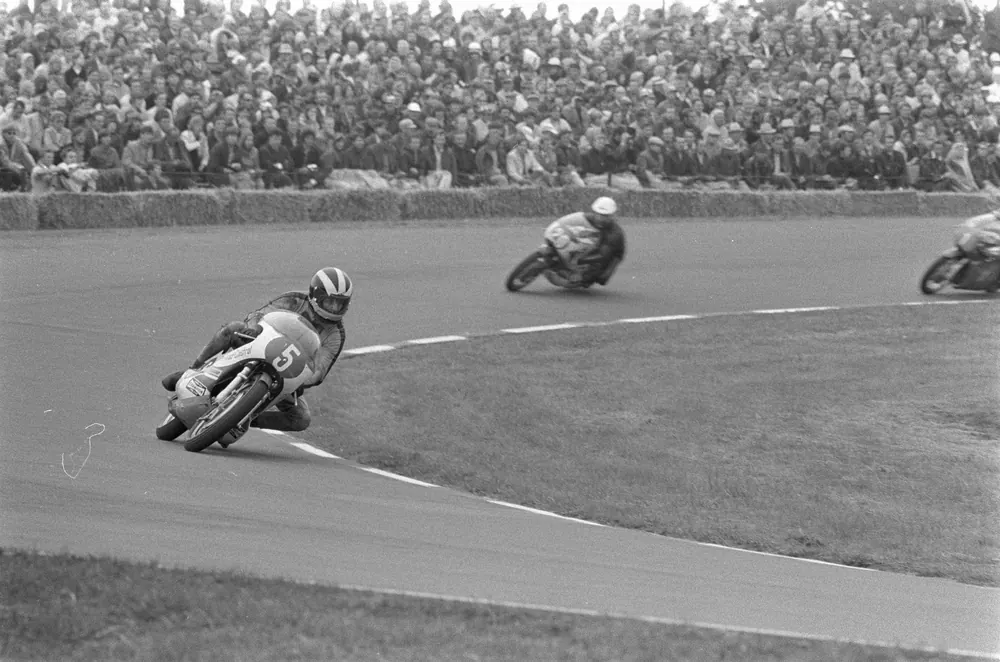

The elbow came next. Spaniard Marc Márquez, a multiple MotoGP world champion, made it his trademark. At the Circuit of the Americas in Austin, in April 2013, he explained:
“I like the elbow, because when I feel it touch, I go down a bit more.” Marc Márquez, Cycle World, April 2013
That year, Cycle World noted that Márquez’s bike was leaned over less than some rivals’, so far did his torso go to the inside. On TV, then, you see the angle of the body, not necessarily that of the bike. According to former rider James Toseland, the elbow also tells Márquez about the front tire, through the vibrations that travel up his arm. For Cal Crutchlow, another former rider, it also provides a support point for catching the front when it washes out.
The elbow is not a goal: the championship’s website sees it as a consequence of the lean angle and body position. In hairpins and chicanes, riders stay more upright; it is in the long, fast sweepers that they lean over the most. In September 2023, at the Barcelona-Catalunya circuit, Jorge Martín, the 2024 MotoGP world champion, goes as far as scraping the track with his shoulder.
“Touching the elbow is a really normal thing because it’s like a reference for us, but when you lean that much and you touch with the shoulder, it’s something special.” Jorge Martín, ESPN, May 2024
The tire and its edge
Michelin has been the sole supplier of the MotoGP class, the premier class of motorcycle Grand Prix racing, since 2016. Its tires are slicks, with no grooves at all: at these angles, every inch of rubber in contact counts. Grip depends on the size of this contact patch and on the quality of the rubber, designed to work between roughly 176 and 248°F (80 and 120°C), a range in which it becomes stickier. At the rear, all of a MotoGP bike’s power, more than 250 hp for the Ducati Desmosedici, goes through a patch that the Goodwood website compares to an open hand.
A leaned-over tire also pushes toward the inside of the turn on its own. This push, known as camber thrust, can be the largest share of the sideways push that turns the bike.
The edge of the tire, though, is not the same as the center. Cycle World explained it in 2013, about the Bridgestone tires of the day: at the edges, the rubber is less supported by the carcass, the inflated fabric structure that forms the tire, and so it is softer. This edge rubber is for turning, not for accelerating: the rider quickly straightens the bike to get back onto the part the carcass supports. Rider Miguel Oliveira places the zone where you can really accelerate between 25 and even 35 or 40° of lean.
Left and right can even get different rubber. At the Sachsenring in Germany, the bikes turn only left between turns 4 and 10: the right side cools down before turn 11, a tight, downhill right-hander. In 2025, Michelin brought asymmetric front tires there, with reinforced rubber on the left and softer rubber on the right, to heat up quickly.
How far: from 59 to 70°, figures that don’t measure the same thing
| Angle | Where and when | What it is |
|---|---|---|
| 64° | 2013 | angle commonly reached at the time |
| 66° | Márquez, Sachsenring, July 5, 2019, turn 3 | record while riding, in second free practice (a practice session during the weekend) |
| About 70°, 70.8° according to Honda | Márquez, Phillip Island, October 25, 2019, turn 10 | a crash saved during a tire test session |
| 59° and 63° | Michelin, 2025 | maximum angle reported at Aragon (turn 8) and at the Sachsenring (turn 3) |
These figures can’t be compared: 64° is a commonly reached angle in 2013, 59° and 63° are maximums reported by Michelin for a given circuit, 66° and 70° are records by a single rider, the second one set while saving a crash.
The biggest angle is not that of a successful turn. At Phillip Island in Australia, Márquez takes part in a session that follows second free practice: the future 2020 Michelin rear tire is being tested. At turn 10, the front washes out at 42 mph (67 km/h). He first thinks about giving up on saving the bike, then opens the throttle to see what happens. The bike nearly wheelies and straightens up. He ends up off the track, but without falling.
His big lean angles in 2019 were not a choice. At the Sachsenring, Márquez explained that his Honda RC213V did not turn well:
“I am using a lot of banking angle, too much, because the bike isn’t turning. I use all this banking not because it’s my style or because I like it, but because I need to.” Marc Márquez, Motor Sport, July 2019
In 2018, Márquez crashed an average of 1.3 times per Grand Prix. In 2019, after nine race weekends, he had six crashes, against eleven at the same point in 2018: “I crash less, but I save more.” The limit is still the tire’s, however: once grip is lost, the bike slides or goes down.
Michelin is contesting its last season in 2026: in 2027, the premier class switches to Pirelli, which already equips Moto2 and Moto3, the two other Grand Prix classes. The next lean-angle records will be measured on different rubber.
FAQ
Who was the first to drag an elbow on the ground in Grand Prix racing?
Motor Sport magazine names Frenchman Jean-Philippe Ruggia, in the 250cc class in the 1980s: he lay out over the front of his bike, elbows stretched toward the road. Fast but often on the ground, he did not start a trend. Marc Márquez popularized the move, and he was the first to wear magnesium elbow protectors.
Does the gyroscopic effect of the wheels still play a part?
A limited one. According to a physics article from the University of California, Berkeley, published in 2000, it is not what lays the bike over: it is countersteering, that brief flick of the handlebars in the direction opposite the turn.
How many tires does a MotoGP rider use in a weekend?
Up to 22 slicks per Grand Prix weekend: 10 front and 12 rear, chosen from a larger allocation.
Can a road bike lean over like a MotoGP bike?
No. According to an engineering study published in 2015, the maximum lean angle of most motorcycles is between 25 and 50°, and on many of them it is parts that touch the ground before the tires slide.