Why Do Drivers Brake With Their Left Foot?
Against Senna, Häkkinen counted on his left foot. Born on rally Saabs and tried on a 1974 Lotus, the technique wins you an instant, on one condition.
Published November 18, 2026 · Facts checked November 18, 2026
Estoril, Portuguese Grand Prix, 1993. Mika Häkkinen, 24, is racing for McLaren for the first time. His teammate is Ayrton Senna, a three-time world champion. Before qualifying, the Finn is counting on his left foot to get the edge; Senna, according to Häkkinen, brakes with his right:
"I was left-foot braking, Ayrton was right-foot braking, and that’s going to take an extra millisecond: foot off the throttle, go onto the brake, go back onto the throttle." Mika Häkkinen, McLaren, 2024
He qualifies five hundredths of a second ahead of Senna, who, after one joke too many, did not speak to him for two weeks, he says.
The right foot never leaves the throttle
The answer fits in one sentence: by braking with the left foot, the driver keeps the right foot on the throttle and removes the trip from one pedal to the other. Journalist John Davenport, a former rally co-driver, wrote in 2001 that in racing the left foot is used first to cut the time between leaving the throttle and hitting the brake. That time can even drop below zero: the driver starts braking an instant before lifting the right foot, so the brakes are already hot, and fully effective, by the time the throttle is released.
How much do you gain? No published measurement tells us. The figures that circulate are memories or promises: Häkkinen’s "millisecond," or "a second a lap," which rally driver Pentti Airikkala promised Vauxhall touring car drivers if they came to learn left-foot braking at his school.
One of them, John Cleland, a British touring car champion, did not go. For him, the left foot is free only if no clutch pedal claims it.
"A kart has two pedals. So does a Formula 1 car. I get that. But to the best of my knowledge touring cars still have three." John Cleland, Motor Sport, 2020
So the left foot followed the cars that dispense with a clutch pedal, or use it less. It all starts in rallying.
A Saab in the snow
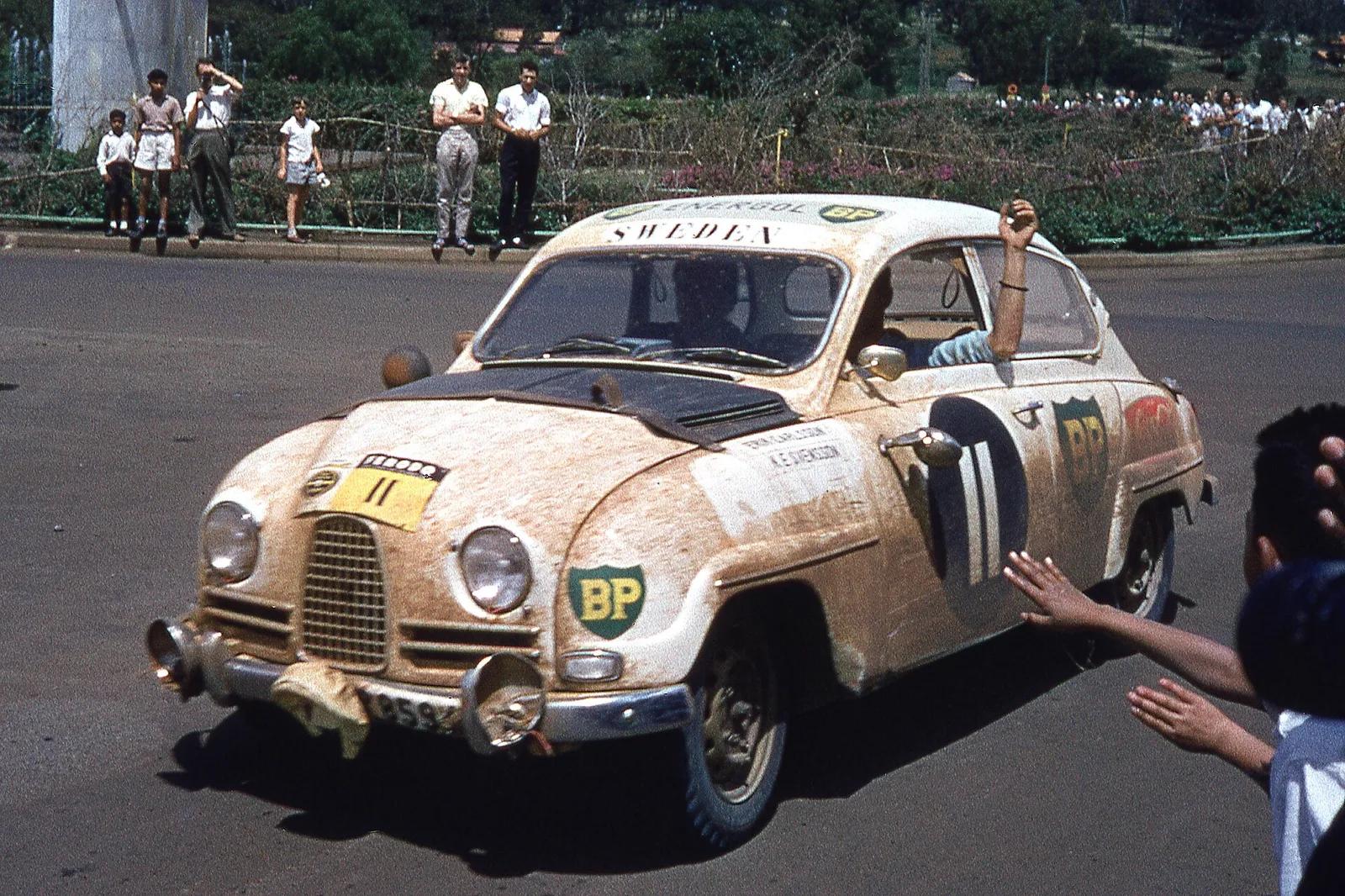
The Saab 93B is a small front-wheel-drive car with a 750 cc two-stroke engine. Above all, it has a freewheel: a mechanism that lets the transmission spin faster than the engine, and lets you change gears in either direction without using the clutch. The left foot can therefore stay over the brake.
Rauno Aaltonen, a Finnish rally driver, buys one in 1957. On snow, the car understeers: the front refuses to turn, and it plows straight on. Aaltonen told Davenport about it in 1997:
"…wanted to make car-sized holes in snow banks by understeering. The others used the handbrake. I invented left-foot braking." Rauno Aaltonen, Motor Sport, August 1997
Not everyone gives him sole credit. In 1998, Davenport speaks of a Finnish invention, developed by Aaltonen and his compatriot Timo Mäkinen, then passed on to the young Simo Lampinen, whom Davenport himself later co-drove with. Škoda, which devotes a profile to Aaltonen, writes only that he may have discovered the technique by instinct. And the 2015 obituaries make Erik Carlsson, the other great Saab driver, a left-foot braking pioneer, when Davenport had written back in 2001 that he never left-foot braked.
In rallying, you steer with your feet too
On a front-wheel-drive car, the left foot is precisely what beats understeer. A dab of the brake without lifting off the throttle shifts weight forward; the rear unloads, and a small steering input is enough to slide the car through the corner. Aaltonen once confided to journalist Paul Fearnley that most corners were faster than they looked, and that the left foot was his way of getting through the few that weren’t.
Sweden’s Stig Blomqvist, trained on Saabs, takes the technique to the Audi Quattro and becomes world rally champion in 1984. The Audi’s turbo engine adds a reason. A big turbo takes a moment to respond when you get back on the power; by braking with the left, the driver keeps the right foot on the throttle, and the turbo stays "spooled," ready to push. But it took careful judgment:
"Sure, I used left-foot braking, but early Quattros were quite difficult: the power came in suddenly and it was easy to brake too much with the left foot, kill the speed and the engine, or not enough and get caught by understeer." Stig Blomqvist, Motor Sport, November 2004
Yet the Audi does have a clutch pedal. On the Sport Quattro, the company fits a hydraulic clutch operated from the gear lever, and Blomqvist is delighted: he no longer has to keep going back to the clutch pedal.
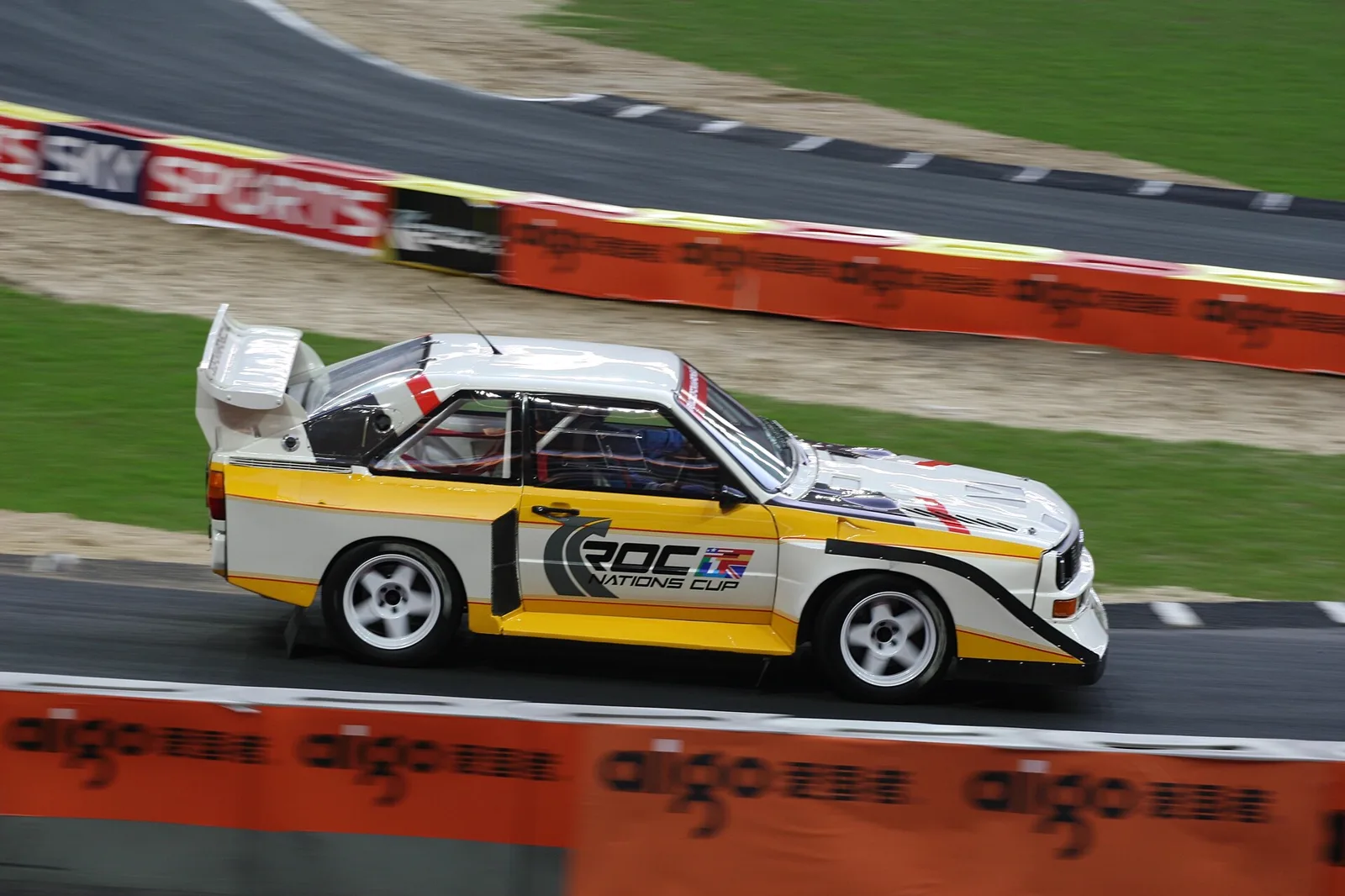

In modern rallying, Chris Atkinson, a former World Rally Championship driver, says he always brakes with his left foot, to balance the car on dirt and to react a little faster.
In F1, from the V-shaped pedal to the paddles
Formula 1 gives it a try in 1974. On the Lotus 76, Lotus boss Colin Chapman wants an electric clutch so the driver can brake with the left foot. A button on the gear lever operates the clutch, and a forked, V-shaped brake pedal runs on either side of the steering column: the driver can brake with either foot.
Ronnie Peterson sticks with it during practice for the South African Grand Prix at Kyalami, then the system is dropped for the race. He was never convinced, and his teammate Jacky Ickx took no interest in it.
In 1989, the Ferrari 640 opens another path: a semi-automatic gearbox, operated by paddles behind the steering wheel. Motor Sport describes it as the pioneer of those paddles, which have since become universal. It wins the first race of the season, in Brazil, with Nigel Mansell.
The left foot follows over the course of the 1990s. Without a clutch pedal, the official F1 glossary explains, drivers can slow down with the left foot and then get straight back on the throttle with the right. The shift is slow: at the start of the decade, McLaren writes, the semi-automatic gearbox is still new, many drivers learned with a clutch pedal, and left-foot braking is far from universal. That is what made Häkkinen so confident at Estoril.
Häkkinen, Coulthard and the extra pedal
In 1997, McLaren’s two drivers still don’t brake with the same foot. Neil Oatley, designer of the McLaren MP4/12, describes them:
"Mika was already left-foot braking whereas David was dabbling with it but normally using right-foot braking, so they had very different driving styles." Neil Oatley, Motor Sport, October 2006
David Coulthard, Häkkinen’s teammate, right-foot braked for most of his career; he switched to the left foot only in his last four or five years.
That season, McLaren adds a pedal that brakes only the rear wheel on the inside of the corner, to help the car turn. The idea comes from engineer Steve Nichols. For Häkkinen, whose left foot is already working the brakes, all it takes is one more pedal next to the other; he gains half a second almost immediately, the site Planet F1 reports. Adrian Newey, who designs the 1998 McLaren, estimates the system’s average gain at 0.3 second per lap.
At the Nürburgring, both McLarens break down just after the pits. Photographer Darren Heath slips his camera into Häkkinen’s cockpit, where the steering wheel has been removed: the shot shows the extra pedal. The system is banned from the 1998 Brazilian Grand Prix on: according to the ruling as reported by Oatley, it amounts to steering the car with one more rear wheel in addition to the two front wheels.
An instant gained, not a guaranteed lap time
Not every driver converted. Cleland never left-foot braked. Braking in a straight line and then taking the corner was kinder to the car, he says, and he didn’t want a technique he didn’t master.
On Gran Canaria, he was put in a Toyota Celica alongside Stig Blomqvist and rally drivers Carlos Sainz and Didier Auriol. Some braked with the left foot, others with the right, some with both, often to settle the car rather than to slow it. And they all posted about the same lap time: at that level, the instant gained between two pedals does not by itself decide the lap time.
The technique itself has become the norm in F1: a "standard" technique, according to the official glossary.
FAQ
Do F1 rules require left-foot braking?
No. The 1999 regulations call for a single braking system with two separate hydraulic circuits "operated by the same pedal" (RacingMind translation), without saying which foot. What frees the left foot is the absence of a clutch pedal, not a rule.
Do you brake harder with the left foot?
No. The drivers and engineers quoted describe a shorter move from throttle to brake and better balance in the car, not a more powerful stop. The brakes are the same; the foot just gets there earlier.
Is the left foot still used to keep the turbo spooled?
Hardly anymore. According to Chris Atkinson, a former World Rally Championship driver, pressing the brake against the throttle was used to keep the turbo spooled before good anti-lag systems became widespread. On very slippery surfaces, the same technique can still act as traction control.
What is McLaren's "fiddle brake"?
It is the nickname Ferrari's Ross Brawn gave to the McLaren pedal that braked a single rear wheel. According to McLaren engineer Tim Goss, the term refers, on off-road trials vehicles, to a hand brake that acts on each rear wheel separately to help the vehicle turn.