ArticlesIndyCar & NASCAR5 min read
Why Does NASCAR Almost Always Turn Left?
No known document explains the direction of American ovals. That leaves three leads, from horses to the British, and cars built for left turns.
Published November 18, 2026 · Facts checked November 18, 2026
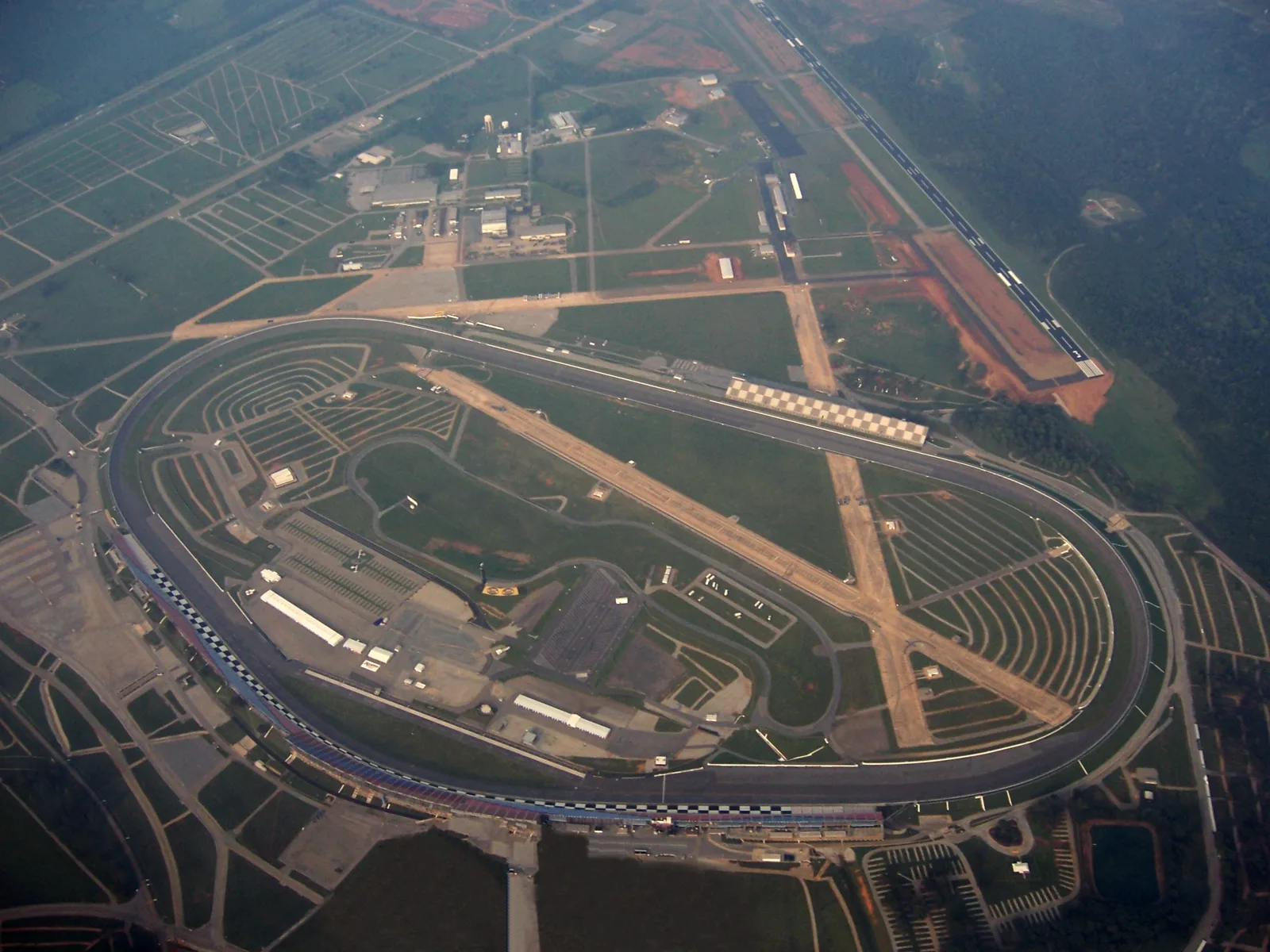
On May 4, 1905, August Belmont Jr. opens the racetrack that bears his name in Elmont, near New York City. A great admirer of England, he has the horses run clockwise, “the English way”: the turns are taken to the right. The track’s signature race, the Belmont Stakes, had already been run that way before 1905, at two other tracks. American crowds, meanwhile, are used to seeing horses turn left. In 1921, sixteen years after the track opened, the Belmont Stakes falls in line and switches to the opposite direction. Twenty-seven years later NASCAR is born, and its cars, too, will almost always turn left. Why?
The short answer
No document from the period is known to explain this choice. Historians put forward three leads. The best supported: the first car races took place on horse tracks, and American horses turned left. The other two, a challenge thrown at the British and the safety of the driver seated on the left, remain explanations without proof.
One thing is certain: once the direction was set, cars were built for it. And the “almost” matters: NASCAR also turns right, at a few tracks every year.
First lead: cars took over the horses’ track
On September 7, 1896, in Cranston, Rhode Island, the state fair lends its one-mile dirt oval, usually reserved for horse racing, to seven cars without horses. The start is so slow that spectators shout “Get a horse!” An electric Riker from Brooklyn wins the five laps.
For Donald Davidson, historian of the Indianapolis track, this race is where the cars’ left turn comes from. In 2008, he answered ESPN The Magazine’s “Answer Guy” column:
“Racing counterclockwise definitely predates Indy. […] The first oval event was at Narragansett Trotting Park in 1896. Electric cars racing on a horse track made left turns, like the horses did.” Donald Davidson, ESPN The Magazine, October 9, 2008
Indy is the Indianapolis oval, whose first race took place on May 30, 1911. Davidson cites no document for the direction of the 1896 race: it is his conviction as a historian. Buz McKim, a NASCAR historian, extends the thread in the same column: “When NASCAR built its speedways, they kept the tradition.”
NASCAR is born in Daytona Beach, Florida, and its first official race is run on February 15, 1948, on a course made of road and beach; driver Red Byron wins it. Follow the layout: the cars head south down Highway A1A for about two miles, the ocean on their left, turn onto the beach, run north up the sand, then rejoin the road. Both turns are therefore taken to the left. The town was already racing cars there in 1936, on a 3.2-mile course.
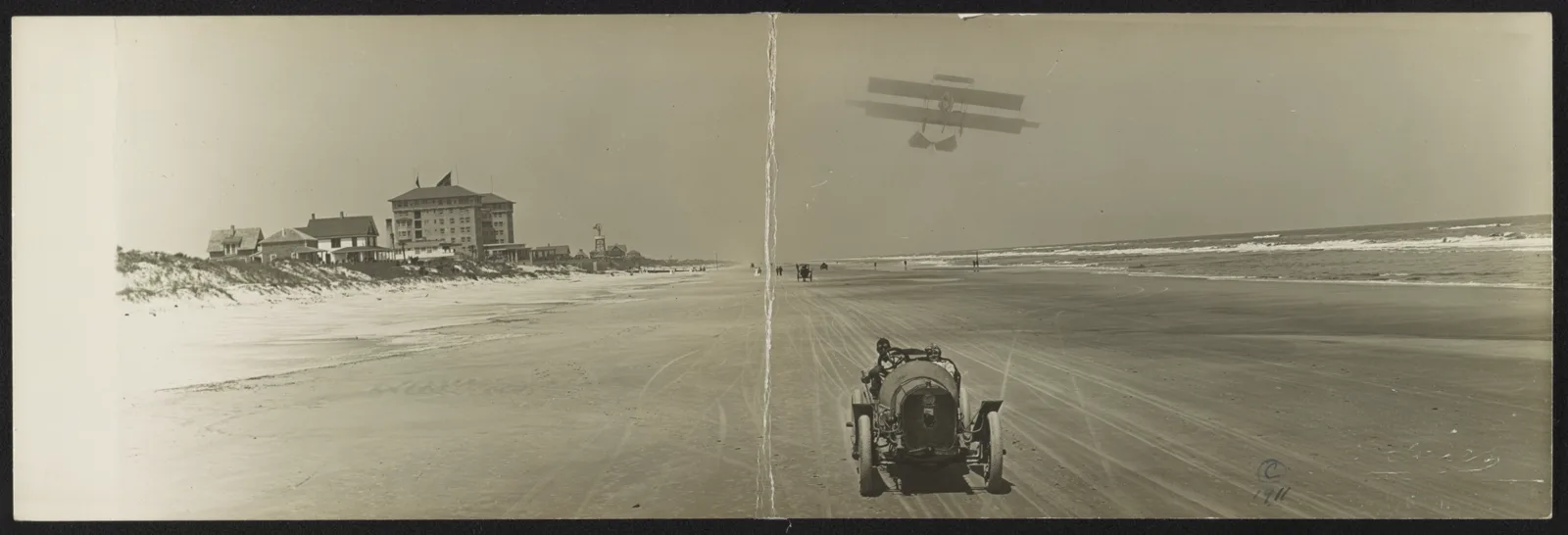

A year later, the first season of the ancestor of the Cup Series, today NASCAR’s top division, has eight races: seven on dirt ovals, one on this beach.
Second lead: turning their backs on the British
For Buz McKim, counterclockwise is first of all political:
“From the beginning, our horse races were run counterclockwise, as an act of defiance against the British.” Buz McKim, ESPN The Magazine, October 9, 2008
In Kentucky, the story of William Whitley, a pioneer, is told to illustrate this. According to a Kentucky historical marker, he built his house around 1780 and built a track there to set it apart from British tracks: clay rather than turf, and races run counterclockwise. The motive, however, remains oral tradition: still angry over the Revolutionary War, Whitley supposedly wanted to thumb his nose at the British.
The reversal at Belmont Park mainly shows the force of habit. According to Allan Carter, a historian at the National Museum of Racing, there were so many protests that August Belmont Jr. ended up changing direction.
But the defiance assumed that the British all turned right. Owen Byrne, communications officer for the British horseracing authority, denied this in the same column:
“We have tracks with a variety of shapes and sizes. They don’t all run clockwise.” Owen Byrne, ESPN The Magazine, October 9, 2008
Third lead: the driver seated on the left
The third explanation has to do with the car. The NASCAR driver sits on the left. Turning left, he has the outside wall of the turn on the other side of the car, and therefore farther from him in a crash. The website MotorBiscuit wrote this in 2023 and goes further: if drivers sat on the right, most ovals would probably turn the other way.
The argument holds up, but it was built after the fact: MotorBiscuit cites no 1940s organizer who put it forward.
What the one-way direction did to the cars
Until 2021, Cup cars were asymmetrical: their bodies were offset to one side. Tommy Joseph, aerodynamics lead at Ford Performance, gave the reason to The Charlotte Observer:
“Because the cars only turn left, if you angle this (right rear) to the right, this (left front) side has more pressure and this side has less pressure so there’s a force going the way you’re turning.” Tommy Joseph, The Charlotte Observer, May 6, 2021
In other words, the body works like a sail that pulls the car toward the inside of the turn. The Next Gen, the Cup car unveiled in May 2021 and on track since 2022, ended this offset: its body is symmetrical, which makes research into crooked panels pointless.
The tires, for their part, are still set up for one direction only. On a Cup car, they are not all the same circumference, that is, the same distance around the tire: this difference is called “stagger.” In left turns, the right rear tire matters most.
Right turns, since 1954
NASCAR also races somewhere other than ovals. Its first race on a road course, away from the Daytona beach, took place in 1954 at the Linden airport in New Jersey; since 1963 there has been at least one every year. On these layouts, as at Watkins Glen or Sonoma, you turn in both directions.
In 2026, of the 36 championship races, 32 are run on ovals, 3 on road courses (Circuit of the Americas in Austin, Watkins Glen and Sonoma) and 1 on city streets, at Naval Base Coronado in San Diego. Nearly nine races out of ten therefore have only left turns.
FAQ
Why did Belmont Park run clockwise?
According to Wikipedia, so that races would finish in front of the clubhouse, on the west side of the grandstand: the racing association’s members and their guests could thus see the finish up close.
Could the driver feel that the body was crooked?
According to Wikipedia, these offset cars had a nickname, the “Twisted Sisters.” Behind the wheel, according to Ford engineer Tommy Joseph, the driver cannot tell what comes from better tire grip, more downforce or more lateral force.
Since when has NASCAR raced at Watkins Glen?
Its first race there takes place in 1957. NASCAR’s top division still races there in 1964 and 1965, then returns in 1986, after a long break.
Who founded NASCAR?
Bill France, nicknamed “Big Bill,” a mechanic and race promoter in Daytona Beach. On December 14, 1947, he gathered drivers, car owners, mechanics and journalists, some of them from as far as New England, in the Ebony Room, on the top floor of the Streamline Hotel. NASCAR came out of those meetings, incorporated in February 1948.
Keep exploring
Main sources
- Answer Guy (chronique du 9 octobre 2008) — ESPN The Magazine
- The Belmont Stakes: A race of both tradition and change — NYRA (New York Racing Association)
- Next Gen deep dive: Ford engineers answer basic questions about NASCAR’s new car (Alex Andrejev, 6 mai 2021) — The Charlotte Observer, sur Yahoo News