Why Are Race Trucks Limited to 99 mph (160 km/h)?
More than 11,000 lb, a counter that adds up the excess, brakes sprayed with water: how the European championship enforces the 99 mph (160 km/h) limit.
Published November 18, 2026 · Facts checked November 18, 2026
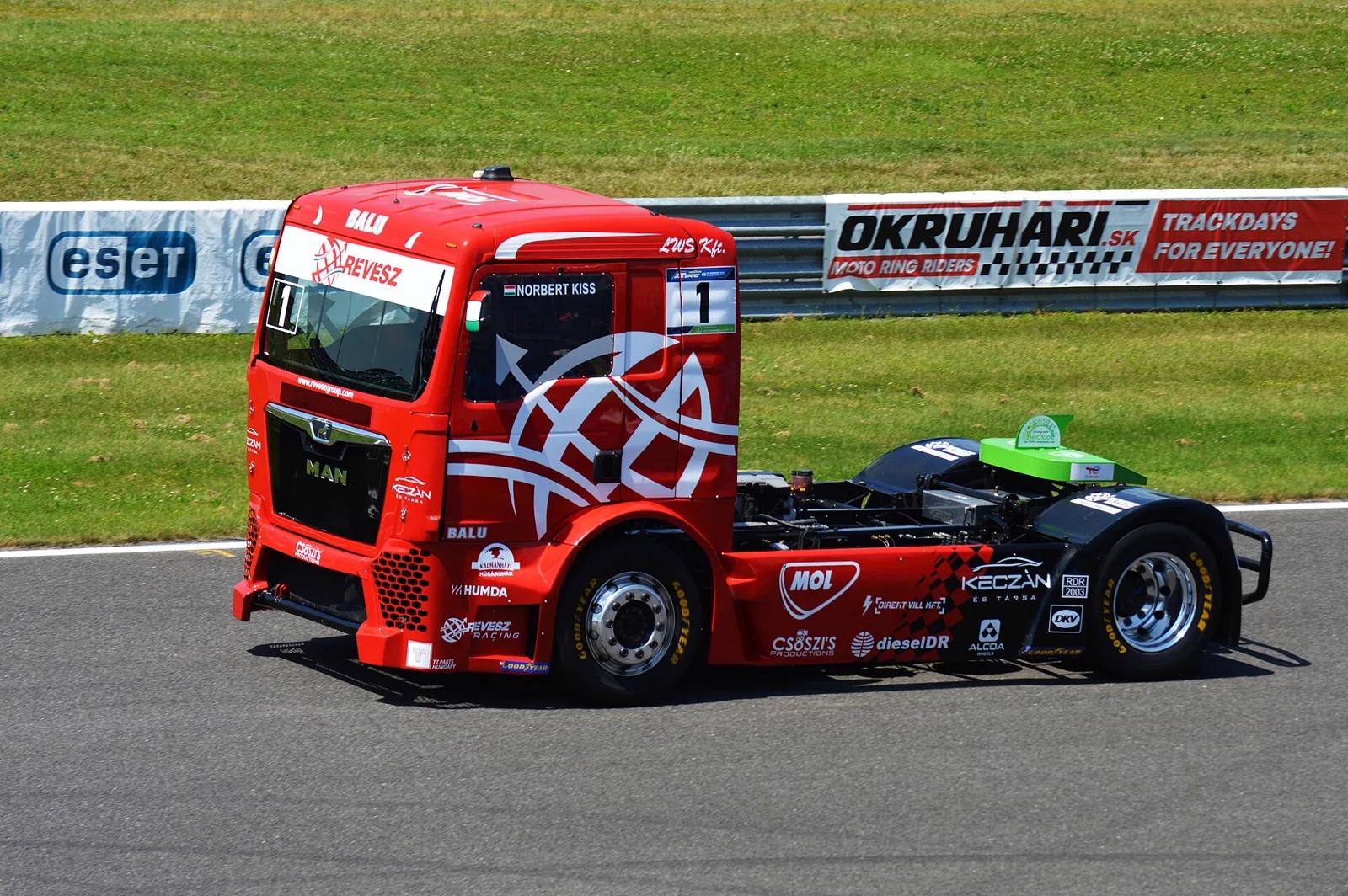
Zolder, Belgium, Saturday, September 12, 2026, the weekend’s first race. Hungary’s Norbert Kiss leads the race in his MAN. One opponent remains, and it isn’t on the track: the 99 mph (160 km/h) limit, picked up by a GPS sensor aboard the truck.
“I had a bit of a gap and then I had to watch out not to make a mistake or over-speed, which is easy here in Zolder with the bridges that can make you go a bit fast with the GPS signal.” Norbert Kiss, September 2026
He wins. Two weeks later, at Le Mans, he takes his eighth European truck racing title, extending his own record.
A limit for safety
These trucks aren’t allowed to exceed 99 mph (160 km/h) for a safety reason. The championship organizer says so: in 2017 it tied the limit to the trucks’ weight, more than 11,000 lb, and it repeats it in its 2026 race announcements. The regulations, for their part, state the rule without justifying it. The technical text of the Fédération Internationale de l’Automobile (FIA) fits in one sentence: “The speed is limited to 160 kph.” It can already be read, word for word, in the 2012 edition. It doesn’t require a limiter on the engine: it requires every truck to carry a measuring instrument approved by the FIA, and denies the start to any truck without one.
The Czech driver Adam Lacko said in 2017 what is peculiar about this rule:
“In other series speed is limited by power, but here we have it for safety and we must live with it.” Adam Lacko, 2017
Why 99 mph (160 km/h) rather than 93 or 112 (150 or 180 km/h)? Neither the regulations nor the organizer justifies the exact figure. The limit is old: in 2000, the American heavy-truck magazine Heavy Duty Trucking traced its birth to the first British Truck Grand Prix, at Donington Park in 1984. The trucks entered then were almost stock.
Five metric tons at 99 mph
A race truck is still a two-axle tractor unit: the cab and engine of a semi, without the trailer. The 2024 regulations require a cab and a chassis produced in at least 50 units, and an engine drawn from a commercial range of truck engines. What the teams do with them for racing, Norbert Kiss called prototypes in 2017:
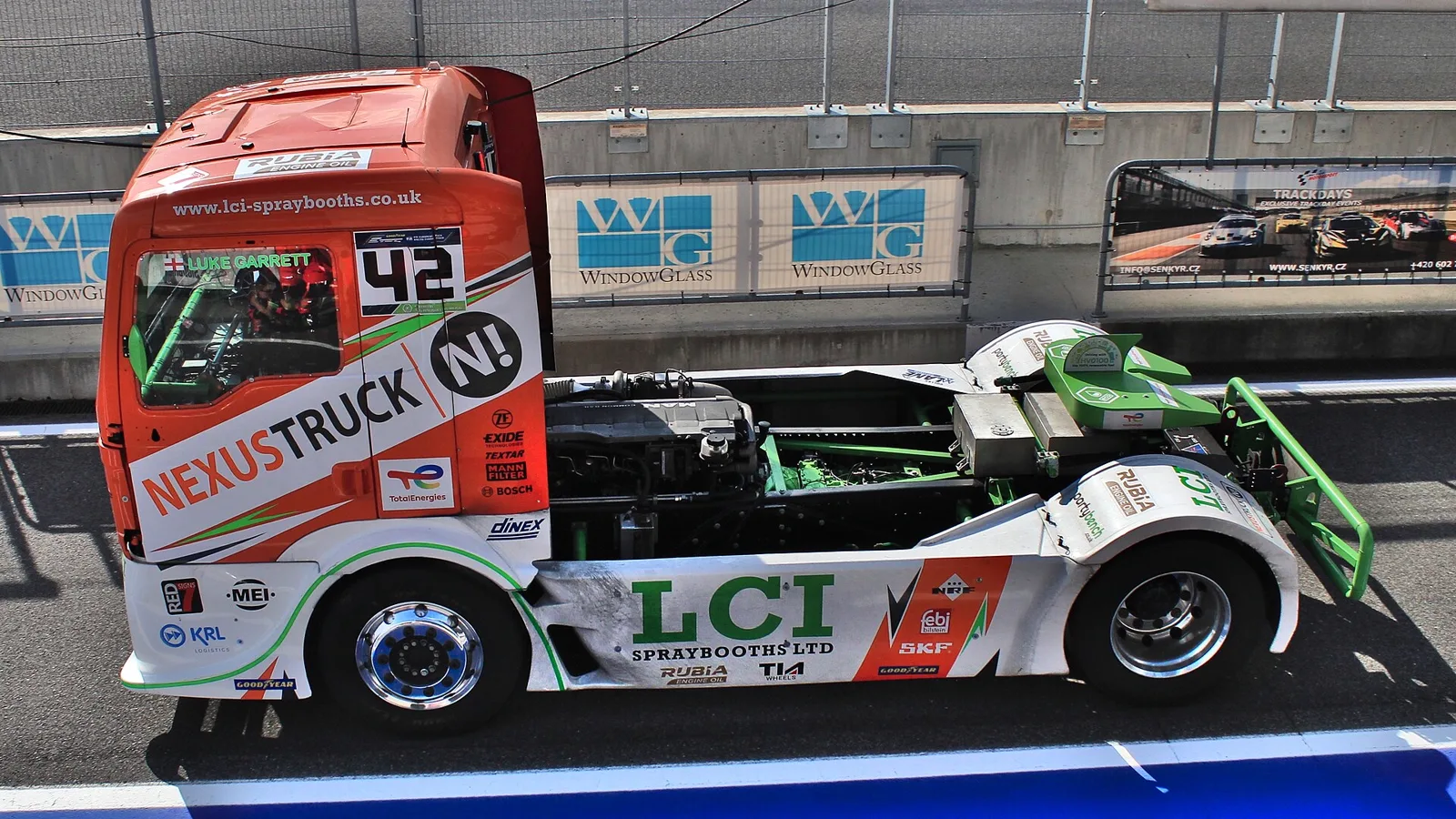

“The trucks we use are prototypes, they’re built within regulations for racing purposes, so they are very stiff and race-car-like.” Norbert Kiss, 2017
The 2024 regulations impose on these trucks a minimum weight of 11,700 lb (5,300 kg), driver included. That weight is what gives the limit its meaning. The specialist site truckracing.de did the math in 2018, and it can be redone: launched at 99 mph (160 km/h), an 11,700-lb (5,300 kg) truck carries about 5,200 kilojoules of motion energy, which a wall or a fence would have to absorb all at once. At 50 mph (80 km/h), the same truck carries only a quarter of that: this energy grows as the square of the speed.
The same site writes that a 112 mph (180 km/h) limit has been discussed several times. It would raise the energy to about 6,600 kilojoules: more than a quarter more for 12 mph (20 km/h) more speed. That is a calculation, not a measurement.
A counter that adds up the excess
The FIA doesn’t catch a truck the way a roadside speed camera does. The 2025 sporting regulations describe a counter: each time the truck exceeds 99 mph (160 km/h), the counter fills, faster the greater the excess. It is updated every 50 milliseconds. When the truck drops back below the limit, the counter gradually empties; it returns to zero each time the truck crosses the finish line. The penalty is triggered when it crosses a threshold that the FIA sets “at its sole discretion.” The purpose, the text says, is to avoid undue penalties: the more serious the offense, the faster the penalty falls.
The 2025 scale, in the race:
| Offense | Penalty (2025 regulations) |
|---|---|
| First | 10 seconds added to the race time |
| Second, on a later lap | mandatory pass through the pit lane, or 30 seconds in the last three laps |
| Third, on a later lap | reported to the stewards, the race officials, for disqualification |
In 2026, the first penalty drops to 5 seconds. On September 27, 2026, at Le Mans, John Newell receives it for speeding and loses third place in a race.
Since the regulations don’t require a limiter, it is the teams that install their own: according to truckracing.de in 2018, an electronic control restricts the engine as soon as the truck touches 99 mph (160 km/h). The teams programmed it to exploit the regulations’ tolerance to the maximum: the truck went above 99 mph (160 km/h) for no more than 2.5 seconds, came back to the limit, went over it again for a very brief moment, and so on. They set it in free practice, according to the circuit and to the day’s conditions, or the expected ones, the wind for example.
Brakes sprayed with water
The energy lost at each braking goes off as heat in the brakes. Slowing 11,700 lb (5.3 metric tons) launched at high speed puts them through a severe test, the championship’s website wrote in 2017. They are compressed-air brakes, with discs on all four wheels, explains Stefan Honens, then technical director of the Tankpool24 Racing team. To cool them, the regulations allow only water, ducted air, or both. Honens describes the trap:
“The problem with trucks is when you have a long straight it becomes cold and then you have a hard braking it becomes hot again, that puts brakes under a lot of stress.” Stefan Honens, August 2017
At Tankpool24, the water travels in what looks, from the outside, like air tanks: about 53 gallons (200 liters), used in a half-hour race, Honens says. Sensors show the driver the disc temperature; a valve lets him meter the water, sprayed into the discs’ ventilation channels. The other teams each meter it their own way: some spray continuously, others wire the nozzles to the brake pedal, still others alternate roughly five seconds of water and five seconds of pause.
On the 2017 calendar, the hardest circuit on brakes is Zolder, Honens answers without hesitation: nonstop accelerating and braking, tight corners, chicanes. Le Mans is the easiest, the championship’s website adds.
Without water, the heat climbs very high. In 2020, the parts maker febi published a test of one of its discs on a race truck, with the water off, on a test track for heavy trucks. The original race disc reaches 1,634 °F (890 °C), to the point of glowing; the febi disc, at the same moment, 1,355 °F (735 °C).
Zolder, the same day, without water
That same Saturday, in qualifying, Luke Garrett is also racing at Zolder. He drives a MAN, in his third season, in the Chrome category, the one for less experienced drivers or those with weaker results. During the second lap, he realizes he has no more water on the brakes:
“The solenoid that puts the feed of water to the brakes broke. The first lap was really slippery, within two corners of the second lap I realised I had no water so I done the last part of the lap with the brakes at 675 degrees.” Luke Garrett, September 2026
He estimates he was about seven tenths up in the first two sectors, enough in his view to move on to the second session. He is eliminated in the first qualifying session, along with two other drivers. The truck weighs more than 11,000 lb; what stopped it fits in a hand:
“We’ve fixed it, a small solenoid no bigger than your hand but it’s frustrating.” Luke Garrett, September 2026
FAQ
How much does a race truck weigh?
At least 11,700 lb (5,300 kg) with the driver, of which 6,950 lb (3,150 kg) on the front wheels, and at most 14,300 lb (6,500 kg), according to the 2024 FIA technical regulations. The minimum has come down: 12,100 lb (5,500 kg) in 2012, 11,900 lb (5,400 kg) in 2015, always with the driver. The 5.5 metric tons still quoted here and there is the old figure.
How much power does a race truck have?
About 1,200 hp, and torque, the engine’s twisting force, of about 4,400 lb-ft (6,000 Nm), according to the championship organizer in 2026. The regulations don’t set power but displacement: 13 liters at most.
Do race trucks have ABS?
No. The 2024 technical regulations ban ABS and any electronic braking assistance: braking must be controlled by the driver’s foot alone. The pressure of the compressed-air circuit is capped at 12 bar (174 psi).
What does a driver risk for speeding in qualifying?
According to the 2025 sporting regulations, for a first offense, the time of the lap during which he exceeded 99 mph (160 km/h) is canceled.