The Apex: Why the Racing Line Is Longer
At the apex, drivers lengthen their path to go faster. Why, and why a car can sometimes take the shortest way.
Published November 18, 2026 · Facts checked November 18, 2026
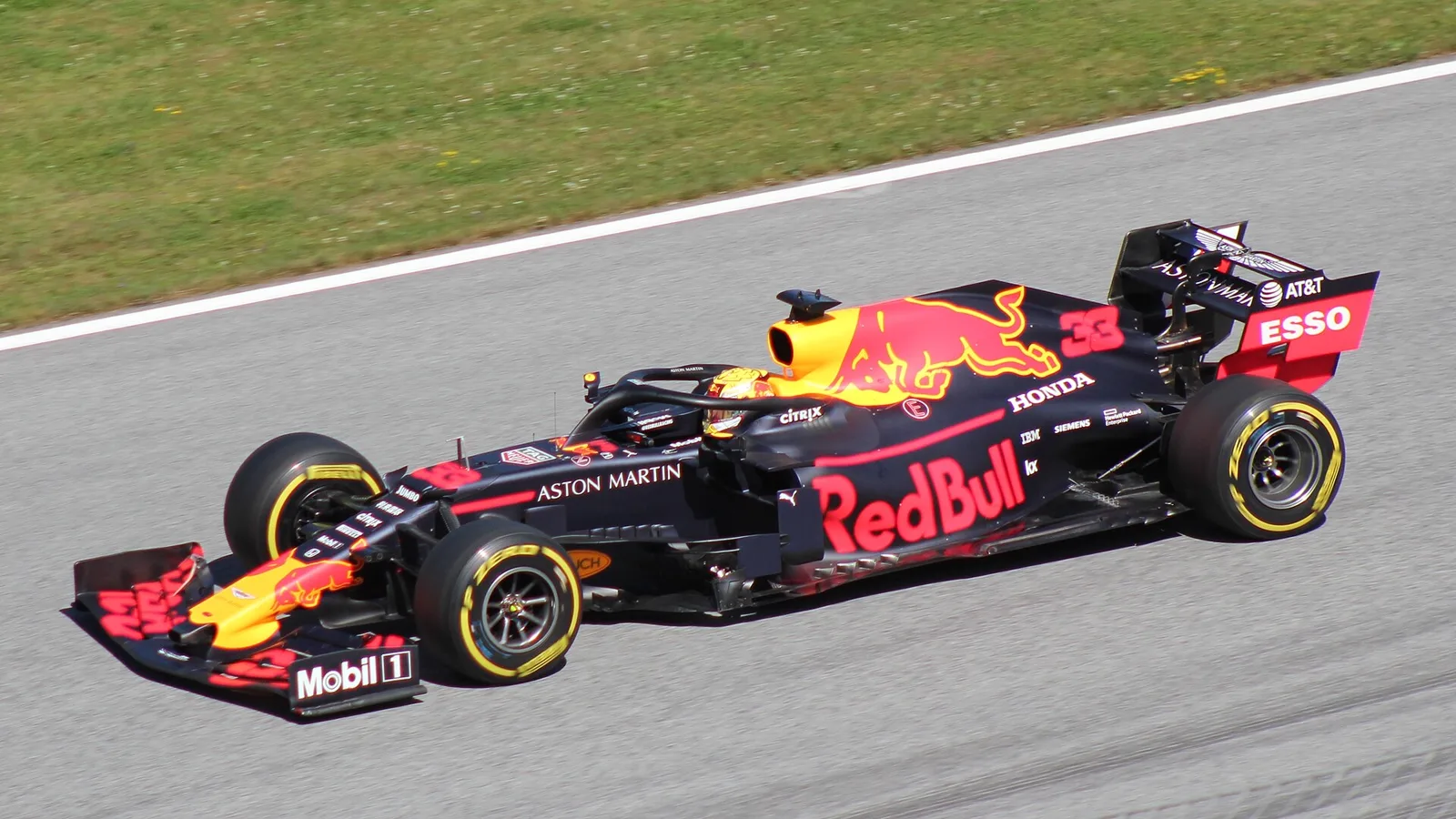
Max Verstappen is looking for his line. At Turn 4 of the Red Bull Ring, in Spielberg, Austria, during first practice on June 28, 2019, he tries two. Sometimes he rounds off his path and takes a longer way; sometimes he takes the corner pointed, the shortest way. In this downhill hairpin, F1 cars arrive at about 200 mph (320 km/h) and go through at about 80 mph (130 km/h). From the trackside, for Formula 1’s official site, journalist Mark Hughes watches this corner.
A wider corner is faster
A turning car holds its curve only through the grip of its tires: on flat ground, it’s the only force pulling it toward the inside of the corner. Since that grip has a limit, every curve has a maximum speed, and that speed grows with the radius. For a car with no aerodynamic downforce, the calculation gives an order of magnitude: speed follows the square root of the radius, so a radius twice as large lets you go about 1.4 times faster.
An F1 car is not in that situation. Its downforce presses it onto the ground, which increases its grip and its cornering speed: the relationship between radius and speed no longer applies as is.
The driver can’t change the shape of the corner, but he chooses the shape of his path. He enters from the outside, comes to touch the inside edge, then exits on the outside. The place where he passes closest to the inside is called the apex. This way the line uses the full width of the track to open up the arc. In a right-angle corner, on a 39-foot (12-meter) track, a simple calculation gives him a radius of about 130 feet (40 meters); a line hugging the inside corner would have a radius close to zero.
This line is longer than the path that hugs the inside, but a car goes faster in a big corner than in a small one. Many beginners on track don’t use the full width: they stay away from the edges, tighten the corner themselves and deny themselves the speed it allowed.
Exit speed carries onto the straight
The roundest line touches the apex in the middle of the corner; it would allow the same speed from start to finish. It is the fastest for an isolated corner, with nothing before or after. On a circuit, though, a corner leads onto a straight or into another corner.
What matters then is the speed at the exit: it affects the speed along the whole straight that follows.
Hence the late apex. The driver turns in a little later, touches the inside farther into the corner and exits on a straighter line. He can get back on the throttle earlier, and that gain in exit speed carries down the straight, as if it were longer. The price is paid at the entry: he has to turn in a little sharper, on a tighter arc, and so go a little slower at the slowest point of the corner than on the round line.
To fix ideas, and it’s an image more than a measurement: a little speed lost over about 330 feet (100 meters) of entry, a little speed gained over about 1,640 feet (500 meters) of straight. The trade is favorable, and all the more so the longer the straight.
Conversely, turning in early and touching the apex too soon gives a fast entry and a slow exit: that’s the early apex, most often considered a beginner’s mistake.
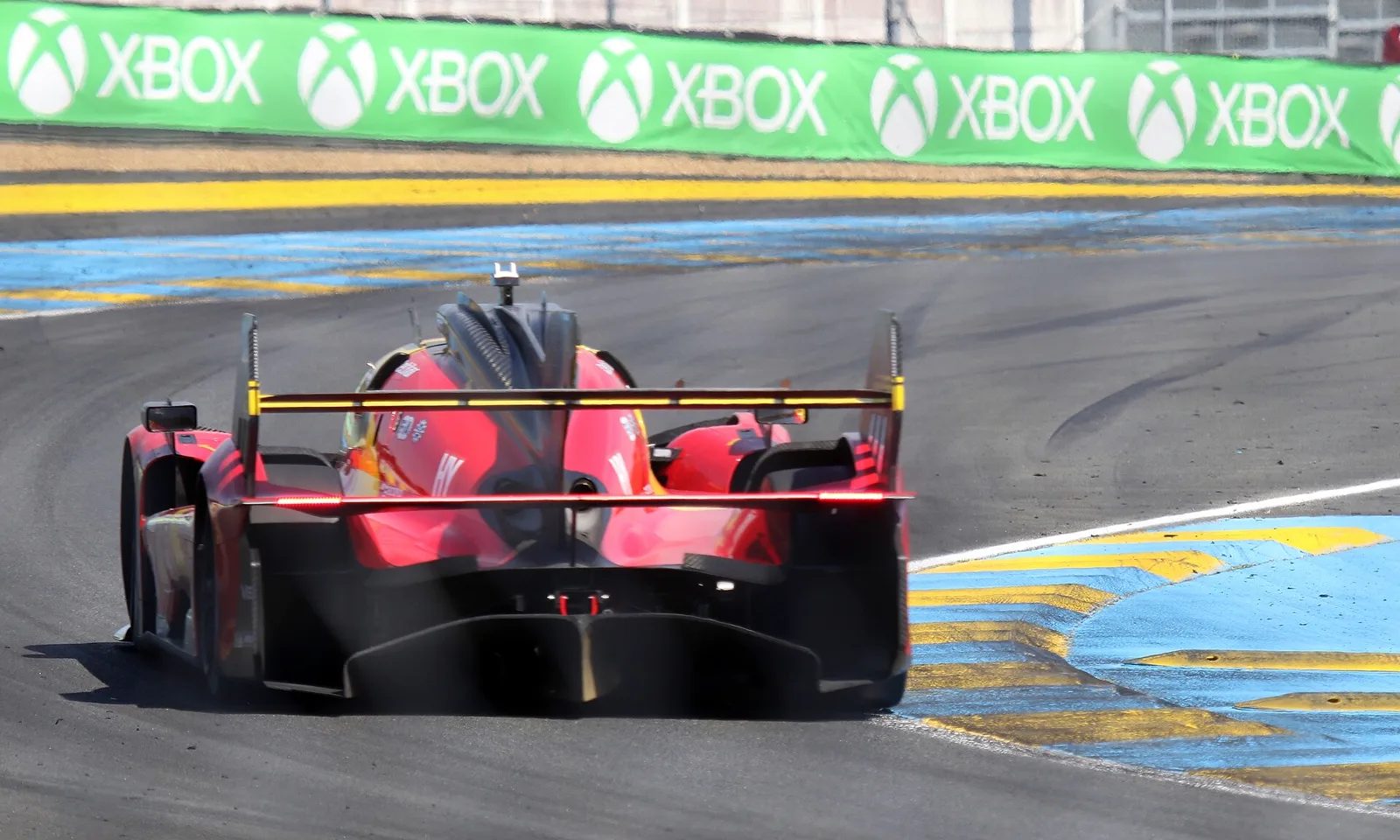
Tertre Rouge, gateway to the Hunaudières
At Le Mans, the Tertre Rouge corner opens the Hunaudières straight. The organizer of the 24 Hours, the Automobile Club de l’Ouest, describes it this way:
“Tertre Rouge can be extremely challenging especially as a fast exit from this right-hander is essential to maximise speed coming into the long Mulsanne Straight.” Automobile Club de l’Ouest, 2015

The faster the corner, the less you delay the apex
The late apex is not a rule to be pushed ever further. Scott Mansell, a former driver turned coach who teaches racing lines on his site Driver61, sums it up: in general, the faster the corner, the closer the right line gets to the round line; the slower it is, the more you delay the apex.
The reason lies in what’s left to gain on the straight: the faster you exit a corner, the less there is left to accelerate. Take a theoretical car that tops out around 150 mph (240 km/h). Exiting a hairpin taken at about 40 mph (65 km/h), it has some 110 mph (175 km/h) left to pick up: the sooner it gets back on the throttle, the more it gains. Exiting a corner taken at about 100 mph (160 km/h), it only has about 50 mph (80 km/h) left to pick up, and opening up the exit pays less.
Two corners, one line
When two corners follow one another, the exit of one is already the entry of the next. The driver then aims for the best speed at the exit of the last one, even if it means sacrificing his line in the first.
A month after Spielberg, on August 2, 2019, Mark Hughes takes up position at Turns 8 and 9 of the Hungaroring in Hungary. Turn 8 goes left, Turn 9 goes right, and what you take in the first is paid for on the approach to the second. To attack Turn 9 well, you have to arrive on the far left; but whoever takes the full width at the exit of Turn 8 can no longer cross the track to get there.
On his first pass, George Russell, then at Williams, takes almost the whole exit of Turn 8: he then manages to cross only about 30% of the track width toward the left, far from the edge where he’d like to be. Lewis Hamilton and Max Verstappen, for their part, leave a little track at the exit of Turn 8 to keep some at the entry to Turn 9. This compromise, close to what Hughes judges nearly the best possible, shows that you can’t take everything in both corners.
A program rediscovers the driver’s apexes
Researchers at Stanford University asked a program to calculate the racing line for Thunderhill circuit in California, 2.8 miles (4.5 km) long. Their method looks for the least curved line possible without leaving the track. They compared it with the line from another calculation method and with that of a professional driver, recorded on the track. All three lines use the full width whenever they can and touch similar apexes in each of the 15 corners.
In simulation, their line promises a lap in 136.4 seconds. On the track, an autonomous Audi TTS following it completes the lap in 138.6 seconds, tuned conservatively for safety. The driver’s best lap, in their data, is 137.7 seconds.
The shortest way, when the car allows it
That leaves Turn 4 at Spielberg. The rounded, “U”-shaped line covers more ground but keeps more momentum; the pointed, “V”-shaped line is shorter but forces the driver to slow down much more. From the trackside, the V seems to suit the Red Bulls, Verstappen’s team, better, while the McLarens look comfortable in a U.
Lewis Hamilton brakes very late in his Mercedes and turns in late; yet the car points well, which lets him take the shortest path and get back on full throttle right at the apex. Hughes describes this line without calling it faster than any other: the shortest remains possible when the car accepts it.
At the end of the session, only a tenth of a second separates the fastest in this corner, Max Verstappen, from Romain Grosjean, classified 10th. The journalist draws a trackside lesson from it:
“As ever, what works for one doesn’t necessarily work for another.” Mark Hughes, Formula 1, 2019
Related reading: Why do drivers brake with their left foot?
FAQ
Why is there a curb at the apex?
Most circuits put one there to stop overeager drivers from cutting across the grass. The apex is also sometimes called the clipping point.
Is an early apex always a mistake?
Not always. A driving course from a regional chapter of the Porsche Club of America (2024) recommends it for a corner that ends a straight without opening onto another one: the aim is then to extend the preceding straight, not to polish an exit that leads nowhere.
Does the Hunaudières straight still exist?
Yes, but no longer in one piece. About 3.7 miles (6 km) long before 1990, it has been broken up since the 1990 24 Hours of Le Mans by two chicanes, spaced roughly equally.
Why does aerodynamic downforce change the calculation?
Because it comes from the air flowing over and under the car: it grows roughly as the square of speed, and only becomes noticeable above a certain speed. At double the speed, the car gets about four times as much downforce, if shape and ride height don’t change, and therefore more grip in fast corners.
Keep exploring
Main sources
- University Physics Volume 1, 6.3 Centripetal Force (septembre 2016) — OpenStax
- TRACKSIDE PERFORMANCE ANALYSIS: A look at driver technique through Austria’s downhill Turn 4 (juin 2019) — Formula 1
- 24 Hours of Le Mans - The legendary spots on the Circuit de la Sarthe (mars 2015) — Automobile Club de l’Ouest