Audi R10 TDI: How a Diesel Won Le Mans in 2006
In 2006, a diesel-powered Audi won the 24 Hours of Le Mans. What the rules allowed it, and what the organizer fixed the following year.
Published November 18, 2026 · Facts checked November 18, 2026
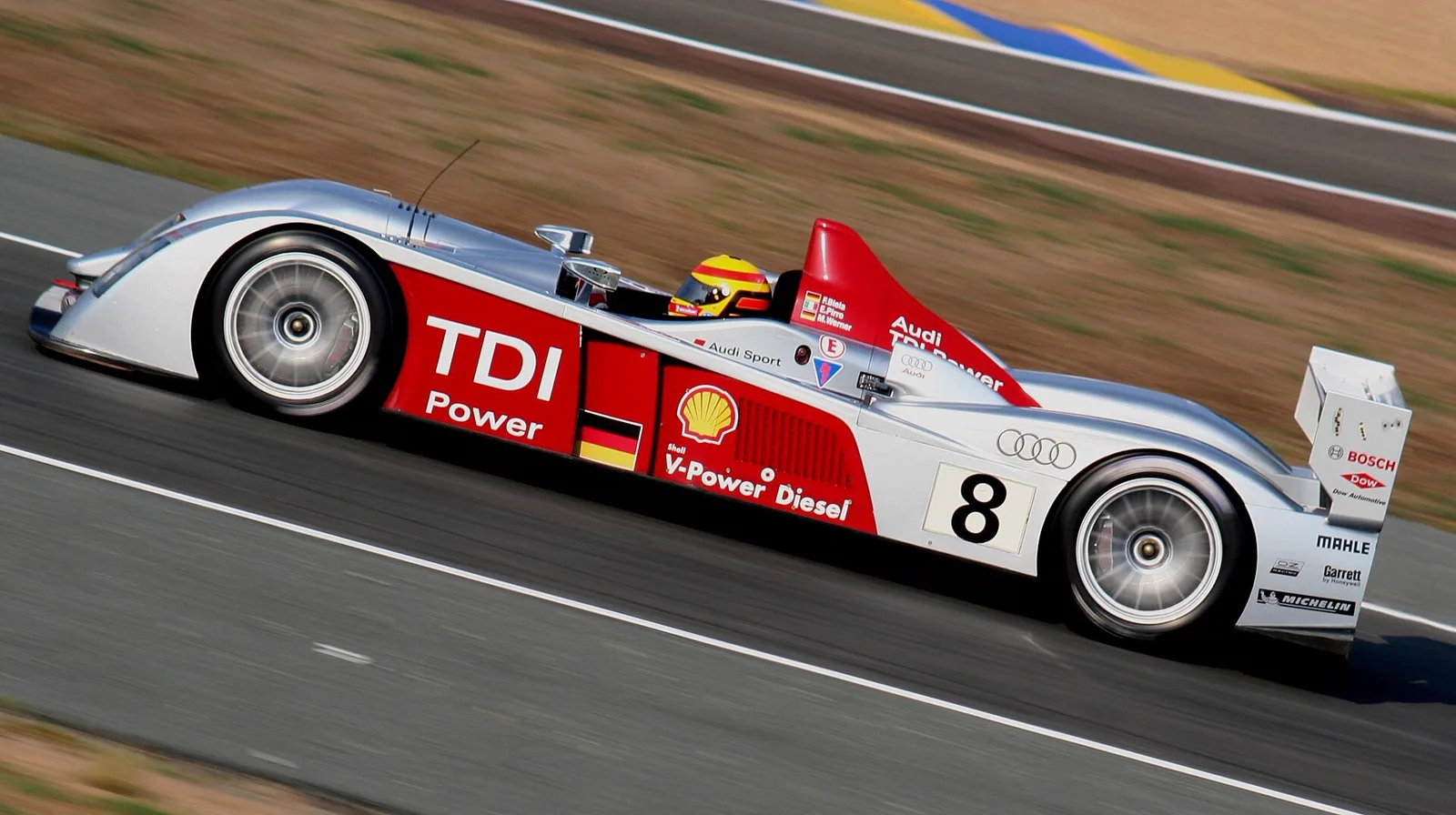
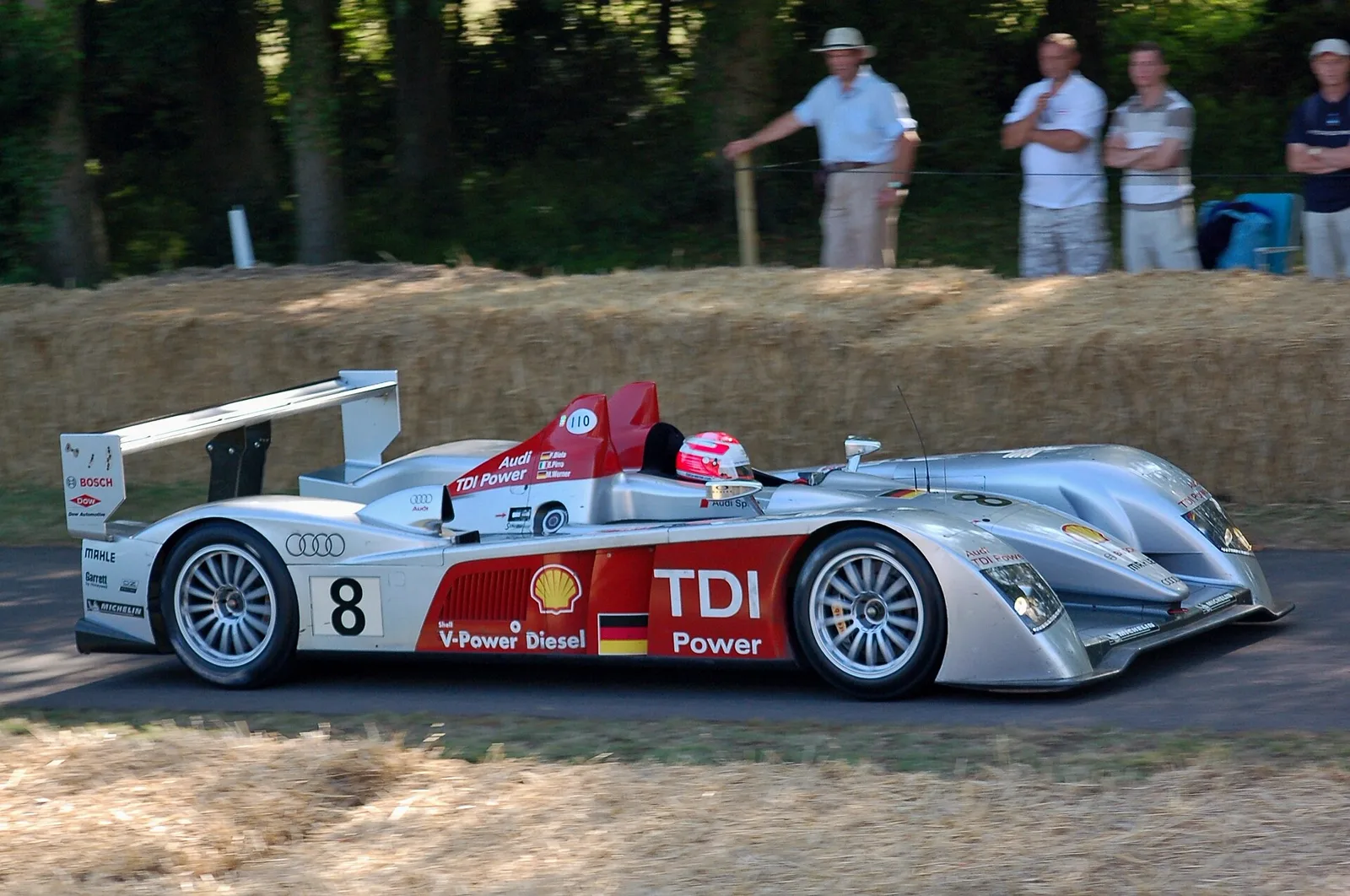
At the start of the 24 Hours of Le Mans on June 17, 2006, Scotland’s Allan McNish pulls away in the lead at the wheel of the No. 7 Audi R10 TDI, with Germany’s Frank Biela in his wake in the No. 8. Both cars run on diesel fuel. From that moment on, an Audi leads every lap of the race, all the way to the finish.
Fewer pit stops: what the rules left to the diesel
Part of the R10’s advantage comes from its fuel tank. The rules of the Automobile Club de l’Ouest (ACO), which organizes the race, give all prototypes 90 liters (about 24 gallons) of fuel on board, gasoline or diesel. But a liter of diesel contains about 10% more energy than a liter of gasoline, and a diesel burns noticeably less. On the same tank, the Audi goes farther.
In the race, the difference is counted in the pits. The Audis stop every 14 or 15 laps; their rivals, the gasoline-powered Pescarolos, every 12. As early as July 2006, Autosport counted two to three more laps per stint, meaning between two refuelings.
The diesel has a second asset. For the same displacement, it is less powerful than a gasoline engine, but it has much more torque, that is, more force to turn the wheels, and it gets it at lower revs.
The R10 is also faster per lap. After the race, the ACO studies the lap times: according to Autosport, the Audi was on average 3.2 seconds a lap faster than the Pescarolos. Henri Pescarolo, a four-time Le Mans winner and head of the team that bears his name, will put it at five seconds.
Where does this gap come from? The ACO itself cannot decide between the engine, the chassis, and the aerodynamics, Autosport writes; according to the site Crash.net, though, the diesel appears to have been judged decisive. Pescarolo, for his part, attributes it in 2007 to engine power alone.
The 2004 rules that opened the door
For 2004, the ACO rewrites the rules for the fastest prototypes, now called LMP1. It admits turbocharged diesel engines, that is, engines boosted by a turbo, up to 5,500 cc. The text sets no limit on the number of cylinders; Audi will choose twelve.
The rules also set limits, which apply to all engines, gasoline and diesel alike. Each engine breathes through a restrictor, a calibrated opening that limits the air drawn in and therefore the power; and no visible smoke may come out of the exhaust.
In the very first year, a small British privateer team, Taurus Sports Racing, fields at Le Mans a Lola powered by a diesel V10 derived from the Volkswagen Touareg, an SUV. It retires. But according to the specialist site DailySportsCar, the Lola could run 16 laps between fuel stops, against 11 for the Audi R8 that won that year.
An engineer’s idea, a green light in the middle of the night
At Audi Sport, the brand’s racing arm, the idea comes from Ulrich Baretzky, the head of engines. He tells the British magazine Motor Sport in 2016 that it took shape in January 2001, during a boozy evening in a bar with two ACO executives. He sums up his moment of clarity this way:
“I realised that if someone else other than Audi, as the pioneer of direct-injection diesels for the road, should bring this technology to Le Mans and win, I would regret it for the rest of my life. It was like a bolt of lightning.” Ulrich Baretzky, Motor Sport, 2016
The brand also has commercial reasons. It has raced in the American Le Mans Series, the American endurance championship, since 2000, and plans to launch its diesel range in the United States, where such cars are still nicknamed oil-burners. Wolfgang Ullrich, the head of Audi Sport, says so in 2016:
“We wanted to push the sportiness of the diesel, and the best way to do that was through motor sport.” Wolfgang Ullrich, Motor Sport, 2016
The green light comes during the night of the 2004 24 Hours. Baretzky lays out the project to Ferdinand Piëch, father of the Porsche 917 and chairman of the supervisory board of Volkswagen, Audi’s parent company. His answer, according to Baretzky: “You should do it.”
A V12 so quiet you can no longer hear the gears
The racing engine fires up for the first time in May 2005. It is a 5.5-liter all-aluminum V12, a first for an Audi diesel, boosted by two turbos. Its power is such that one gear of the R8’s gearbox becomes pointless: the supplier Xtrac builds a five-speed instead of a six-speed.
Audi dates the car’s first run to November 29, 2005, 200 days before the race. In between, the R10 covers about 18,600 miles (30,000 km) of testing, and its engine runs 1,500 hours on the dyno.
Behind the wheel, the drivers lose a reference point: noise. Tom Kristensen, the driver with the most Le Mans wins, nine, remembers:
“At high speed, even the wind noise was louder than that of the engine.” Tom Kristensen, Audi, 2016
McNish says the display of the engaged gear on the dashboard had to be enlarged: when downshifting, you could no longer hear the revs. The R10’s first win comes on March 18, 2006, at the 12 Hours of Sebring: the R10 of McNish, Kristensen, and Rinaldo Capello, the crew of the future No. 7 at Le Mans, wins there with a four-lap lead.
At Le Mans, a more fragile victory than it looks
Le Mans week starts badly. From the first qualifying session, the Audis suffer injector trouble, and each car has only one engine for the whole week. In the race, in the fourth hour, the No. 7 loses twenty minutes and six laps: the electronics of the day could tell which bank of cylinders had the problem, not which injector. It then suffers a collision with a GT car and a turbo change.
The No. 8 of Biela, the Italian Emanuele Pirro, and the German Marco Werner escapes the injector troubles; even today, Audi cannot quite explain why. It still has to stop around the halfway point to repair its gearbox. During the repair, the leading Pescarolo closes to within one lap of the Audi.
On Sunday, June 18, the No. 8 completes 380 laps, or 3,223 miles (5,187 km) at an average of 133.8 mph (215.4 km/h). It is the first win by a diesel engine at Le Mans, and Audi’s sixth. Biela and Pirro had already won together in 2000, 2001, and 2002 with Kristensen; Werner had won in 2005.

| Pos. | Car | Drivers | Laps |
|---|---|---|---|
| 1 | Audi R10 TDI No. 8 | Biela, Pirro, Werner | 380 |
| 2 | Pescarolo C60 Hybrid-Judd No. 17 | Montagny, Hélary, Loeb | 376 |
| 3 | Audi R10 TDI No. 7 | Capello, Kristensen, McNish | 367 |
Between the two Audis, Sébastien Loeb, then a two-time World Rally champion, shares the Pescarolo with Franck Montagny and Eric Hélary.
After 2006: the smaller tank and Peugeot in the race
The ACO wants to correct the gap. Its press release, picked up by the site Crash.net, proposes:
“The capacity of the fuel tank will have to be tailored so that the cars receive the same quantity of energy at every stop. That will mean a smaller tank for the cars with a diesel engine.” ACO press release, 2006
For 2007, the diesels’ tank goes from 90 to 81 liters (from about 24 to 21 gallons), 10% less. Henri Pescarolo finds the correction insufficient: in his view, it costs only 0.7 seconds a lap.
“Right now, you have to have a diesel engine if you want to win. I’d love to run a diesel, but unfortunately there isn’t one available to me.” Henri Pescarolo, Motor Sport, June 2007
In 2007 a diesel rival arrives, the Peugeot 908 HDi FAP, also a 5.5-liter V12, FAP standing for particulate filter. Audi wins again that year, with the same crew.
In 2012, the Audi R18 e-tron quattro, a diesel paired with two electric motors, becomes the first hybrid prototype to win Le Mans. In 2015, Porsche wins with a gasoline hybrid, the 919 Hybrid, and the era of diesel prototypes at Le Mans comes to a close.
Test yourself on endurance racing
Read also: How did a rotary engine win Le Mans in 1991?
FAQ
Had a diesel engine raced at Le Mans before 2006?
Yes. The brothers Jean and Jacques Delettrez entered one as early as 1949, a 4.4-liter six-cylinder of about 70 hp, but never won. The No. 8 Audi R10 TDI is the first winning diesel, on June 18, 2006.
How many times did Audi win Le Mans with a diesel engine?
Eight times in the nine editions run from 2006 to 2014: with the R10 in 2006, 2007, and 2008, the R15 in 2010, then the R18. The only other win of that period, in 2009, also went to a diesel, the Peugeot 908 HDi FAP.
Was the Pescarolo C60 Hybrid a hybrid car?
No. “Hybrid” is part of the car’s name: the C60 Hybrid, raced in 2005 and 2006, had a Judd GV5 gasoline engine.
Are Audi’s 380 laps in 2006 a record?
No. The distance record dated from 1971: 3,315 miles (5,335 km) for the Porsche 917 K of Marko and van Lennep. It was broken in 2010 by another diesel Audi, the R15 TDI, with 397 laps.
Keep exploring
Main sources
- 24 Heures du Mans 2006, résultats — Racing Sports Cars
- 10 out of 10 (Audi R10 TDI, Gary Watkins, juin 2016) — Motor Sport
- Smaller fuel tanks for diesel cars (13 juillet 2006) — Autosport