How Did a Rotary Engine Win Le Mans in 1991?
A helping hand from the rulebook, an engine detuned to last, favorites that broke down: here is how Mazda won.
Published November 18, 2026 · Facts checked October 30, 2026
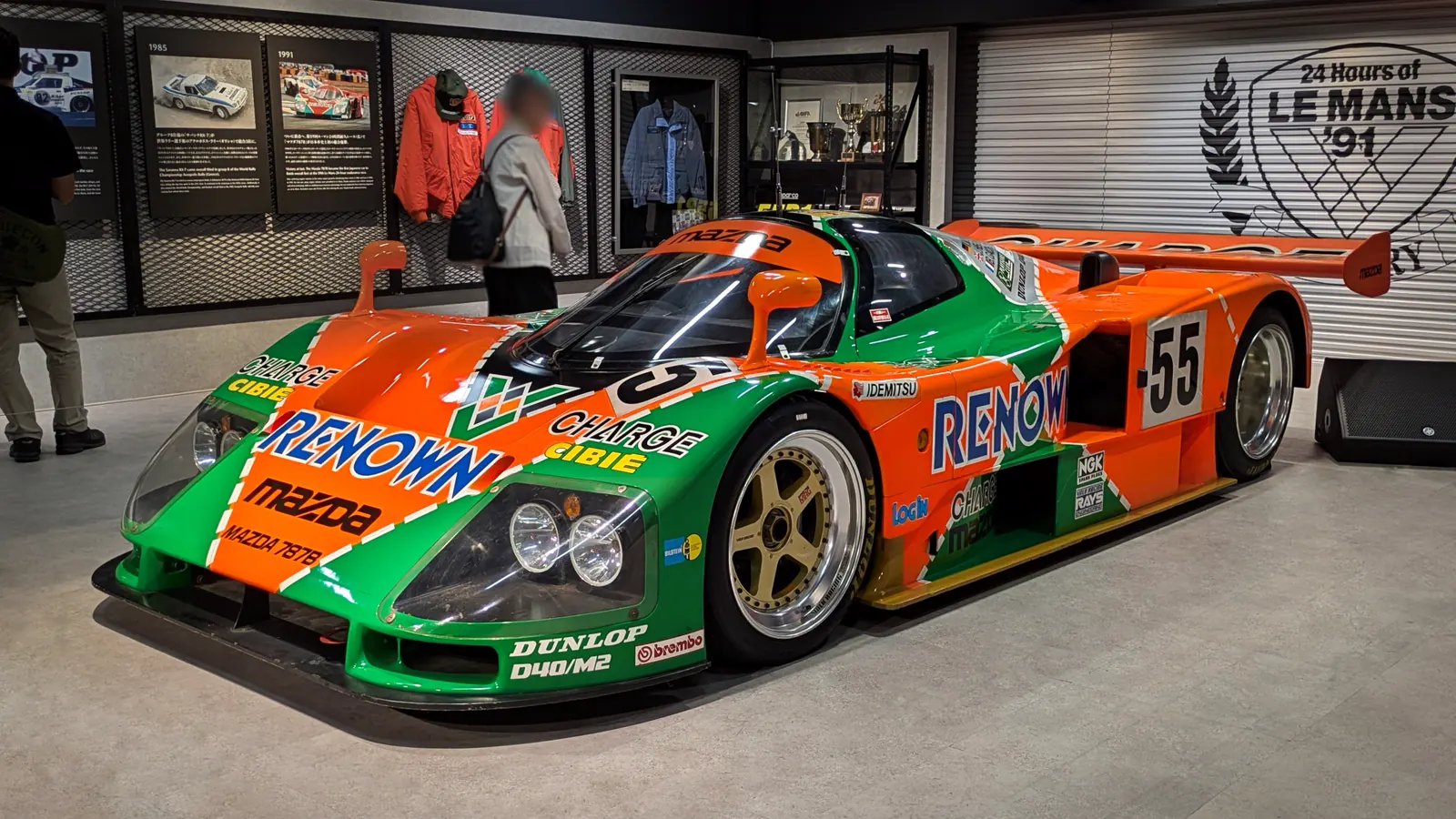
On June 23, 1991, at 1:05 p.m., after twenty-two hours of racing, the No. 55 Mazda takes the lead of the 24 Hours of Le Mans amid the scream of its engine and the cheers of the grandstand. It will never give it up. No rotary-powered car had won before it.
An unusual engine, a team coming back from far away
In a conventional engine, the explosion of the gasoline pushes pistons up and down. In the rotary engine, whose principle was demonstrated by German engineer Felix Wankel, it pushes on the face of a rotor shaped like a bulging triangle, which spins in its chamber and drives a shaft. Mazda entered Le Mans as early as 1974, and one of its rotary cars finished the race that year, a first. It would take another seventeen years to win it.
Mazda advances step by step. Its first class wins at Le Mans date from 1983. In 1986 it moves to a three-rotor engine; in 1989, four-rotor Mazdas take 7th, 9th and 12th place.
The 1991 car is entered by Mazdaspeed, Mazda’s racing team, whose competition director is Takayoshi Ohashi. Mazdaspeed relies on the French team Oreca and on an adviser: Belgian Jacky Ickx, six-time winner of the 24 Hours of Le Mans. The three drivers of the No. 55, Volker Weidler, Johnny Herbert and Bertrand Gachot, are young Formula 1 drivers who were already racing together for Mazda in 1990.
In 1990, Mazda ran two 787s, the previous version of the car. Both retired: one with an oil leak, the other with an electrical failure followed by a fire. For 1991, Mazda builds three 787Bs, a new version of the 787.
The 1991 rules: pushed back on the grid, lightened on the scales
The rules are written by FISA, the sporting arm of the International Automobile Federation. In endurance racing, it has prototypes compete, cars built purely for racing. Their category, Group C, has an unusual rule: instead of limiting the size of the engine, it limits the amount of gasoline you can burn during the race.
In 1991, FISA launches a new formula: 3.5-liter naturally aspirated engines, that is, with no turbo or supercharger, as in Formula 1. Cars that comply form the main category, C1, and no longer have a fuel limit. All the others, including the Mazda, are reclassified into C2, where the fuel limit remains in force. To showcase its new formula, FISA puts the 3.5-liter cars at the front of the starting grid, regardless of their lap times; all the others move back seven places. The No. 55 set the twelfth-fastest qualifying time: with seven places lost, it starts 19th.
On the scales, by contrast, the rules work in Mazda’s favor. In 1991, the minimum weight of piston-engined Group C cars is raised by 220 lb (100 kg), to 2,205 lb (1,000 kg); the Mazda, for its part, was supposed to be ballasted to 1,940 lb (880 kg) for Le Mans. In the spring, Mazdaspeed, Oreca and Jacky Ickx get FISA to let it keep its minimum of 1,830 lb (830 kg), the previous year’s figure.
On paper, then, the Mazda is 375 lb (170 kg) lighter than the piston-engined cars in its category. At technical inspection, the heaviest of the Mazdas still weighs 331 lb (150 kg) less than the lightest of the Porsches in its category. It lacks the single-lap speed of the Sauber-Mercedes, the Jaguars or the Porsches, but it is reliable. And its power-to-weight ratio is better than theirs: about 345 hp per 1,000 lb (760 hp per metric ton) according to published estimates, against 331 (730) for the Jaguars and the Sauber-Mercedes and 327 (720) for the Porsches.
An engine detuned to last
The 787B’s engine, the R26B, has four rotors for a displacement of 2.6 liters (2,616 cc). With a limited amount of gasoline for 24 hours, the fastest car is not necessarily the one that goes the farthest. Mazda claims 700 horsepower. In the race, according to evo magazine, the engine produces about 680: the engineers limited the engine speed to 8,500 rpm, at the cost of power, because they judged fuel economy decisive for winning. Published figures range from 650 to 710 horsepower.
This engine, which appeared in 1990, has three spark plugs per rotor instead of two and ceramic seals at the rotor tips. For 1991, the car adopts carbon-ceramic brakes, a first for a Mazda race car, which allow larger wheels. Over the race, the most economical is the No. 1 Sauber-Mercedes (4.7 mpg, or 49.8 liters per 100 km), but the Mazdas (4.5 mpg, 52.6) do better than the Jaguars (4.3 mpg, 54.4).
A race lost by the favorites, and taken by Mazda
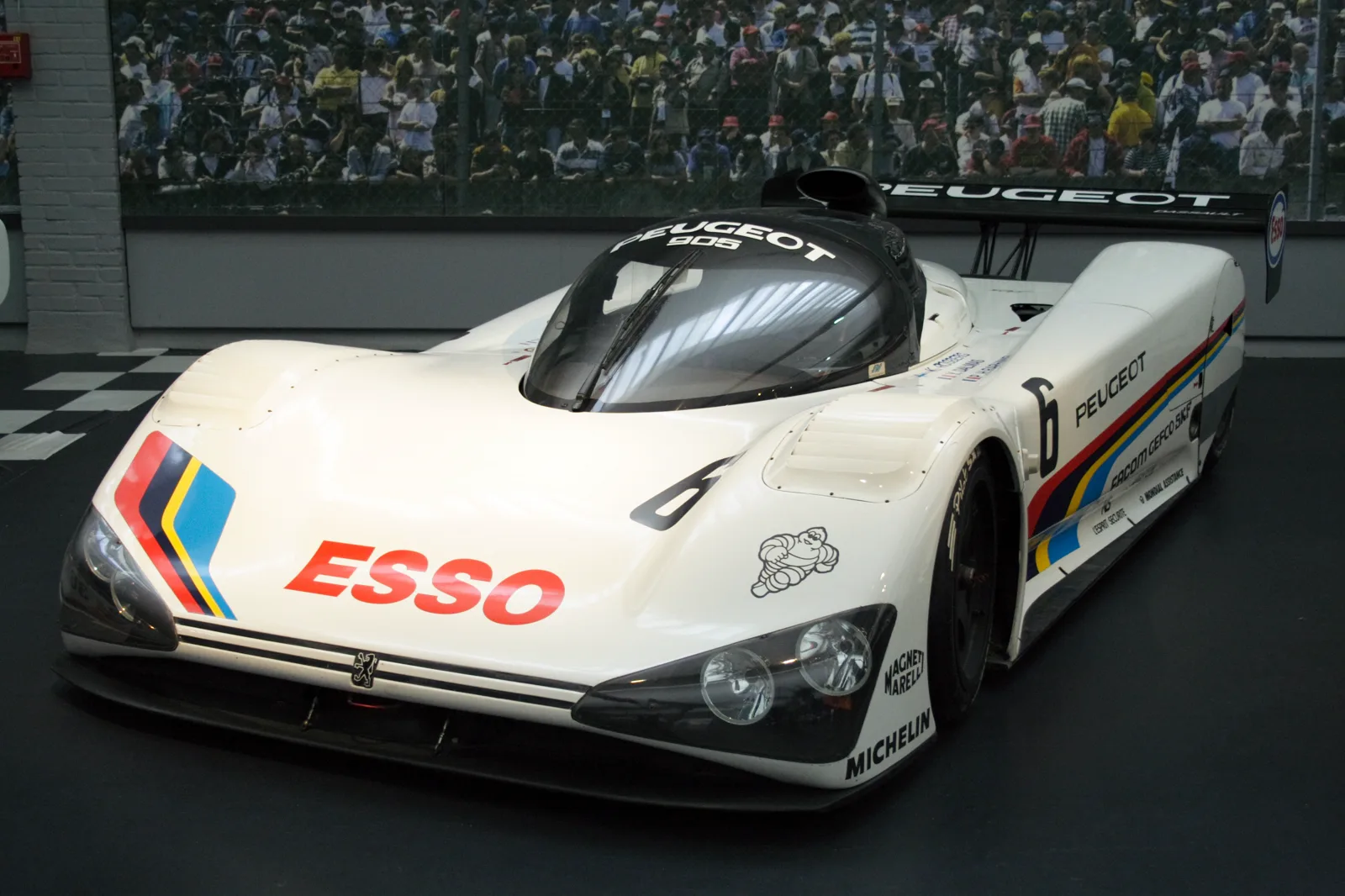
The race was shaping up as a final duel between Jaguar and Sauber-Mercedes, the two big teams of the championship, with Mazda in a supporting role. The Peugeot 905s, cars of the new 3.5-liter formula, lead the first hour, then break down and retire. The Jaguars have to slow down to save fuel.

The No. 55 does not go unnoticed. It is painted orange and green, the colors of a sponsor, the Japanese clothing maker Renown, while the other two Mazdas are blue and white. The shrill sound of its four-rotor, writes the Automobile Club de l’Ouest, which organizes the race, also leaves an indelible mark on the spectators.
The day before the race, the team, usually cautious, changes its plan: it asks the No. 55 drivers to race as if it were a sprint race. The car holds up. In 24 hours, it suffers only a blown headlight bulb and a precautionary wheel bearing change.
The leading Sauber-Mercedes has been in front for nearly 17 hours when an alternator bracket breaks: a “$1 part.” The belt that drives the water pump jumps off; without water, the engine cooks. The Mazda then takes the lead. At the last pit stop, Herbert asks to stay in the car and finishes the race. Dehydrated, he has to be helped out of the car and taken to the medical center: he misses the podium.
The No. 55 covered 3,059 miles (4,922.8 km) at an average of 127.6 mph (205.33 km/h). Three Jaguar XJR-12s follow it, the first two laps behind the Mazda. Only twelve cars are classified; the other two Mazdas finish sixth and eighth. Mazda becomes the first Japanese manufacturer to win Le Mans. In Japan, television networks interrupt their programming to broadcast the last eight hours.
Why the rotary engine never won again
Mazda knew this was its last chance. As early as 1988, FISA president Jean-Marie Balestre had announced a ban on rotary engines from 1990; FISA then granted the previous generation of cars a reprieve until the end of 1991. In 1992, the main category admits only piston engines.
In 1992, for lack of competitors, the race organizers reopen a category for older Group C cars; limited on fuel, they no longer play for the win there. Mazda has little in the way of a race engine other than its rotaries, and it judges it too expensive to design a new one. It races in 1992 with the MXR-01, powered by a piston V10 of Judd origin; Weidler, Herbert and Gachot bring it home fourth.
What became of the No. 55
The winning car raced only this one race: it was retired after Le Mans. It is on display most of the time at the Mazda Museum in Hiroshima. In 2011, Mazda restored it to running condition, and Johnny Herbert drove it on a demonstration lap of the Le Mans circuit. The number 55 reappears on the Furai concept car, unveiled by Mazda in 2008.
Test yourself on endurance racing
Read also: Why Le Mans drivers used to run to their cars.
FAQ
How much did the Mazda 787B weigh at Le Mans in 1991?
Its minimum allowed weight was 1,830 lb (830 kg); at technical inspection, the No. 55 weighed 1,863 lb (845 kg). Piston-engined cars in its class had to weigh at least 2,205 lb (1,000 kg): their minimum weight had just been raised by 220 lb (100 kg). The Mazda should have been ballasted to 1,940 lb (880 kg) for Le Mans, but Mazdaspeed, Oreca and Jacky Ickx got FISA to let it keep its 1,830 lb (830 kg).
How much power did the 787B’s R26B engine make?
Mazda claims 700 hp for this four-rotor engine, with a displacement of 2.6 liters (2,616 cc). According to evo magazine, the engine speed was limited to 8,500 rpm in the race to save fuel, which gave about 680 hp. Published figures range from 650 to 710 hp.
Why has the rotary engine never won at Le Mans again?
The 1992 rules reserved the main class for 3.5-liter naturally aspirated piston engines, as in Formula 1. Mazda had little in the way of a race engine other than its rotaries and judged it too expensive to develop one: in 1992 it raced the MXR-01, with a piston V10, which finished fourth.
Where can you see the winning Mazda 787B?
The No. 55 is on display most of the time at the Mazda Museum in Hiroshima, Japan. The 24 Hours of Le Mans museum shows another authentic example, chassis 04, whose mechanicals do not work.
Keep exploring
Main sources
- Le Mans 24 Hours 1991, résultats — Racing Sports Cars
- Bringing the museum to you: the triumphant underdog Mazda 787B — 24h-lemans.com (ACO)
- Mazda 787B Le Mans-winning car restored — Mazda (communiqué, mai 2011)