The Le Mans Start: Why Run, and Why Stop?
Born of a 1925 rule, the running start disappeared between 1969 and 1971. The journalist, the organizer and the 1969 winner each blame a different culprit.
Published November 18, 2026 · Facts checked November 11, 2026
At the 1970 24 Hours of Le Mans, at 4 p.m., for the first time since 1925, no driver runs across the track. All of them are already lying in their cars, strapped in, and very few see the flag drop: each one takes off as soon as his neighbor does. The British journalist Denis Jenkinson, there for Motor Sport magazine, calls this start “the dullest thing imaginable. (But safe and clinical, hurrah!)”
1925: The Birth of the Running Start
The first two editions of the 24 Hours, in 1923 and 1924, started from a standstill, cars lined up like a Grand Prix. The running start was born in 1925, out of a rule. Cars of the day carried a removable top. To check that it was sturdy and easy to put up, the Automobile Club de l’Ouest (ACO), which organizes the race, required drivers to raise it themselves at the start: so they had to run to their cars.
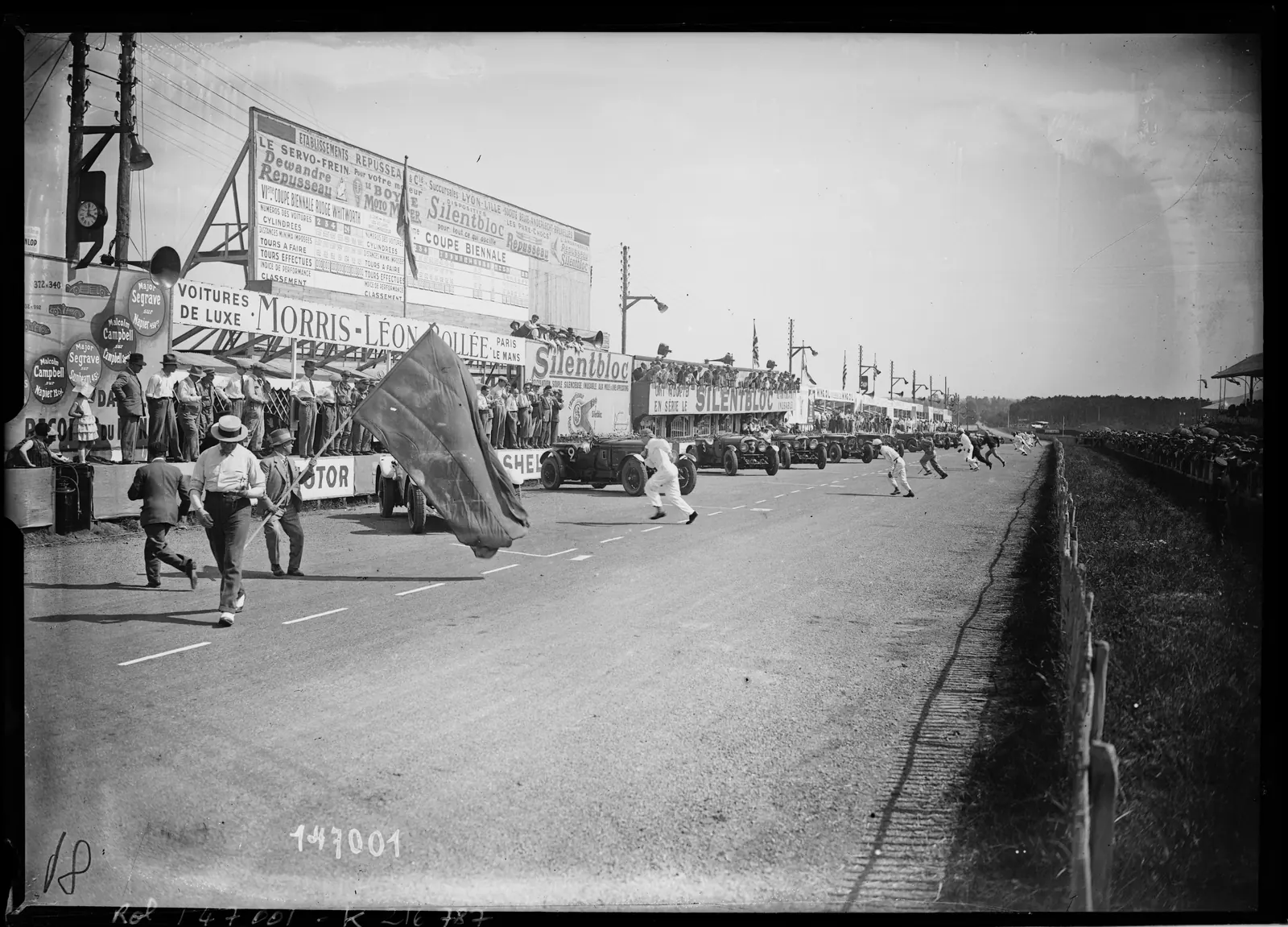
The cars wait at an angle, side by side, on one side of the track; the drivers are on the other. According to the ACO, which explained it in 2013, this layout kept drivers from tending to their cars before the signal. The arrangement is called the “en épi” start, or Le Mans start.

J. D. Benjafield, who raced a Bentley, tells the story of this first start in Motor Sport in August 1925. The cars wait facing the grandstand, arranged by size, the biggest in front, staggered so that each can leave as soon as it is ready. He describes the signal:
“Sharp to time the flag fell, and the loud speakers bellowed ‘Partez’ when the drivers made a dash for their cars, feverishly erected the hood (20 laps having to be driven with the hood up), leapt in, pressed the starter, and away they went in a cloud of dust.” J. D. Benjafield, Motor Sport, August 1925
The First-Lap Showcase, Then the Harness
Why the rush? Being in front at the end of the first lap, the ACO writes, is publicity that manufacturers prize, and some drivers collect bonuses for it. In open cars, some drivers practice vaulting over the door and the windshield to save time.
It is also a show. Jenkinson remembers the drivers standing in circles painted on the road, and the flag being carried to the head of the line. Fifteen seconds before the signal, the crowd falls silent on its own. To Jenkinson, there was “something almost sacred to motor racing” about it.
By the late 1960s, the harness is spreading: several straps that hold the driver in the seat, “like an Air Force pilot,” Jenkinson writes. Running, jumping into the car and then buckling everything becomes impossible: some drivers need a mechanic to close their harness.
Many therefore give up on strapping in. Belgian Jacky Ickx, the 1969 winner, explains it in 2017:
“When you ran to your car and wanted to be among the first away, there was no question of fastening your seat belt.” Jacky Ickx, ACO, 2017 (RacingMind translation)
Briton Brian Redman, who raced at Le Mans in 1969, describes the habit: most drivers left with their belts undone and let the field stretch out. On the second or third lap, on the long Hunaudières straight, they buckled up while holding the wheel with their knees. The ACO adds another danger: cars more powerful every year, and more and more frequent contact at the start.
1968, 1969: A Door That Flies Off, a Driver Who Walks
In 1968, Belgian Willy Mairesse runs to his Ford GT40 like everyone else and takes off. A few moments after the start, on the Hunaudières straight, his door, poorly latched, opens and flies off. The crash is violent.
Mairesse spends about two weeks in a coma, and he never races again. According to one ACO page, Mairesse had also left without fastening his harness; the other accounts mention only the door.
On June 14, 1969, Ickx is 24. Starting 14th on the grid, he shares JW Automotive’s No. 6 Ford GT40 with Briton Jackie Oliver. At the signal, all his rivals run to their cars. Ickx crosses the track at a walk, about 65 feet (20 meters), settles in, buckles his harness and starts the engine. Rolf Stommelen, on pole in a factory Porsche 917, is already far down the track. Ickx sets off last of the 45 cars.
The gesture is premeditated. “Obviously I hadn’t told anyone about my plan, I’d kept it a surprise, otherwise they would have locked me in a trailer or a motor home at the time of the start,” he says in 2019 (RacingMind translation). In 2016, he explains to the Fédération Internationale de l’Automobile (FIA) why he dared:
“And also the fact that we were not supposed to be a real contender for the win helps you to have the idea of walking, to show that in 24 hours, starting first and last doesn’t change anything.” Jacky Ickx, FIA, 2016
John Woolfe’s First Lap
That day, John Woolfe, a 37-year-old Briton, drives his own Porsche 917. This wealthy amateur is the first private customer for the car, which was judged unstable at high speed in testing. He has little experience in it: only a few test laps, and his first co-driver gave up racing after a high-speed crash.
Porsche advises handing the first stint (the first period at the wheel) to Herbert Linge, who has more experience in the 917. Woolfe insists on starting. He jumps into the car without buckling his harness.
On the first lap, he drops a wheel onto the grass at Maison Blanche, the fast corners leading onto the pit straight, and loses control. Unbelted, he is thrown out. The car splits in two and catches fire; Chris Amon, driving a factory Ferrari, hits the burning fuel tank, and his car ignites. Amon climbs out unhurt. John Woolfe dies.
The race is not stopped, but the wreckage and the fire block much of the field. Ickx, who started last, gets stuck in the traffic jam: his walk, writes Motor Sport, nearly cost him the race. Ickx and Oliver win anyway the next day, with a lead of about 330 feet (100 meters) over second place. Ickx imagines a different ending:
“Now imagine that I finished second by around 20 metres. That’s not at all the same story. You would be sitting here telling me it would’ve been wiser to start like the others. It was a very attractive start for the show, but it wasn’t a solution any more.” Jacky Ickx, FIA, 2016
Who Ended the Running Start?
The facts fit in three lines: Mairesse’s accident in 1968, Woolfe’s death in 1969, the mandatory full harness in 1970. The culprit, though, changes depending on who is talking. Jenkinson reports that inside the ACO, the end of the running start was first justified by the full harness. But in 2018, the ACO names Mairesse’s accident as “the trigger for the eventual end of the Le Mans start” (RacingMind translation). In 2021, it writes of Ickx’s gesture: “That gesture sounds the death knell of the traditional 24 Hours start” (RacingMind translation). The FIA, in 2016, ties the two 1969 events together: Woolfe’s death and Ickx’s walk.
The ACO even suggests, in early 1970, that Woolfe’s door, poorly fastened in the rush of the start, contributed to the accident. Motor Sport doesn’t buy it: Chris Amon, who was right behind the 917, saw the accident developing from a distance.
Ickx, for his part, claims no credit. In 2019, he turns down that role: “As for saying that it was my few steps […] that later changed the 24 Hours of Le Mans start procedure, that changed the course of history, I don’t think so. Unfortunately, it was poor John Woolfe’s accident on the first lap that year […] that ended that Le Mans start where the drivers ran, jumped into their cars and took off.” (RacingMind translation)
When was the decision made? Nobody knows. Jenkinson places it sometime in 1969, without saying whether it was before or after June 14; by February 1970, Motor Sport already knows the new rule.
1970 and 1971: Two Starts to Finish It Off
In 1970, nobody runs anymore. The rules first call for a half-measure. The first driver waits, strapped in, in the car; his teammate runs across the track to flip the battery master switch. The idea is dropped before the race, and the full harness becomes mandatory.
In 1971, the angled lineup disappears as well. A guardrail now separates the track from a wide pit lane; to Andrew Marriott, Motor Sport’s correspondent, it dooms the old start. On June 12, 1971, the cars leave two by two, in qualifying order, behind a Porsche 911 that leads them around on a warm-up lap. Marriott concludes: “It was all distinctly pathetic.”
The running start has not quite left Le Mans. In 2025, at the Le Mans Classic, the event for historic cars, drivers in the 1961–1965 field still ran to their cars, lined up in front of the pit wall, before the official start was given at 4 p.m. sharp.
Read also: How a Rotary Engine Won Le Mans in 1991.
FAQ
Why was the 1969 24 Hours of Le Mans started at 2 p.m.?
Because of the French presidential election: the runoff was held that Sunday, and starting two hours early gave spectators time to go vote. The usual 4 p.m. start returned in 1970.
Does the Le Mans start still exist in racing?
Yes, mostly in motorcycle endurance racing. The ACO noted it in 2013 at the Le Mans 24 Hours motorcycle race, and Honda described it in 2023 for the Suzuka 8 Hours in Japan.
Did other races besides Le Mans use this start?
Yes. The Goodwood Nine Hours, in England, started this way in 1952 and 1955; in 1955, Stirling Moss stalled there and left last. At the 12 Hours of Sebring, in Florida, 70 drivers ran across the track in 1969, for the last time.
How many times did Jacky Ickx win the 24 Hours of Le Mans?
Six times, and 1969 was the first. It wasn’t his first start, though: he made his Le Mans debut in 1966, with the Essex Wire team.
Keep exploring
Main sources
- 24 Heures du Mans, un certain style de départ — Automobile Club de l’Ouest (24h-lemans.com)
- Le Mans 1970: a dead loss (juillet 1970) — Motor Sport
- Ickx, la marche victorieuse du Mans 1969 — Automobile Club de l’Ouest (24h-lemans.com)