The Brabham BT46B Fan Car: Why Only One Grand Prix?
A crushing win, a car ruled legal, and yet it was withdrawn: the affair was settled less with the stewards than among the team bosses.
Published November 18, 2026 · Facts checked November 18, 2026
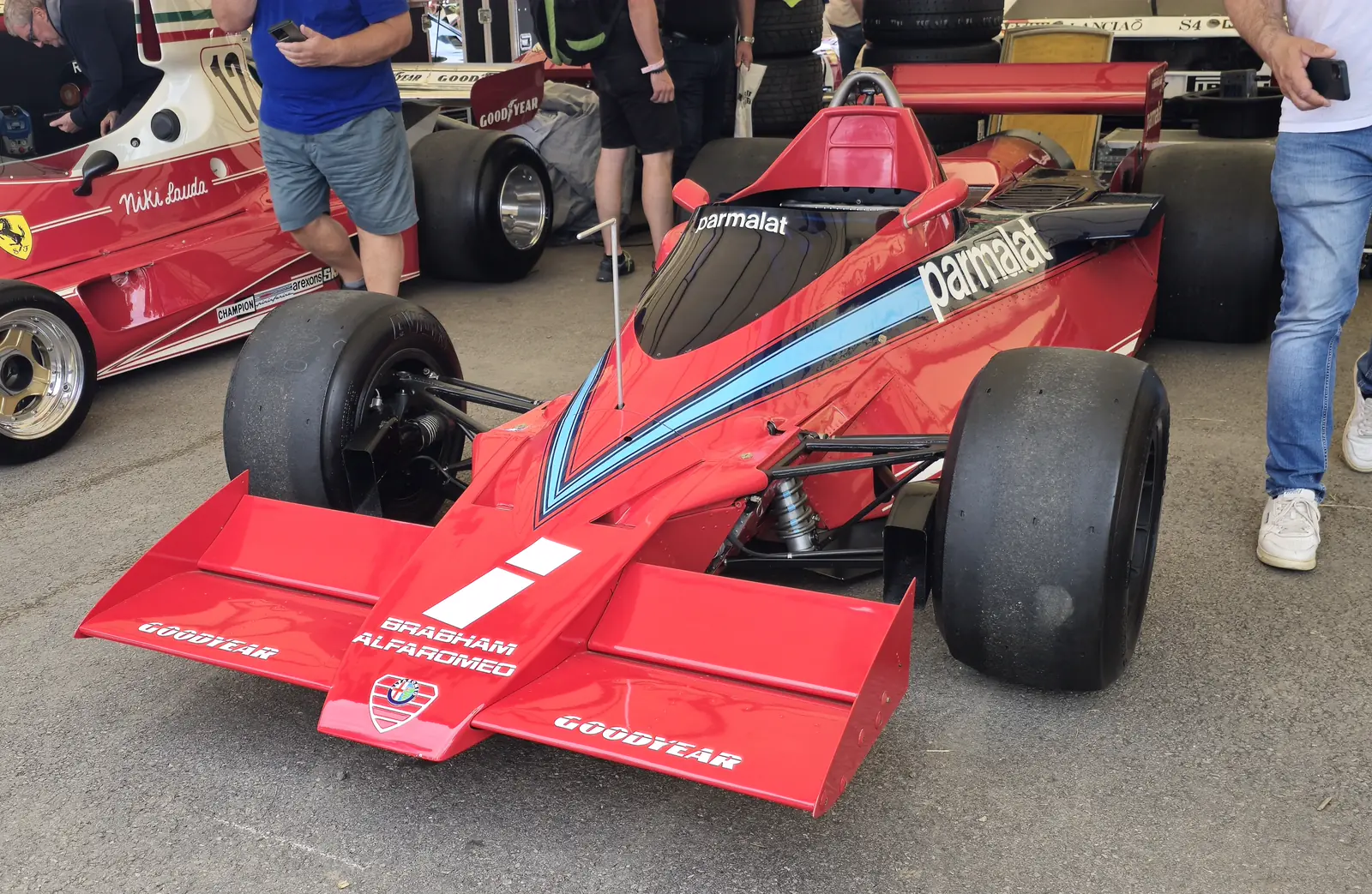
On June 17, 1978, at the Swedish Grand Prix, Austria’s Niki Lauda wins by 34.019 seconds. A two-time world champion with Ferrari in 1975 and 1977, he is racing that year for the Brabham team, in a car of a new kind: it carries a large fan at the rear, which the team hides under a trash can lid when the car is parked.
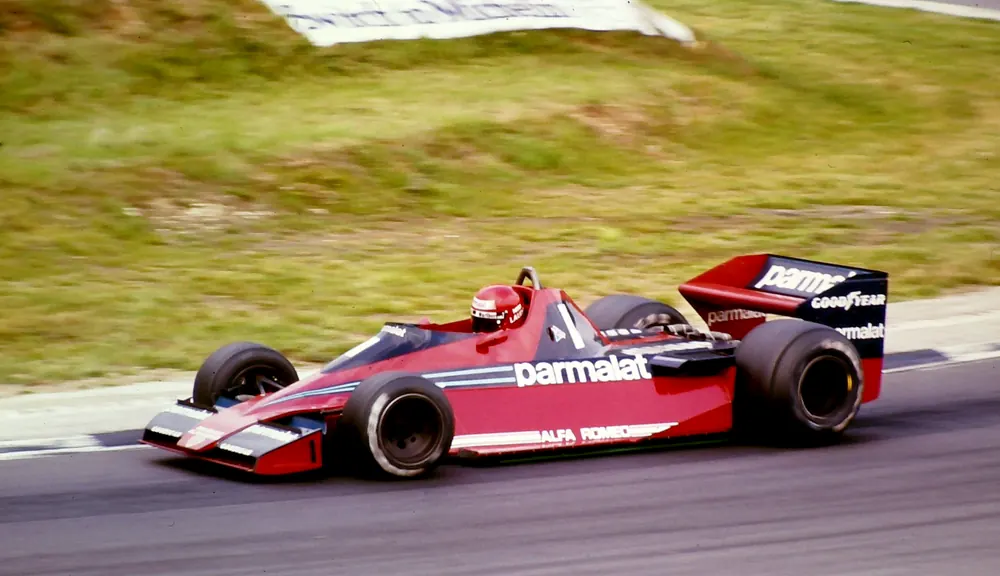

Ground effect, the weapon Brabham couldn’t copy
A race car goes faster through corners the more it is pressed against the track: that force is called downforce. In the late 1970s, Formula 1 discovers a new way to create it, ground effect. The underside of the car is shaped like an upside-down airplane wing: the air passing underneath speeds up, its pressure drops, and the car is sucked toward the track. On the sides, flexible skirts reach almost to the ground to keep outside air from filling that void.
At Lotus, the team’s founder, Colin Chapman, and the engineer Peter Wright work the idea out. Their 1977 Lotus 78, nicknamed the “wing car,” is the first attempt; the 1978 Lotus 79 takes it all the way, and is the first F1 car to take full advantage of it. Before the Swedish Grand Prix, it had taken pole position at every one of its races.
Across the way, Brabham belongs to the British businessman Bernie Ecclestone. Its chief engineer is Gordon Murray, who will design F1 cars at Brabham and then at McLaren. In 1978 he is looking to beat the Lotus, but he can’t copy it. Ground effect requires carving channels on each side underneath the car, where the air accelerates: Venturi tunnels. But the Brabham’s engine, an Alfa Romeo twelve-cylinder, has its cylinders laid flat, six on each side. It is therefore very wide, and it sticks out exactly where those tunnels should run.
The fan: a vacuum cleaner under the car
Murray’s answer: put a flat radiator on top of the engine, close off the rear of the car completely, and mount a fan at the end of the gearbox, driven by the gearbox. The fan sucks air from around the engine, but also from under the car. Flexible skirts seal the underbody at the front, on the sides, and at the rear: the vacuum created this way pins the car to the ground. In 1978, Motor Sport magazine speaks of the reverse of a hovercraft. The faster the engine turns, the stronger the suction. Brabham’s 1978 car is called the BT46; its fan version, the BT46B.
The idea had a precedent. In 1970, the Chaparral 2J was already sucking air with two fans, in the Can-Am, a North American sports car championship. In qualifying, it was up to 2.2 seconds ahead of the others, and it was banned as early as the end of the season: its rivals saw “movable aerodynamic devices” in it.
The rules trick: cool first
That leaves the rulebook, which forbids moving aerodynamic parts. In 2008, Murray explained how he read it:
“Article 3.7 said: ‘Any device whose primary function is to have an aerodynamic influence on the performance of the car has to be firmly fixed.’ So I had to ensure that more than half of the air was cooling the radiator.” Gordon Murray, Motor Sport, January 2008
On paper, then, the fan is there first to cool. The team had, in fact, already fitted a small electric one to its cars early in the season.
Anderstorp: a hidden car, then a win
The Grand Prix is run at Anderstorp, in Sweden. Brabham arrives with two BT46Bs: one for Lauda, the other for Britain’s John Watson. The rival teams file five official protests against the car; the organizers reject them all.
In qualifying, Ecclestone has his cars run with full fuel tanks, and so heavier, to avoid revealing their potential. Even so, Watson and Lauda start second and third, behind the Lotus of America’s Mario Andretti.
In the race, Lauda harasses Andretti for 37 laps and takes the lead on the 38th. Eight laps later, the Lotus’s engine blows. Watson, meanwhile, has already gone off the track.
| Pos. | Driver | Team and engine | Time / gap |
|---|---|---|---|
| 1 | Niki Lauda | Brabham-Alfa Romeo | 1:41:00.606 |
| 2 | Riccardo Patrese | Arrows-Ford | + 34.019 s |
| 3 | Ronnie Peterson | Lotus-Ford | + 34.105 s |
Patrese drives for Arrows, a team in its first season. Sweden’s Ronnie Peterson, Andretti’s teammate at Lotus, steps onto the podium in front of his home crowd.
The rivals protest. Andretti, in the British daily The Times of June 17, 1978:
“It is like a bloody great vacuum cleaner. It throws muck and rubbish at you at a hell of a rate.” Mario Andretti
Murray disputes this: according to him, the air came out of the fan at only 55 mph (90 km/h). Lotus nonetheless immediately starts studying a fan-equipped 79.
Legal, but withdrawn
The sporting arm of the FIA, then called the Commission Sportive Internationale (CSI) and which will become FISA in 1979, seals the car after the race, according to Murray, then comes to the factory to measure the airflow: 60% goes to cooling, 40% to downforce. It then writes to Brabham; Murray quotes the letter, attributing it to “the FIA”:
“The car is legal, but it’s using a loophole in the regulations. In next year’s rules we’ll close that loophole, but you can use it for the rest of the season.” Letter as reported by Gordon Murray, Motor Sport, January 2008
According to Murray, the pressure that will stop the car comes from elsewhere: from the teams themselves, gathered in FOCA, the Formula One Constructors Association. Ecclestone takes over its leadership in 1978; it is through FOCA that he will later win F1’s television contracts, then commercial control of the sport.
According to Terry Lovell, Ecclestone’s biographer, the other FOCA teams, led by Colin Chapman, threaten to withdraw their support from him unless he gives up the BT46B. Murray recounts:
“He reckoned the uproar was in danger of collapsing FOCA completely. So he asked me – he didn’t dictate – he asked me to fit normal radiators to the car. I was very pissed off, but I agreed.” Gordon Murray, Motor Sport, January 2008
At the very next race, both cars are back in their normal configuration, without the fan. An agreement among the teams was supposed to let the BT46B race three more times before its withdrawal. But the sporting authority of the day, the CSI, steps in: from now on, fan cars will no longer be admitted. The Swedish victory, for its part, is never taken away.
One Grand Prix, won
The BT46B ran only one championship Grand Prix, and won it. Andretti, for his part, regained the upper hand with the Lotus 79 and won the title.
Read also: Why F1 cars no longer refuel during races.
FAQ
Was the Brabham BT46B banned?
Not after the fact. It was ruled legal as it raced, and its victory stood. Brabham withdrew it itself, then the sporting authority announced that fan cars would no longer be admitted, and the loophole in the rules was closed for 1979.
How did the BT46B’s fan work?
Driven by the gearbox, it sucked air from the engine compartment and from underneath the car. Flexible skirts sealed the underbody: the low pressure pulled the car down onto the track, the opposite of a hovercraft.
Who drove the Brabham BT46Bs?
Niki Lauda (chassis BT46/6) and John Watson (BT46/4), at the 1978 Swedish Grand Prix. Lauda won; Watson, who started 2nd, went off the track.
How many races did the BT46B run?
Just one championship Grand Prix, which it won with Niki Lauda; the second BT46B, John Watson’s, went off the track. A fan version raced a second time, outside the championship, at Donington Park in 1979.
Keep exploring
Main sources
- 1978 Swedish Grand Prix, race result — Formula 1 (formula1.com)
- Swedish Grand Prix (rapport de course, juillet 1978) — Motor Sport
- Lunch with… Gordon Murray (janvier 2008) — Motor Sport