Why Don’t F1 Cars Refuel During Races Anymore?
Banned in 1984, reinstated in 1994, banned again in 2010: the FIA cited cost, while recent articles talk about safety.
Published November 18, 2026 · Facts checked November 18, 2026
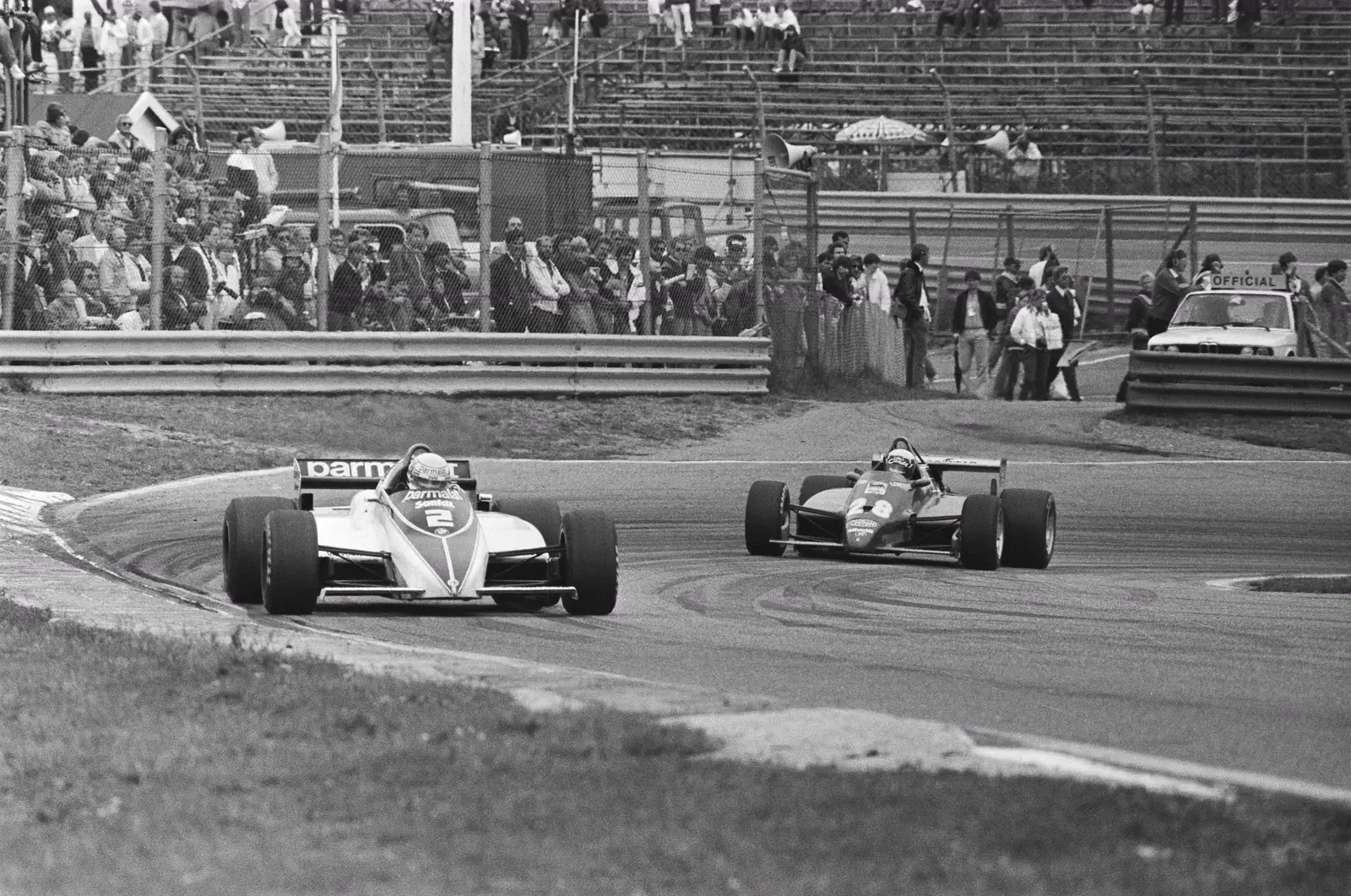
On August 15, 1982, at the Austrian Grand Prix, Riccardo Patrese pits on lap 24 while leading the race. The Brabham mechanics change all four wheels and pour fuel into the tank. About fifteen seconds later, Patrese rejoins, still in first. Since the early 1960s, though, a stop in the middle of a Grand Prix had cost the win. His engine fails three laps later, but the stop itself worked.
1982: Brabham starts half empty
Brabham is then owned by businessman Bernie Ecclestone. Its BT50 is the work of engineer Gordon Murray.
The car’s turbocharged BMW engine drinks heavily: to last a full Grand Prix, the car would have to start very heavy. The team chooses the opposite. It starts with a half tank and accepts losing time in the pits.
The math comes down to two gains. Lighter, the car can run a softer, faster tire without destroying it before halfway. And the drivers can raise the turbo boost pressure, and so burn more fuel, since they know they will be refueled.
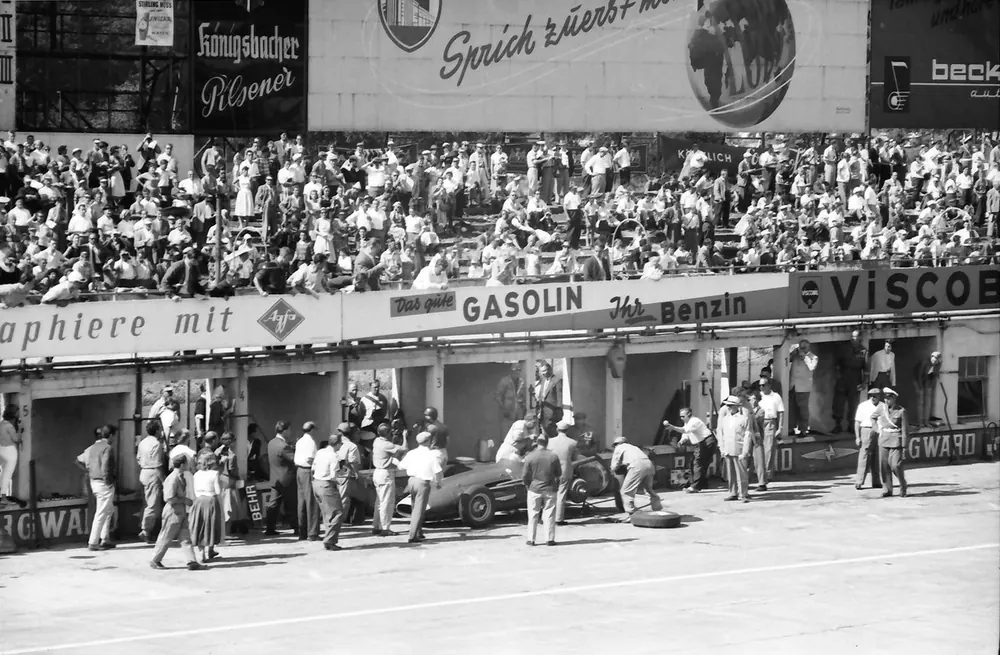
Stopping for fuel was nothing new. As early as 1957, at the German Grand Prix, driver Juan Manuel Fangio had taken a half tank and softer tires, planning to stop. Brabham turned it into a prepared strategy, with its own equipment and rehearsals.

The first attempt in a race came a month earlier, at the British Grand Prix at Brands Hatch, on July 18, 1982. The mechanics pull pressurized fuel cans out of the truck, under the gaze of the whole pit lane, and jacks are fitted to the cars. But Patrese stalls at the start, and his teammate Nelson Piquet retires on lap 9, before he has been able to stop.
The equipment is homemade. Charlie Whiting, then at Brabham, remembers:
“We started doing it with old beer barrels, which we pressurised. It was pretty crude, but it worked very well.” Charlie Whiting, Motor Sport, January 2006
Herbie Blash, also at Brabham, puts it more bluntly in the same interview: “It was a bomb, literally a bomb waiting to go off.”
The idea is usually credited to Murray. Whiting credits another man on the team, Dave North, who supposedly did the calculations.
1984-1993: banned, then reinstated despite almost every team
In 1983, the other teams copy Brabham. F1’s rules are then written by FISA, the sporting body of the Fédération Internationale de l’Automobile (FIA). The tank is limited to 66 gallons (250 liters).
For 1984, FISA limits the cars’ fuel capacity to 58 gallons (220 liters). It also bans refueling during the race. Motor Sport gives the reason in 1994: safety, given growing fears for the mechanics.
Refueling returns in 1994, after a long negotiation. In 1993, Max Mosley, president of FISA, wants to ban electronic driver aids; the discussion with the teams drags on for months. According to Frank Williams, boss of the team that bears his name, Bernie Ecclestone then slips the return of refueling in at the end of the agenda of a long meeting at Hockenheim.
Almost no team wants this return. After the meeting, they band together to get refueling dropped, but cancellation requires unanimity, and Ferrari, alone in defending it, blocks it. The FIA World Motor Sport Council ratifies the package, refueling included, on October 13, 1993.
The website RaceFans offers another reason for the return in 2009: to spice up races judged dull in 1992 and early 1993.
Hockenheim 1994: fire in the pits
Before the season, McLaren boss Ron Dennis worries in Motor Sport:
“The chances are there will be a conflagration” Ron Dennis, Motor Sport, March 1994
On July 31, 1994, at the German Grand Prix at Hockenheim, 22-year-old Dutchman Jos Verstappen, teammate of German Michael Schumacher at Benetton, pits on lap 15. During refueling, fuel sprays onto the hot bodywork. A few seconds later it ignites and the car disappears in a fireball. Verstappen, who had raised his visor, gets away with minor burns to his face; several mechanics are hurt, none with lasting serious injury.
The FIA and Benetton give two versions of the accident. On August 10, the FIA publishes a statement: according to Intertechnique, the company that supplies the refueling equipment, Benetton illegally removed a filter from the system, and that was the cause of the fire. Benetton replies that it had permission and blames a faulty valve.
On September 7, the World Council rules: the filter was indeed removed, by a junior employee acting on his own initiative. No penalty is imposed.
After this fire, the refueling hose gets an automatic shutoff system.
Nine years later, on May 18, 2003, at the Austrian Grand Prix, a fire breaks out on Schumacher’s car during his refueling; the shutoff works. The FIA keeps refueling. Its president, Max Mosley, explains himself to the BBC:
“If there is to be a fire, then better in the pitlane where it can be dealt with efficiently and expertly than somewhere out on the track.” Max Mosley, BBC Sport, May 2003
2009: the FIA talks money
The end is decided in the middle of the global financial crisis. In October 2008, FOTA, the association of the teams, is already considering eliminating refueling.
On December 12, 2008, the FIA announces a series of cost-cutting measures. The 2009 measures are meant to cut the budgets of the manufacturer teams by about 30%. For 2010, it is the refueling ban that makes the headlines.
On April 29, 2009, an extraordinary World Council meeting in Paris confirms this ban. The FIA’s statement, picked up by Autosport the next day, gives two reasons:
“It was confirmed that from 2010, refuelling during a race will be forbidden in order to save the costs of transporting refuelling equipment and increase the incentive for engine builders to improve fuel economy (to save weight)” FIA statement, April 29, 2009
Engine builders are the engine manufacturers: the less an engine consumes, the less fuel the car has to carry, and so the lighter it is. As for transport, it is expensive: according to RaceFans, each team ships two refueling rigs around the world, at least twenty in all.
Those years also saw accidents in the pits. In Singapore in 2008, driver Felipe Massa drives off with the fuel hose still attached to his car. In Brazil in 2009, driver Heikki Kovalainen does the same, and the sprayed fuel catches fire on Kimi Räikkönen’s Ferrari.
The FIA’s statement says nothing about safety. The press does: in April 2010, journalist Adam Cooper recalls in Motor Sport that “the threat of a catastrophe was always present.” In 2026, the same magazine describes a decision made mostly for safety and cost, after a series of pit fires.
2010: cars designed for a single fill-up
With no fuel stops, each car must start with enough to finish the race. Before 2010, teams designed their cars for roughly 187 to 198 lb (85 to 90 kilos) of fuel; Adam Cooper later cites around 386 lb (175 kilos), a figure that varies by engine builder. That fuel has to go somewhere, and chassis grow longer and wider.
The 2010 sporting regulations spell it out in one line, in article 29.1 c:
“Fuel may not be added to nor removed from a car during a race.” F1 sporting regulations, 2010
Filling now happens only in the garage, at 0.2 gallon (0.8 liter) per second at most. In 1994, Intertechnique’s equipment had to deliver about 5 gallons (20 liters) per second. Pit stops themselves remain: in a dry race (no rain), tires still have to be changed.
2026: a comeback under study
Refueling remains banned in 2026. In July, at Silverstone, FIA president Mohammed Ben Sulayem reopens the subject, in remarks picked up by the Reuters news agency:
“The refuelling we are studying as we speak. It’s not a concern if you do it in the right way. So we are studying this. Nothing is being done yet.” Mohammed Ben Sulayem, Reuters, July 2026
The idea would be to run lighter cars, and Ben Sulayem talks about sustainable fuel. At the end of August, several team bosses say no. Peter Bayer, boss of Racing Bulls and former FIA secretary general, cites the conclusions of a working group of the FIA and F1:
“[…] other than a couple of very spectacular and dangerous images, refuelling has not done really anything for the sport because most of the overtaking suddenly took place in the pit lane.” Peter Bayer, RaceFans, August 2026
James Vowles, boss of Williams, doesn’t think it’s the right solution either, and jokes: “It’s quite warm wearing a race suit when you’re on the pit wall, so I’d prefer not to do that again!”
Related reading: The Brabham fan car, winner of a single Grand Prix.
FAQ
Since when has refueling been banned in F1?
Since the 2010 season. The last race with refueling stops was the Abu Dhabi Grand Prix on November 1, 2009. Refueling had already been banned once before, from 1984 to 1993.
Was refueling banned because of Jos Verstappen’s fire?
Not according to the FIA, whose 2009 statement talks about costs and fuel consumption. Refueling in fact lasted fifteen years after Hockenheim. Michael Schumacher’s fire in Austria in 2003 was the fourth since his return, and the least serious.
From what point is an F1 car no longer allowed to touch its fuel?
According to the 2026 sporting regulations, article B5.1.4, as soon as it leaves the pit lane for its reconnaissance lap, and until the signal marking the end of the session. The rule applies to the race and to the Sprint.
What stop time was announced for refueling in 1994?
Before the 1994 season, Motor Sport predicted that a fill-up would take about five seconds, as much as the best tire change. It was a forecast, made before the first Grand Prix.
Keep exploring
Main sources
- Refuelling ban confirmed for next season (Pablo Elizalde, 30/04/2009) — Autosport (archive web du 03/05/2009)
- They stop to conquer (novembre 2007) — Motor Sport
- 2026 Formula 1 Regulations, Section B, Sporting (Issue 09) — FIA