Tyrrell P34: Why Six Wheels, and Why Never Again?
Four small wheels up front, one win in Sweden, then nothing: the story of an engineer’s gamble and what doomed it.
Published November 18, 2026 · Facts checked November 18, 2026
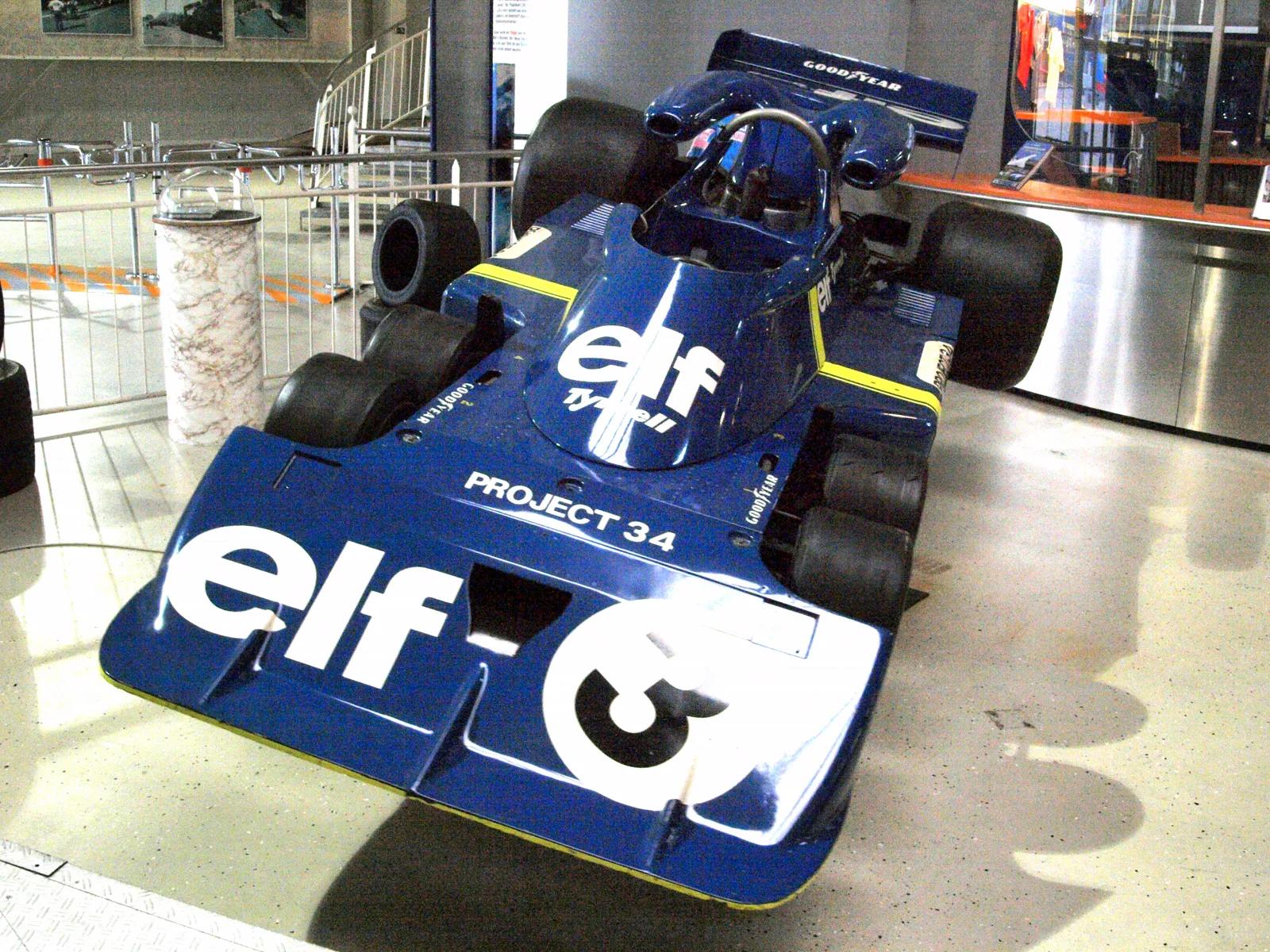
One day, Ken Tyrrell, boss of the British team that bears his name, phones Denis Jenkinson, a journalist at Motor Sport magazine: he has something to show him. Jenkinson rides his motorcycle to Tyrrell’s house in West Clandon, drinks coffee, then follows his host out onto the lawn. There he finds a six-wheeled Formula 1 car, with four tiny wheels at the front. Jenkinson, who was never at a loss for words, is speechless; Tyrrell bursts out laughing.
That car, the Tyrrell P34, would win a Grand Prix. It owes its six wheels to a calculation about the air that lifts the front of an F1 car. Tyrrell abandons it at the end of 1977, for lack of front tires that nobody was developing anymore; from 1983, a rule keeps anyone from trying again.
Gardner’s calculation: front wheels that lift the car
The car’s father is Derek Gardner, Tyrrell’s chief designer. In the mid-1970s, his team races with the same engine as almost everyone else, Ferrari excepted: the Cosworth DFV, a 3-liter V8. Gardner said so in 2001:
"Then we found ourselves in the ’70s and in a strait-jacket. Almost everyone out there had the same engine, the same gearbox, the same tyres: we needed to find a way out, we needed an unfair advantage, and the six-wheeler was it." Derek Gardner, Motor Sport, February 2001
On a conventional F1 car, the front wheels spin in the open air, on either side of the nose. Gardner calculates that they produce lift: they tend to raise the front of the car. Four small wheels tucked within the width of the bodywork produce less. The front then needs less wing to stay planted on the ground. Gardner put a number on the gain:
"Hey presto! My calculation was that that would equate to 40-odd horsepower." Derek Gardner, Motor Sport, February 2011
That figure comes from no test bench: it is, translated into engine power, what the car gained from carrying a less heavily loaded front wing. A calculation, not a measurement. Gardner does, however, dismiss the most widespread explanation, a smaller frontal area (the area the car presents to the air): that depends mostly on the enormous rear tires.
Why four small wheels rather than two? The second pair puts more rubber on the road and adds braking surface. These small wheels also spin much faster than the big ones: the brakes cool better and the pads wear far less.
Leo Mehl, racing boss at Goodyear, which already supplies Tyrrell’s tires, asks Gardner what size he wants. Gardner would ideally like 9 inches; they settle on 10 (254 mm), the size of a Mini wheel.
A 1968 idea, kept secret
The idea is not new. According to Gardner, it dates to 1968, when he was trying to stabilize the Indianapolis Lotus, a turbine-powered, four-wheel-drive car. His drawing from the end of that year already shows four wheels at the front and two at the rear. The project came to nothing.
Again according to Gardner, one of the first to hear about the six-wheeled F1 car is Jackie Stewart, a three-time world champion, by then retired. On the way back from the 1975 South African Grand Prix, Gardner slips into first class to explain his idea to him. Stewart chokes: Gardner doesn’t know whether it was the turbulence or what Stewart was drinking.
In September 1975, the team presents the car to the press in a hotel near Heathrow Airport. According to mechanic Neil Trundle, cardboard wheels had been put on the front so it would pass, under its cover, for a four-wheeler. The cover is pulled off; several journalists think it’s a prank. The team insists: this test prototype complies with the F1 regulations as written. Ken Tyrrell would tell how Leo Mehl later wrote to him that the announcement alone was worth the money Goodyear had spent.
In racing: a win in Sweden
Testing quickly reveals the flaws. At Silverstone, Gardner watches in horror as the small tires seem to be sucked off their rims: as soon as the driver brakes, they sag onto the rim. Yet they never lose their pressure, and the drivers, he says, fortunately couldn’t see it. The brake calipers, jammed inside such small wheels, run hot.
The P34 debuts at the Spanish Grand Prix, at Jarama, on May 2, 1976, the fourth round of the championship. Only one car is entered, for France’s Patrick Depailler: he starts third. South Africa’s Jody Scheckter, who stayed in the old Tyrrell 007, starts fourteenth. Depailler retires after 25 laps. At Monaco, the two P34s finish second and third, behind Niki Lauda’s Ferrari.
On June 13, 1976, at Anderstorp, Sweden, Scheckter starts from pole position. Mario Andretti, in a Lotus, who started second, retires after 45 laps with a blown engine. Scheckter wins, and Depailler finishes second, 19.770 seconds back. It is the only win by a six-wheeled car in a Grand Prix.
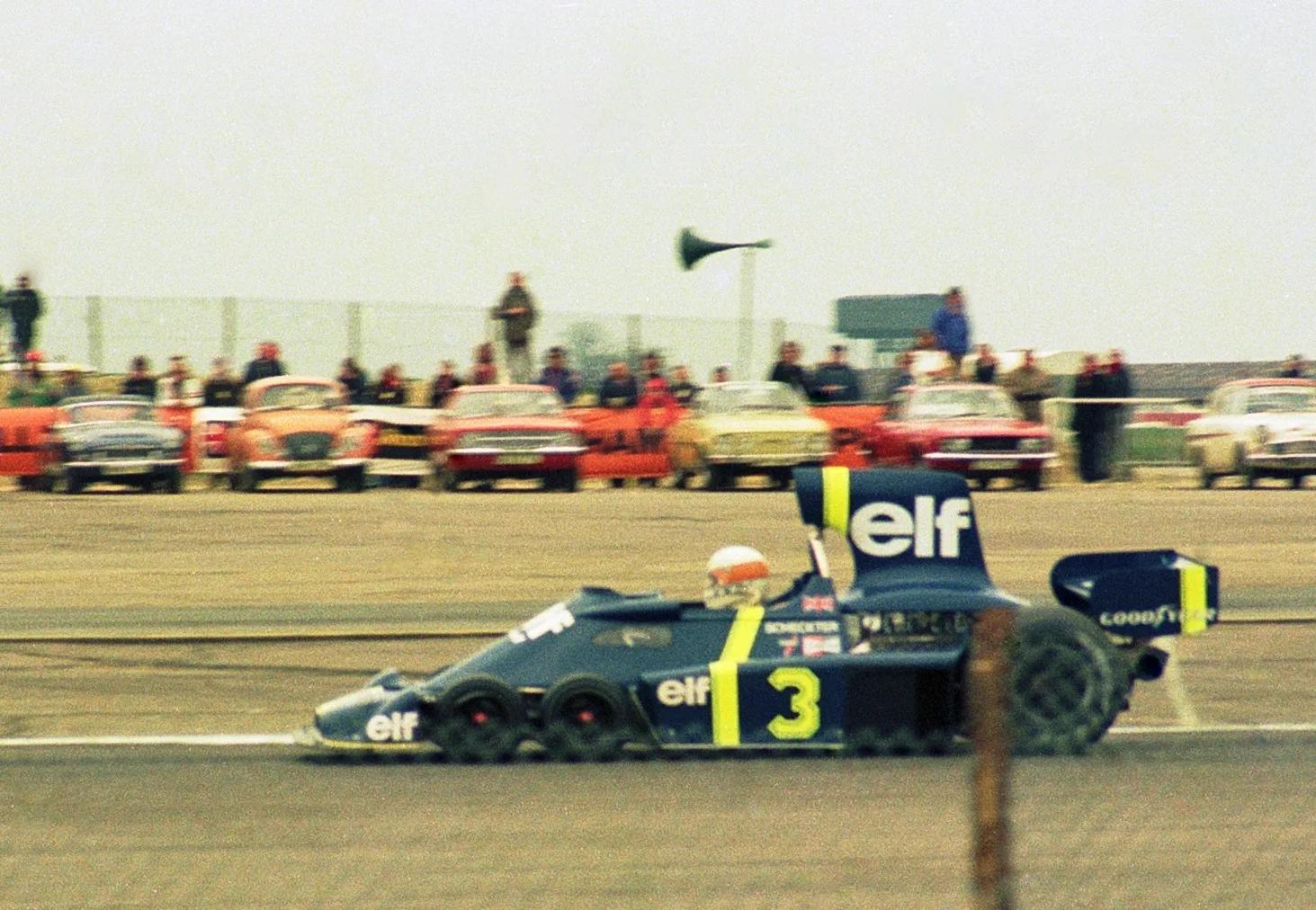

Depailler, according to Gardner, took to the car immediately and loved everything about it. Scheckter has changed his mind over the years:
"It was a rubbish car." Jody Scheckter, Motor Sport, February 2001
"It was a fun car to drive." Jody Scheckter, Autosport, April 2019
He leaves Tyrrell for the Wolf team: he didn’t buy into the logic of the six-wheeler, he says, and the team listened more to Depailler than to him.
1977: front tires nobody was developing anymore
For 1977, Sweden’s Ronnie Peterson replaces Scheckter, and the P34B gets heavier. Above all, Goodyear now supplies all of F1, and every team demands better-performing tires. The small front tires, made for Tyrrell alone, fall behind:
"Therefore we were working with developed rears and static fronts: in ’77 that really began to show up, and the advantage of the six-wheel concept was going rapidly out of the window." Derek Gardner, Motor Sport, February 2011
Other accounts report that Tyrrell himself blamed the car’s weight instead. Late in the season, the front wheels are moved apart to fix the handling: they come out from behind the shelter of the bodywork, and the original idea loses its point. The season yields one second place and three thirds, with no win.
Gardner leaves Tyrrell, and F1, right after the 1977 Italian Grand Prix: the P34 is his last car. His successor, Maurice Philippe, goes back to four wheels with the 008, which wins at Monaco in 1978 with Depailler.
The other six-wheelers, and the 1983 rule
Three other teams tried the opposite of Tyrrell: two wheels at the front, four at the rear, all four driven by the engine. None started a Grand Prix, and each ran into its own obstacle.
At March, on its first test, at Silverstone in late 1976, the gearbox casing twists on the very first lap, and the car ends the day with only two driven wheels.
At Ferrari, the 312T6, tested in 1977 on the private Fiorano track, is far wider than the rules allow. Reutemann told Alan Henry that on the twelfth lap, after a bump, it veered sharply left into the guardrail and caught fire.
At Williams, in 1981 and 1982, the six-wheeler answers a shortcoming: the team has no turbo engine, far more powerful than its V8, and looks elsewhere for speed. Its four rear wheels, the size of the front wheels, reduce drag, the resistance of the air: at the time, the rear tires alone produced about 40 percent of it.
The Williams, for its part, is stopped dead: the 1983 technical regulations state that "The number of wheels is fixed at four" and that "Four-wheel drive cars are forbidden."
Frank Dernie, Williams’ chief engineer, remembers mostly the second rule:
"It wasn’t banned because it was a six-wheeler. It was banned because it was a 4WD." Frank Dernie, Motor Sport
According to him, the teams had agreed at a FOCA meeting, the constructors’ association, that they didn’t want one. Elsewhere, he gives another reason: if the Williams proved competitive, every team would have had to build a six-wheeler, at great expense and at least a year behind. "Eight wheelers?" he even wonders.
The rule still stands. The 2026 technical regulations describe an F1 car that "runs on four non-aligned Complete Wheels," and state: "The transmission may only drive the two rear wheels."
Test yourself on racing legends
Read also: Brabham BT46B, the fan car: why only one GP?
FAQ
Was the Tyrrell P34 banned?
No. The 1976 race version was described by the press of the day as compliant with all the rules. Tyrrell went back to four wheels of its own accord in 1978; the four-wheel rule did not arrive until 1983.
What was the Tyrrell P34’s race record?
30 Grands Prix over two seasons (13 in 1976, 17 in 1977), one win, one pole position and 14 podiums (10 in 1976, 4 in 1977). In 1976, Scheckter and Depailler finished third and fourth in the championship, and Tyrrell was third in the constructors’ standings with 71 points, three fewer than McLaren.
Could P34 drivers see their front wheels?
Not at first: from the seat, they couldn’t see them. Worried that drivers were misplacing the car in corners, Derek Gardner had small windows cut into the sides of the cockpit. The driver could see his front tires through them and keep an eye on their condition.
Why is the car called the P34?
P34 stands for "Project 34," the name under which Tyrrell presented it to the press in 1975, instead of its usual chassis numbering. Asked at the time by a journalist, Ken Tyrrell answered, giving nothing away, that it was only a working name for the next car.
Keep exploring
Main sources
- P34: The real story behind Tyrrell’s incredible six-wheeler F1 car (février 2011) — Motor Sport
- 1976 Swedish Grand Prix, race result — Formula 1 (formula1.com)
- 2026 Formula 1 Regulations, Section C: Technical (Issue 21) — FIA