Why Did F1 Ban Ground Effect in 1983?
A March in the crowd, drivers battered, a rule dodged: what pushed FISA to impose the flat bottom on 1983 F1 cars.
Published November 18, 2026 · Facts checked November 18, 2026
On July 25, 1982, on lap 11 of the French Grand Prix at the Paul Ricard circuit, German driver Jochen Mass, in a March, touches Mauro Baldi’s Arrows at the Signes corner. The March ends up in the crowd. A few spectators are injured; none is killed.
In the fall, Formula 1 bans ground effect, the suction that pulls cars onto the track from underneath and lets them take corners ever faster. The decision comes from FISA, the sporting arm of the Fédération Internationale de l’Automobile, which writes the rules, and from its president, Jean-Marie Balestre. It takes effect from the first race of 1983.
Denis Jenkinson gives the reason while events are still fresh. He wrote it, under the signature D.S.J., in the British magazine Motor Sport in December 1982:
“Nobody was too worried about the outcome to the driver, for that was his known risk, but there was real fear that spectators could be injured or killed by an out of control car.” Denis Jenkinson, Motor Sport, December 1982
Jenkinson cites two warnings: Paul Ricard, and Zandvoort in the Netherlands, where a suspension part broke on René Arnoux’s Renault and he narrowly missed ending up in the crowd. In his view, FISA’s leaders had no choice left: cornering speeds had to come down, which meant going after what had pushed them up.
An upside-down airplane wing under the car
Ground effect arrives in F1 with the 1977 Lotus 78, designed by Colin Chapman’s team. The underside of the car is shaped like an inverted airplane wing: instead of lifting the car, the air passing underneath sucks it toward the track. Skirts, strips that reach down to the ground along the sides, seal the space to keep that suction. In 1978, the Lotus 79 pushes the principle further, and American Mario Andretti turns it into his world championship car.
These cars have a flaw: their downforce, the force that pins them to the ground, is never constant. If a skirt shifts or breaks, it can vanish entirely; if the floor touches the track, the car loses all grip in the middle of a corner.
1981: a first ban, immediately sidestepped
Balestre didn’t discover the problem in 1982. For the 1981 season, FISA already bans moving skirts and requires a 2.4 in (6 cm) gap between the car and the ground. Its argument is safety: cornering speeds are becoming, in its view, uncontrollable.
The rule hits hardest the teams of FOCA, the constructors’ association, mostly British, led by Bernie Ecclestone. According to Tony Dodgins, writing in Autosport magazine in 2009, ground effect was the only way for these small Cosworth-powered teams to stay anywhere near the turbo-powered constructors like Renault and Ferrari.
Gordon Murray, the designer of the Brabhams, finds the loophole: hydraulic suspension. Standing still, his car respects the 2.4 in (6 cm); on the track, it lowers itself until it nearly scrapes the ground, still fitted with skirts. FISA accepts the system, then, in 1982, tolerates skirts again, provided they are fixed.
For fixed skirts not to wear out in a few laps, the car has to stay at a constant ride height. Designers therefore eliminate almost all suspension movement. Several drivers suffer back pain, and FISA’s doctors worry, but no designer agrees to soften his springs at the cost of his ground effect. In Rio, in March 1982, Ferrari driver Gilles Villeneuve describes his car to journalist Nigel Roebuck:
“You know how much I love driving, but I hate these cars. There are moments when you lose vision – everything goes blurred. […] There is no suspension – your legs are flung around in the cockpit, your head hits the rollover bar…” Gilles Villeneuve, as reported by Nigel Roebuck, Motor Sport, May 2010
1982, a season of tragedies
Villeneuve doesn’t see the end of the season. On May 8, in qualifying for the Belgian Grand Prix at Zolder, he hits Mass’s much slower March; his Ferrari flies through the air and he dies that evening. On August 7, at Hockenheim, in the rain, Didier Pironi, also in a Ferrari, runs into the back of Alain Prost’s Renault, which is slowing in the spray. The car takes off, and Pironi will never race again.
These are two collisions with slower cars, but they weigh on the mood. After the last race, on September 25 in Las Vegas, FISA circuit inspector Derek Ongaro confides in Roebuck:
“I’ve hated every second of this season. […] There’s something very wrong when the chequered flag comes down and all you feel is relief that another race weekend is out of the way without someone getting killed…” Derek Ongaro, as reported by Nigel Roebuck, Motor Sport, May 2010
What the 1983 regulations say
Tony Dodgins dates the decision to November 3, 1982, in Paris, at a meeting of FISA’s F1 commission. The text goes into the 1983 technical regulations, in articles 3.3 and 3.7:
“Between the rear edge of the complete front wheels and the front edge of the complete rear wheels all sprung parts of the car visible from directly beneath the car must lie on one plane within a tolerance of ± 5 mm.” F1 technical regulations, FIA, 1983
In other words, between the wheels the underside has to be flat, to within 5 mm (0.2 in). The same text requires a solid, rigid, watertight surface, and prohibits under any circumstances any device that fills the space between the car and the ground. Skirts are gone for good.
One winter to redraw everything
A little over four months remain before the first race. Yet the rules allowed a change only on the third January 1 after their publication, unless the FIA and all the constructors agreed. In Dodgins’s view, Balestre trampled this stability rule in the name of safety.
The teams protest: there isn’t enough time. The organizers of the South African Grand Prix, scheduled for February 12, then agree to push their race back to the end of October. Jenkinson reports that this postponement calmed the malcontents and that common sense eventually prevailed on all sides. The season will open in Rio on March 13.
Murray has to give up the Brabham BT51, designed for ground effect. He remembers it in 2020:
“Then: no skirts! Everything on BT51 – centres of gravity and pressure – was in the wrong place now. For the first time, I was absolutely on the back foot.” Gordon Murray, Motor Sport, May 2020
Rio, March 13, 1983
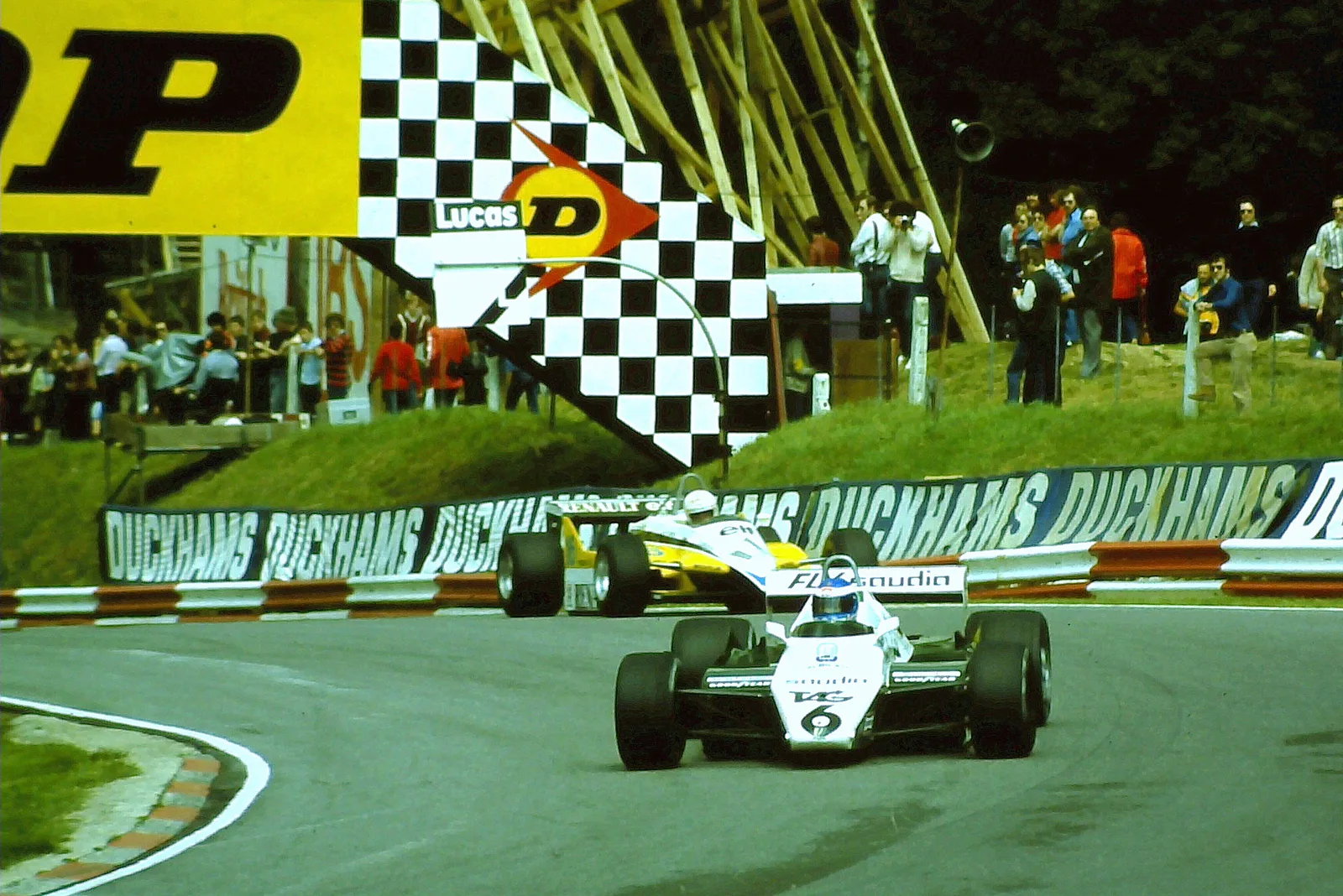
At Jacarepaguá, the Rio de Janeiro circuit, reigning world champion Keke Rosberg takes pole position in his Williams with a 1:34.526. A year earlier, at the same track, Prost had taken it in a Renault with a 1:28.808. This time Prost runs an updated version of his 1982 car and manages only 1:34.672: almost six seconds vanished in one winter.
The rules don’t explain everything: in Friday qualifying, the air temperature approaches 109 °F (43 °C). And the 1982 time had itself just beaten the 1981 pole, the year of the 2.4 in (6 cm) rule, by more than six seconds.
The rule only applies between the wheels, anyway. As early as December 1982, Jenkinson sees designers looking for downforce ahead of the front wheels and behind the rear wheels. In Rio, one team has already recut the sides of its car into ducts that send air through the rear suspension, to press down the rear of the flat bottom.
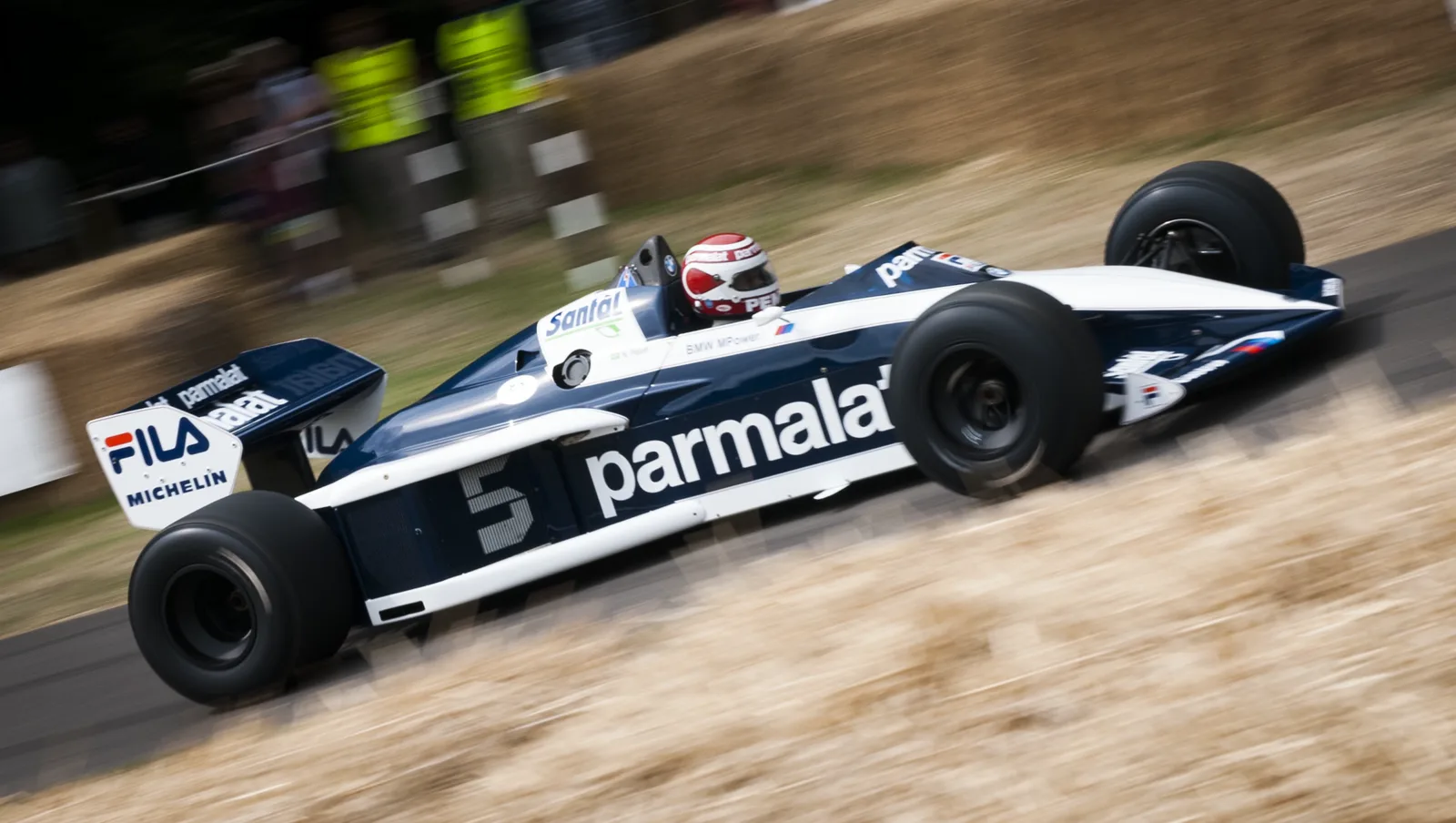
The balance of power changes too. Behind Rosberg’s Williams-Cosworth, the next seven cars on the grid all have a 1.5-liter turbo engine. The race is won by Nelson Piquet, in 1 hour 48 minutes 27.731 seconds, in the Brabham-BMW BT52 that Murray designed for the flat bottom. Rosberg, second on the track, is disqualified after his car was push-started in the pits. At the end of the year, Piquet is world champion: the first drivers’ title won with a turbo engine.

Related reading: Brabham BT46B, the fan car: why just one GP?
FAQ
Did Gilles Villeneuve’s death cause the ban on ground effect?
That isn’t the reason journalists of the time give. Denis Jenkinson, who explained the decision in December 1982, doesn’t mention the Zolder accident. Tony Dodgins of Autosport magazine instead lists Jochen Mass’s trip into the crowd at Paul Ricard among the triggers.
How long did Brabham take to build the BT52?
Gordon Murray and journalist Mark Hughes don’t give the same figure. In December 1983, Murray spoke of three and a half months of nonstop work, seven days a week. In 2018, Hughes wrote on F1’s official site that the car was designed and built in six weeks.
What else changed in the 1983 rules?
The same regulations set the number of wheels at four. Williams, which was then testing a six-wheeled F1 car, had to abandon its project.
Did ground effect come back to F1?
Yes. According to Motor Sport magazine, the 2022 technical regulations created a new generation of F1 cars whose performance rests above all on aerodynamics, and more precisely on ground effect. Skirts did not come back: it is the shaped underside of the car that does the work.
Keep exploring
Main sources
- The Formula One Scene (décembre 1982), par Denis Jenkinson — Motor Sport
- Formula One technical regulations 1983 — FIA (base historique des règlements)
- The 1980s (mai 2010), par Nigel Roebuck — Motor Sport