ArticlesEngineering7 min read
Why Do an F1 Car’s Carbon Brakes Have to Get Hot?
From the Concorde’s brakes to discs drilled with a thousand holes: why F1 has to heat its carbon brakes without letting them burn.
Published November 18, 2026 · Facts checked November 18, 2026

At McLaren, back when the team is trying its first carbon brakes, its designer John Barnard watches the test at dusk. The car arrives at the braking zone, and the wheel lights up from the inside:
“With the carbon brakes you’d suddenly see this orange light bulb switched on inside the wheel…. It literally looked like that, the heat would build up so rapidly.” John Barnard, as reported by Doug Nye, Motor Sport, 2017
As soon as the driver lifts off the pedal, the bulb goes out all at once.
A Brake That Only Works Well Hot
An F1 brake is carbon-carbon: carbon fibers bound by carbon, rather than by a resin as in a chassis. The disc and the pads, the parts the caliper clamps against it like a pair of pincers, are made of the same material.
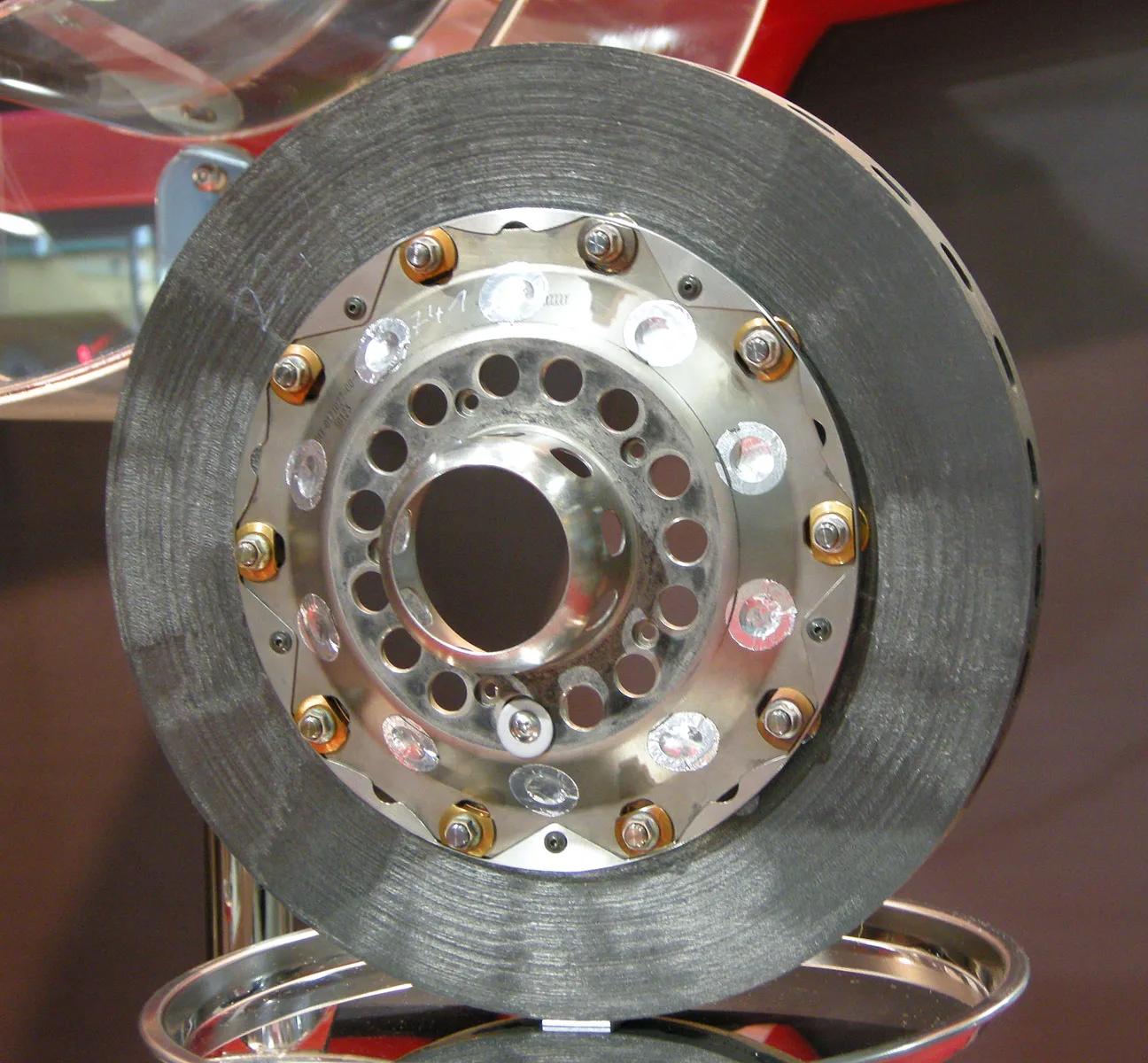

This material brakes poorly while it’s cold. Technical journalist Mark Hughes wrote it in 2018 with Giorgio Piola, on F1’s official website: the disc doesn’t give enough stopping power before it has reached about 750°F (400°C), and, well beyond 1,470°F (800°C), it starts to oxidize. So the brake only works well within a temperature window. That window moves with the carbon blend: each manufacturer places its own.
On paper, carbon-carbon withstands 4,530°F (2,500°C); in a race, in contact with air, the disc burns and gradually evaporates, well before that. So before the first big braking zone, the driver has to bring his brakes into the window, and during the race, the team has to keep them from leaving it at the top end.
From Concorde to Brabham, the First Failures
The idea comes from aviation. In 1975, Gordon Murray, chief designer at the Brabham team, reads in an aviation magazine the description of the carbon-carbon brakes Dunlop developed for the Concorde. Lighter than metal, they hold heat without losing effectiveness: on paper, an F1 designer’s dream.
Brabham puts them on track in 1976. Dunlop fears how carbon behaves under heat and designs a hybrid setup: a steel disc carrying twenty carbon pads, ten on each face.
It is this mix that fails at the 1976 Austrian Grand Prix. On Carlos Pace’s Brabham, steel and carbon don’t expand in the same way: a disc warps and rubs against the caliper. The heat boils the brake fluid. Pace presses the pedal, which goes all the way to the floor without braking, and the car, destroyed, ends up in a barrier.
In 1980, for the Brabham BT49, Murray starts from scratch with the American company Hitco: solid, all-carbon discs. This brake is used at first for testing and qualifying. Murray remembers it, as reported by Doug Nye, columnist for Motor Sport magazine: the material oxidized as soon as it went just past 1,560°F (850°C), in the very air the team was sending to cool it.
“We could run 60 or 70 laps with negligible brake wear and perfectly adequate performance and then in just two qualifying laps the driver might exceed that critical temperature and the material would simply dissolve! The brake would end up like a piece of ragged, floppy cloth – total scrap!” Gordon Murray, as reported by Doug Nye, Motor Sport, 2017
So Brabham keeps conventional cast-iron brakes on circuits that are hard on brakes, like Monaco and Montreal, and reserves carbon for gentler circuits, like Monza. The other teams want the technology, but Hitco is tied to Brabham by an exclusive contract: McLaren turns to the French company Carbone Industrie, which makes it ventilated discs, better cooled.
In 1983, Hitco brakes help Nelson Piquet, a Brabham driver, become world champion. At the end of that season, Brabham finally trusts carbon alone.
Two Carbons, Two Ways to Heat Up
Disc makers haven’t all made the same compromise. Andrea Algeri, head of F1 customers at Italy’s Brembo, summed it up in 2025:
“When you design a material, you can master being perfect at very low temperature, or perfect at very high temperature and stable in the middle.” Andrea Algeri, Brembo, The Race, 2025
Brembo says that from its beginnings in carbon, it chose a material that’s easy to use when cold and in the rain. Gary Anderson, a former technical director turned columnist for The Race, compared Brembo and Carbone Industrie discs in June 2026, drawing on his experience. He gives about 390 to 1,650°F (200 to 900°C) for the former, 660 to 2,190°F (350 to 1,200°C) for the latter, and notes that the gaps have narrowed over time.
According to him, the Brembo disc is more consistent at the first corner, or when it has cooled down behind a safety car. Beyond its window, its wear runs away, or it has to be cooled more, which can cost downforce, the force that presses the car onto the track.
For the Carbone Industrie disc, Anderson adds an instruction for the driver: bring discs and pads up to temperature on the out lap and on the formation lap, the one before the start. Once hot, this carbon has a reputation for biting very hard right from the start of braking, The Race wrote in 2025.
Cooling Without Losing Time
Carbon conducts heat poorly: it isn’t carried off through channels inside, as on a cast-iron disc, but through the disc’s surface. Hence the holes drilled through its thickness, where the air passes. The smaller and more numerous they are, the more heat the disc sheds; weight savings are a side effect.
Brembo tells the story of this race for holes: at most 72 on its discs around 2002, in a single row, each more than 0.39 inch (1 cm) in diameter; 1,480 in seven rows for its most-cooled version of 2020. In 2025, its front discs still have at least a thousand. According to the manufacturer, this ventilation lowered the temperature of the calipers and the brake fluid, and eliminated the pedal that goes spongy from the heat, common forty years earlier.
Air arrives through the brake ducts, conduits that direct it toward the disc. Enlarging them cools more, but costs lap time: Mark Hughes wrote in 2019 that teams often treat it as a last-resort adjustment.
The regulations have capped disc diameter since 1998, at 10.9 inches (278 mm) at the time, and thickness: 1.1 inches (28 mm), then 1.26 inches (32 mm) from 2017 and 1.34 inches (34 mm) in 2026. They also require holes of at least 0.12 inch (3 mm) in 2025, and 0.10 inch (2.5 mm) in 2026.
What Carbon Delivers
Does carbon brake harder than cast iron? At first, yes. In a test at Donington Park, with Niki Lauda at the wheel of the McLaren, Barnard saw the braking distance at the end of the straight go from about 100 yards (91 m) with cast iron to 60 yards (about 55 m) with carbon. But sintered-metal friction materials have progressed. In 1995, driver Damon Hill tries cast-iron brakes at Williams: he and the team notice hardly any difference.
The decisive advantage has become weight. A carbon brake weighs about a quarter of a cast-iron one, perhaps as much as 11 lb (5 kg) saved per wheel, wrote Keith Howard in Motor Sport in 1999. It’s a mass that moves with the wheel, below the suspension.
It also wears very little: less than 0.04 inch (1 mm) per race in F1, according to the technical site F1technical in 2018, compared with 0.12 to 0.16 inch (3 to 4 mm) per disc for Le Mans prototypes.
And it takes the punishment. At Turn 10 of the Circuit Gilles-Villeneuve in Montreal, cars go from 181 to 43 mph (292 to 69 km/h) in 2.82 s, over 351 feet (107 m), according to Brembo in 2025. The driver presses the pedal with a force of 370 lb (168 kg), and the deceleration reaches 5 g: his body is pushed forward by a force five times his weight.
2026: Rear Brakes That Stay Cold
Since 2026, F1 cars rely much more on energy recovery: as it slows, the rear axle recharges the battery. Before the season, Brembo saw teams drawing very small, very thin rear discs; according to Algeri, they thought they would hardly brake with the rear anymore. Recovery does slow the rear axle, Anderson notes, but without heating either discs or pads.
The FIA has set a floor. According to its 2026 technical regulations (Issue 17, April 2026), the rear brake must be able to provide on its own, without help from the engine or from recovery, a torque of at least 2,500 N·m (about 1,840 lb-ft) at each wheel. Torque is the turning effort the brake applies against the wheel.
Before the season, Algeri made it the big question of 2026:
“Then, what can happen is that at the first corner you use the brakes, you are very low with the temperature, and maybe the brake is not ready to operate in the best condition.” Andrea Algeri, Brembo, The Race, 2025
In some corners, he warned, the brakes wouldn’t be used at all. At the rear of the 2026 F1 cars, Barnard’s orange light bulb may no longer come on at every corner.
FAQ
Why don’t road cars have carbon-carbon brakes?
Because they wouldn’t heat them enough. According to Brembo (2025), even on a supercar the system doesn’t reach its minimum operating temperature; the manufacturer adds high wear and an increased risk of damage. Many supercars use carbon-ceramic brakes, a different material.
Do the brakes heat an F1 car’s tires?
Yes, through the rim. According to F1’s official website (2022), the discs spin at between about 930 and 1,830°F (500 and 1,000°C), about 6 inches (15 cm) from a tire working at between 212 and 302°F (100 and 150°C). As a general rule, every 18°F (10°C) increase in rim temperature adds about 1.8°F (1°C) to the tire: that is why a carbon-fiber drum holds the heat around the disc.
How much does an F1 brake weigh?
About 10 lb (4.5 kg) per wheel for the caliper, pads and disc together, according to The Race in 2025. Before the 2026 season, according to Brembo’s Andrea Algeri, teams were cautious about the size of their brakes, even though the 2026 regulations allowed larger ones, so as not to add weight to the car.
How long has Brembo been supplying F1?
Since 1975, according to Brembo, which then supplied cast-iron discs to Ferrari, a year before Brabham’s first carbon brakes.