Why Did Formula E Drivers Switch Cars?
From 2014 to 2018, every Formula E driver had two cars. What that mid-race stop was hiding, from the battery to the harnesses, and what replaced it.
Published November 18, 2026 · Facts checked November 18, 2026
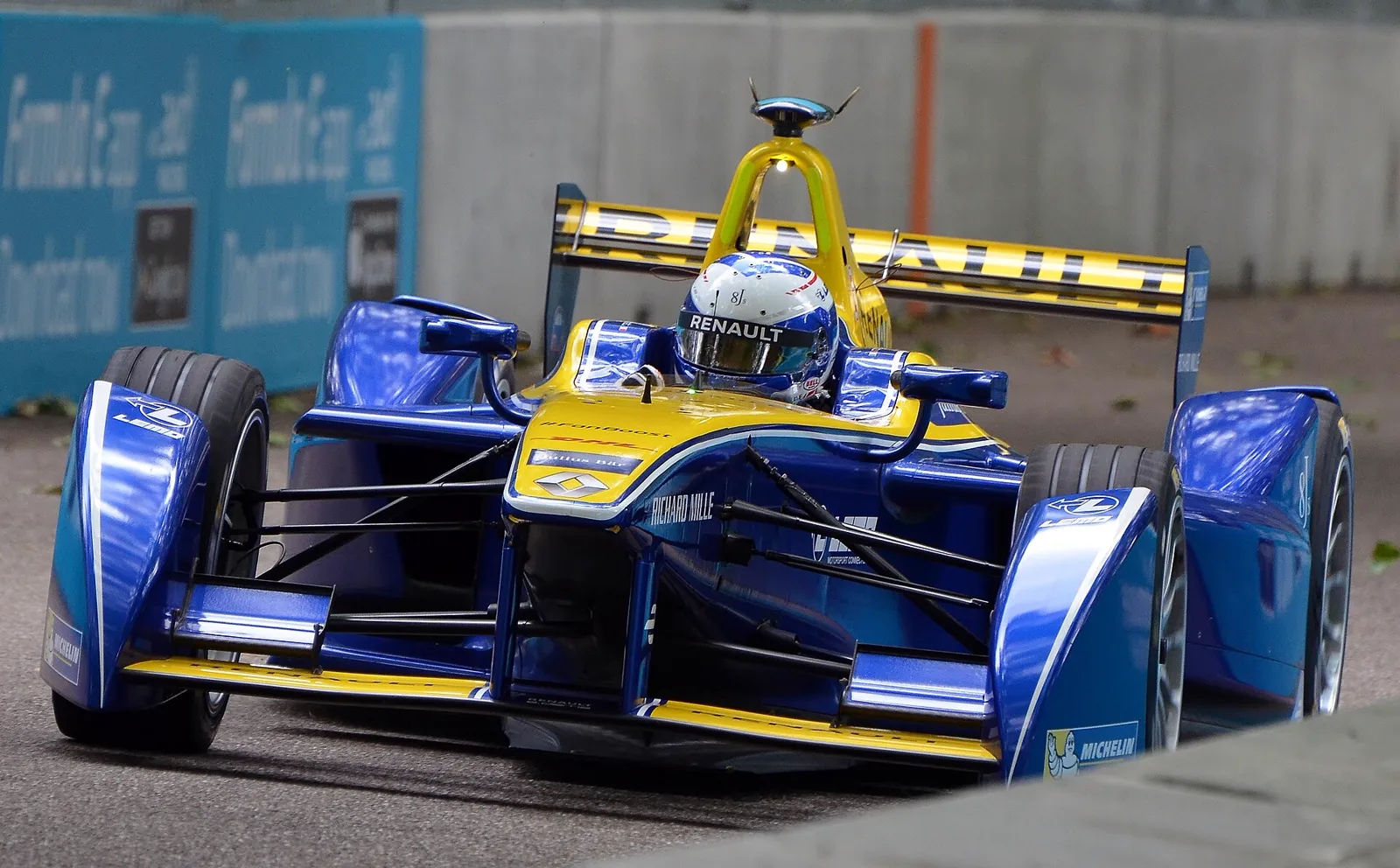
Beijing, September 13, 2014: the first race of Formula E, the electric single-seater championship. Halfway through, race leader Nicolas Prost pulls into his garage, climbs out of his car and settles into a second one waiting for him there. Once the stops are over, he is back in front. Forty cars are entered that day: two per driver. The reason fits in a sentence: the battery couldn’t last the whole race.
A Battery for Half a Race
The championship’s first car, the Gen1, is the Spark-Renault SRT 01E, built by Spark Racing Technology on a Dallara chassis. The championship explained it itself in 2017, in its official glossary: at racing speed, the car could only run for about 25 minutes before using up the 28 kWh of energy in its battery.
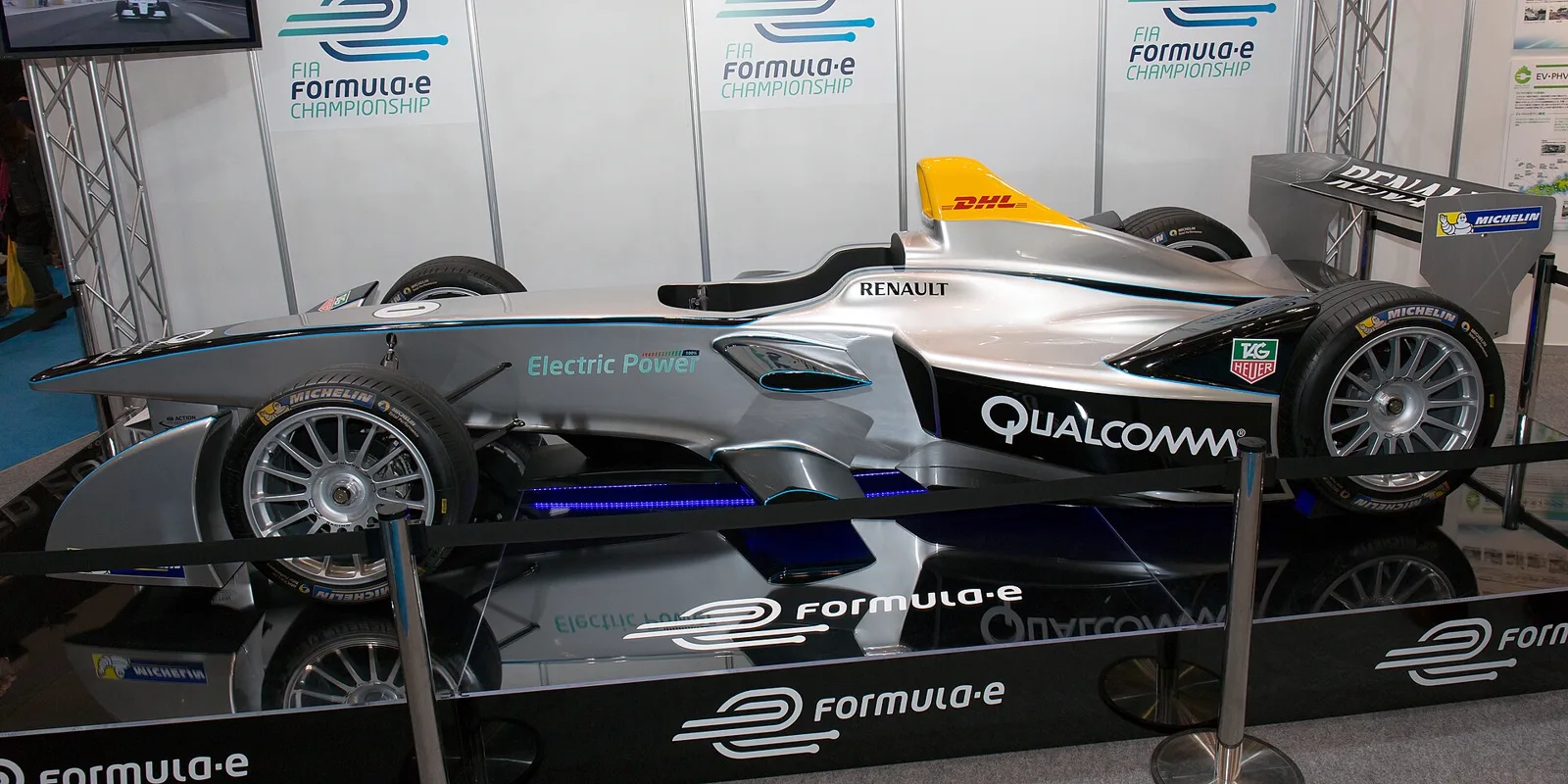

The kilowatt (kW) measures power, the flow from the tap; the kilowatt-hour (kWh) measures energy, the water in the tank. The technical regulations of the FIA, the Fédération Internationale de l’Automobile, cap both in the 2016-2017 and 2017-2018 versions: 200 kW at most coming out of the battery, 28 kWh at most delivered to the motors. An FIA training document specifies that the battery held 32 kWh, of which 28 were usable. Designed by Williams Advanced Engineering, it was used for all four seasons of the Gen1.
Twenty-five minutes was short. The championship studied two short races, then gave up on them, judging that a race of about fifty minutes split by a car swap would make a better show. The 2014 sporting regulations set a race of at least 37.3 miles (60 km) and at most 60 minutes plus one lap, with at least one mandatory car swap, in the driver’s own garage.
Why Not Just Swap the Battery?
Replacing the battery, like refilling a fuel tank, would have seemed simpler. The championship’s glossary gives the reason: the battery and its casing are part of the car’s crash structure, the part that absorbs impacts. The technical regulations require this casing to pass an FIA-defined crash test, and a slide from the federation describes it as a carbon safety shell placed between the monocoque and the transmission. As for recharging the battery during the stop, the 2014 regulations forbid it.
The championship cites an example from Beijing. At the last corner, Prost tangles with Nick Heidfeld, and the win goes to Lucas di Grassi of the Audi Sport ABT team. Heidfeld’s crash happens at high speed; his battery nevertheless stays attached to the chassis, which the championship credits to that strength.
A Stop Choreographed Down to the Gesture
The regulations describe the swap step by step. It takes place in the driver’s assigned garage, with no more than two team members to help. Before leaving his car, the driver checks that it is no longer ready to run: a white indicator and a red light must both be off. It is forbidden to power up the second car before the driver is seated in it with his belts fastened. He must then tighten his harness before leaving the garage. The abandoned car goes into parc fermé as soon as the driver enters the pits.
The championship saw in this stop “one of the main differences” between Formula E and all other forms of motorsport. It presented the strategic stakes: attack from the start to build a lead or move up, knowing you would have to pit sooner and save energy afterward. Autosport would sum it up in 2019: the mid-race car swap “caused the purists to wince.”
The Race Against the Clock in the Garage
The risk was rushing the swap to save time. In June 2017, in Berlin, the two Mahindra cars nearly collide: Felix Rosenqvist leaves his garage just as his teammate Nick Heidfeld is entering the pits. Heidfeld misses his stopping point, then, once in his second car, is released in front of Nelson Piquet Jr. Fines and penalties of 5 and 10 seconds follow; Autosport asks the FIA to crack down on this “needless risk.”
To prevent rushed swaps, before each round the FIA set a minimum time between pit entry and pit exit, with a few seconds of margin, and lowered it as the teams got more efficient. In January 2018, it scrapped it. Lucas di Grassi, the reigning champion, isn’t convinced:
“I’m in favour of the concept but if they do such a change they should do it before the beginning of the season. […] The current belts are standard single-seater belts that are not designed for a quick change.” Lucas di Grassi, Autosport, January 10, 2018
Sam Bird, a driver for the DS Virgin Racing team, voices his worry in the same article:
“There’s nothing stopping drivers not doing the bottom belts up in order to gain time, and then that becomes extremely dangerous.” Sam Bird, Autosport, January 10, 2018
In the following weeks, the Techeetah and Dragon teams are fined for modifying their harnesses. In Mexico City, André Lotterer, a Techeetah driver, hits a mechanic as he accelerates to leave his garage. The FIA then reminds everyone of the prohibitions: unfastening your belt or removing the steering wheel while the car is moving.
On March 17, in Punta del Este, Uruguay, the episode Bird feared occurs, though its cause is not established. Daniel Abt, an Audi driver, feels his belts loosen under braking two laps after his car swap. Third before the stop, he finishes 14th. The stewards nonetheless conclude, with tension data to back it up, that he left the pits with his belts fastened and tight: no penalty. In April, the FIA installs cameras in the garages to monitor the swaps.
The Gen2, One Car for the Whole Race
On March 6, 2018, at the Geneva Motor Show, Jean Todt, president of the FIA, and Alejandro Agag, founder and CEO of Formula E, unveil the second-generation car, the Gen2. Its battery, supplied by McLaren Applied Technologies, can deliver nearly twice as much energy as the Williams one. The championship draws the conclusion: no more need to swap cars from season 5, in 2018-2019.
“It’s incredible to see the progress made in just four years - to double the range of the car and increase the power output is a fantastic achievement” Jean Todt, Geneva, March 6, 2018
Power, for its part, barely moves: in the race, it goes from 180 kW in 2017-2018 to 200 kW with the Gen2.
Without a stop, the racing needed to keep some give. Agag told Crash.net:
“It is very important for TV and the product to have some kind of strategy in races.” Alejandro Agag, Crash.net
The answer comes from the FIA World Motor Sport Council: two power levels, both mandatory in the race. On June 7, 2018, the FIA spells it out: 200 kW in normal mode, 225 kW in the higher mode, after driving through an activation zone visible on the track and on TV. The 2018-2019 regulations call it Attack Mode.
New York, the Last Swap
Season 4 ends in Brooklyn, New York, on Sunday, July 15, 2018, with a 43-lap race. Daniel Abt pits first, at the end of lap 22, after a strategy mix-up; the other front-runners follow him on the next lap. Jean-Éric Vergne of the Techeetah team and Lucas di Grassi come out of their garages still glued to each other. Vergne wins, di Grassi finishes second, and Audi Sport ABT Schaeffler takes the teams’ title. The FIA notes it the very next day: it was the last time cars would be swapped mid-race.
The garage hasn’t disappeared, though. In February 2025, in Jeddah, Formula E brings back a mandatory stop at some races, the Pit Boost: 30 seconds of recharging at 600 kW, for 10% more energy. What the 2014 regulations forbade has become the reason to stop.
Test yourself on electric racing
Read also: Why F1 cars no longer refuel during races.
FAQ
Did energy recovered under braking count toward the 28 kWh limit?
Yes, in part. The 2016-2017 and 2017-2018 technical regulations add braking energy to the allowance, but only at three-quarters of its value, to account for losses.
Did FanBoost apply to both cars?
In 2014, yes: the three drivers with the most fan votes got a burst of up to 180 kW in each of their cars, once, for 5 seconds. From 2015-2016 on, it could only be used in the second car, and only once.
Can Attack Mode be used right from the start?
No. The 2018-2019 regulations forbid it during the first two laps. They let the FIA set, race by race, the number of activations, the number of mandatory periods of use and the minimum time the mode must be armed.
How long did a Formula E race last without a car swap?
The 2018-2019 sporting regulations, in the version published in April 2019, set the race at 45 minutes at most, plus one lap. From 2014 to 2018, it was 60 minutes plus one lap, with the car swap.
Keep exploring
Main sources
- A-Z of Formula E (glossaire, lettre C : car swap) — FIA Formula E (fiaformulae.com)
- 2014 FIA Formula E Championship, Sporting Regulations — FIA (fia.com)
- Formula E drops minimum pitstop time (10 janvier 2018) — Autosport