Why Did Formula E Race Without Rear Brakes?
From 2023 to 2026, Formula E cars had no rear hydraulic brakes, only a backup brake. Where did that gamble come from, and what did the crashes change?
Published November 18, 2026 · Facts checked November 18, 2026
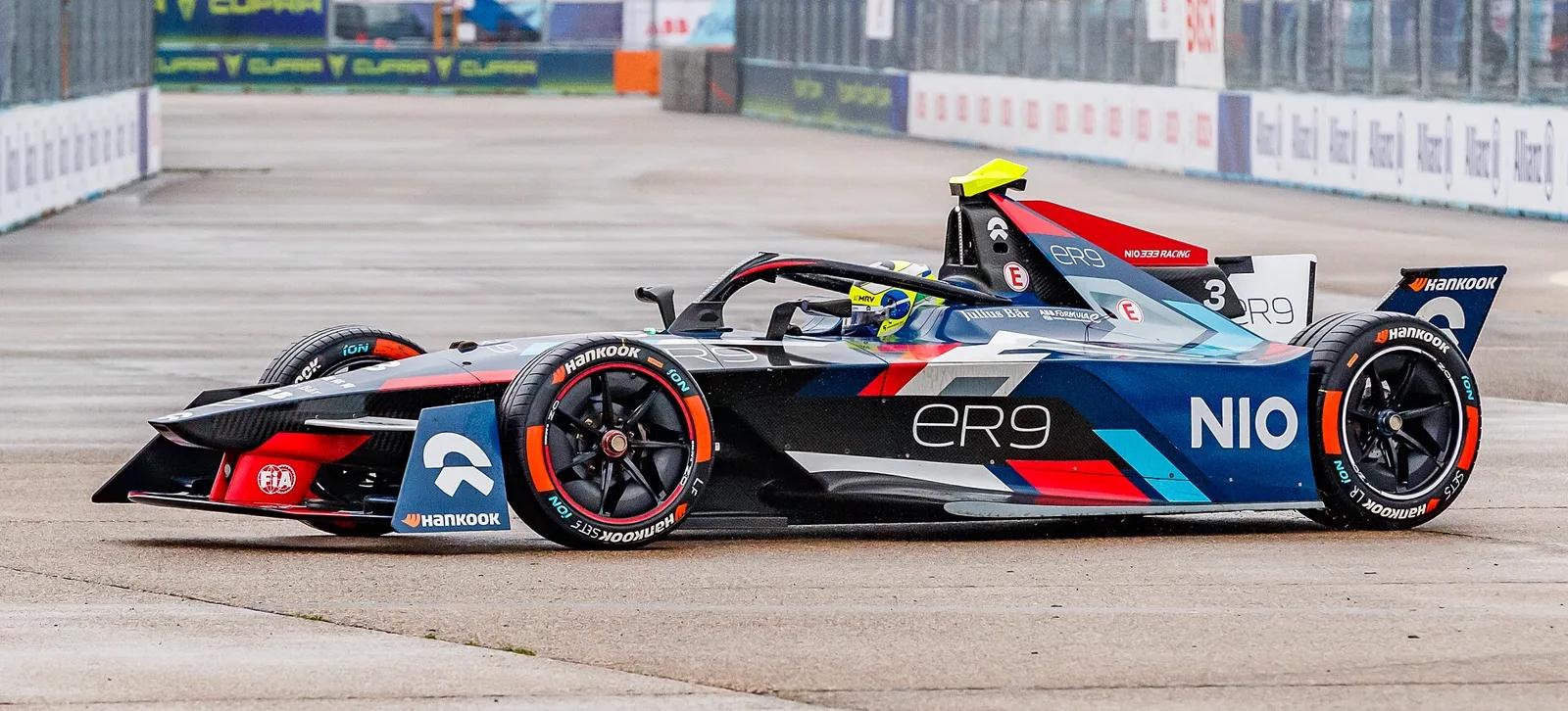
Valencia, Friday, December 16, 2022, the last day of Formula E testing, the electric single-seater championship. The session has been running for almost an hour when Sébastien Buemi, a Swiss driver for Envision Racing and the 2015-2016 champion, arrives at Turn 4. According to witnesses, his car does not seem to slow down at all. It crosses the gravel and ends up in the tire wall. The shell that forms the chassis, the monocoque, is cracked.
This car, the Gen3, has no hydraulic brakes at the rear. Its rear wheels are slowed by the electric motor, which slows the car by recharging the battery. From 2023 to 2026, every Formula E car raced this way. As long as the motor is running, it works.
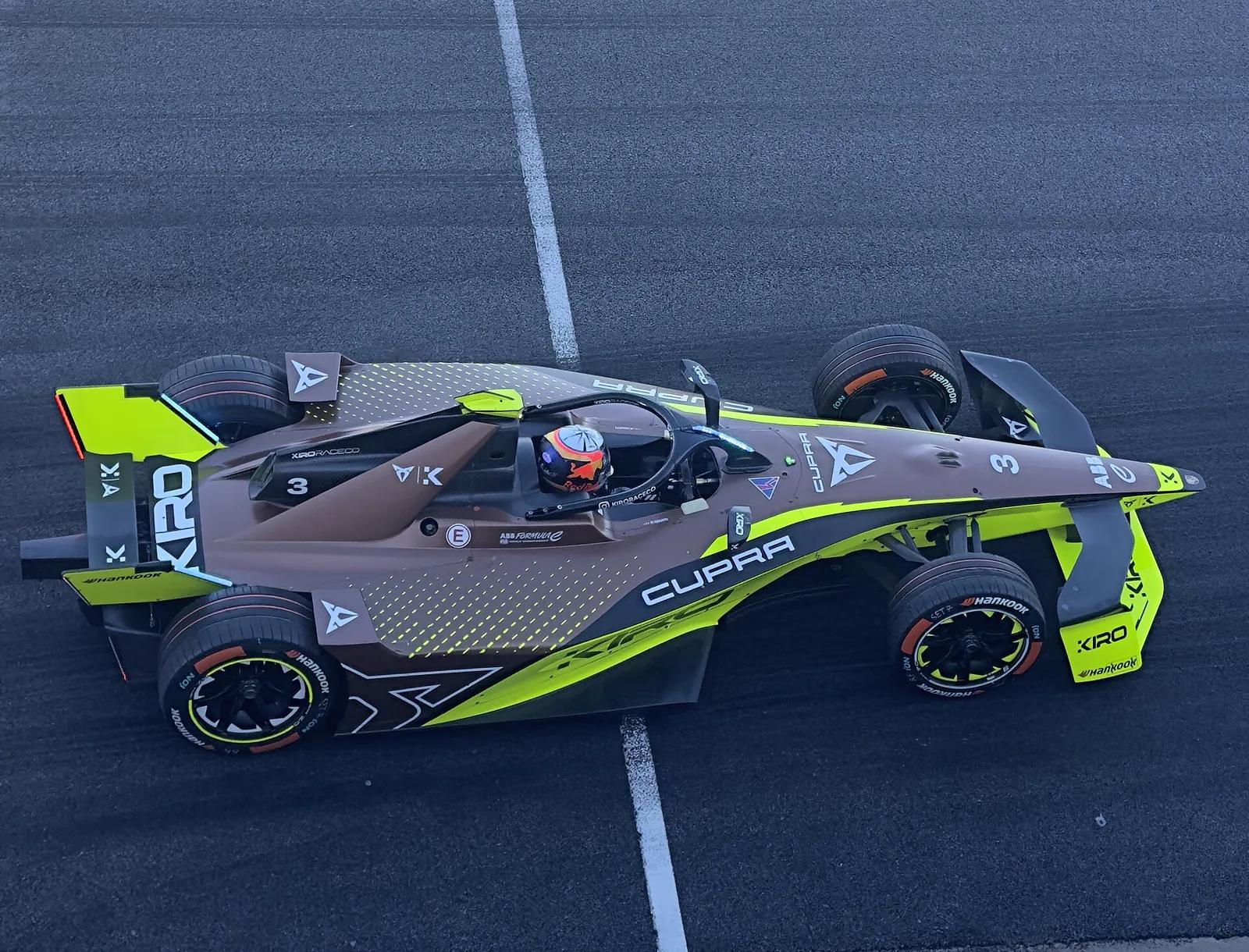

The Rear Motor Does the Brakes’ Job
Formula E unveils its third car, the Gen3, in Monaco on April 28, 2022. The FIA’s technical regulations for 2022-2023, the Gen3’s first season, call for three braking circuits operated by the same pedal. Two act on the front wheels: one is hydraulic, the other goes through an electric motor mounted at the front. For the rear, the text is plain:
“The circuit that acts on both rear wheels must use the rear powertrain; no hydraulic circuit is permitted.” Formula E Technical Regulations 2022-2023, Art. 11.1, FIA (official English text)
The electric motor then does the opposite of its usual job: instead of pushing the wheels, it holds them back, and the energy it takes from the car’s speed goes back into the battery as current. That is regeneration.
The Gen3’s only hydraulic brakes are therefore at the front. They work with electronic braking, known as “by wire”: sensors read the pedal position and computers control the brakes. At the rear, a backup brake is added starting in 2023, but it is used only in case of failure.
Why the Rear Can Do Without Them
In December 2019, before the Gen3 was built, a Michelin simulation shows that, with the planned regeneration power, the rear brakes are hardly used anymore: 4 bar (58 psi) of pressure at most, versus 130 bar (1,885 psi) on a Formula 1 car. Michelin also notes that it makes sense to recover energy at the front: under braking, weight shifts forward and loads the front tires, which can brake harder. The simulation then raises the possible removal of the rear brakes; the decision belongs to the FIA.
The Gen3 can indeed brake while recovering more power than it delivers. The rear motor sends up to 350 kW back to the battery, and the front motor, which under the 2022-2023 regulations is used only for that, 250 kW: 600 kW in total, more than double the Gen2. When accelerating, the car delivers no more than 350 kW, about 469 hp.
Lucas di Grassi, a Brazilian driver and the 2016-2017 Formula E champion, had noticed it as early as the Gen2. In April 2022, then at Venturi, he explains:
“This year, we only use the hydraulic brakes on the rear axle in the first two or three laps of the race. Because after that you will use the regen, otherwise you’re wasting energy. So we already race like 90 percent of the race without the rear brakes.” Lucas di Grassi, The Drive, 2022
With 350 kW, he figures, it will be easy, even better: the electric motor modulates deceleration far more precisely than brakes can.
According to The Race, a specialist website, a large part of the FIA’s and Formula E’s choice was also about the showcase: demonstrating this technology before it spreads further into road cars. The site also sees an environmental message in it: fewer metal and carbon particles from the brakes.
Manufacturers and teams had questioned this choice from the Gen3’s design stage, in 2019. In 2021, Benoît Treluyer, a three-time winner of the 24 Hours of Le Mans, drives the Gen3 for his first real test, at the Monteblanco circuit in southwestern Spain. Before his first run, this braking system worried him a little:
“I was really impressed because the bite really felt like a normal brake and I couldn’t believe it at the beginning.” Benoît Treluyer, The Race, 2021
It is even better than a normal brake, he adds: it is very consistent, and there is no more playing with temperatures or adjusting the cooling.
2022: When the Motor Cuts Out
Private testing in 2022 goes badly. In July, Oliver Rowland crashes heavily at Mallory Park after a powertrain cutout, the motor and its electronics. In November, Lucas di Grassi’s crash at Almería is at least the fourth major Gen3 crash in testing that year.
In late November 2022, The Race writes that some of these crashes were triggered by powertrain cutouts or software glitches: the driver then can no longer stop his car properly. It adds that the brakes themselves are probably not the root cause. In August 2026, taking stock of the Gen3, the same site judges differently: these crashes came mostly from the lack of rear brakes, because when the motor cut out, which happened often, the driver no longer had enough braking.
At Valencia, three days after Buemi’s crash, The Race puts forward an explanation, with no official confirmation: an inverter problem, the part that feeds the motor with current, would have shut the car down on the approach to Turn 4. Buemi brakes, but all he has left is the front hydraulic brakes, still cold: they only supplement the front motor’s regeneration. Sylvain Filippi, of Buemi’s team, sums up the danger in January 2023:
“But of course, with this car [Gen3] if you have a system failure in some cases you lose the regen, if you lose the regen you have no brakes” Sylvain Filippi, The Race, 2023
The drivers say so too. At Valencia, Sergio Sette Camara, a driver for NIO 333, tells The Race:
“…very robust and they can take a hit, but as a driver, you don’t like not having rear brakes.” Sergio Sette Camara, The Race, December 2022
A Backup Brake, for One Use Only
The decision predates Valencia. In late November 2022, the FIA confirms to The Race that it has decided, with the promoter and the manufacturers, to add a backup brake at the rear. Its technical director, Xavier Mestelan-Pinon, describes it as a reinforcement of the braking that acts only when needed. It might not be ready until March 2023; after Buemi’s crash, the pressure to move faster builds. Alessandra Ciliberti, head of the FIA’s Gen3 project, holds to the principle:
“It really still is a car with no rear hydraulic brakes.” Alessandra Ciliberti, The Race, 2022
The system takes shape in January 2023. A solenoid valve, an electrically controlled valve, which the driver opens when braking, connects the front braking directly to the rear wheels, to stop the car in the event of a complete cutout. It works only once, then has to be reset, and the FIA monitors by telemetry that no one uses it outside an emergency stop.
The backup brake is not ready for the Gen3’s first race, in Mexico City, in January 2023. Extra protective barriers are installed at some corners. Mitch Evans nonetheless has a big crash there. For several hours, Jaguar and Envision, which runs with a Jaguar motor, consider withdrawing, then are persuaded to stay. The backup brake arrives for the next round, at Diriyah, Saudi Arabia, in late January 2023.
The Gen4 Puts Hydraulic Brakes Back at the Rear
The Gen3 Evo, the version of the Gen3 entered from the 2024-2025 season, keeps the same rule: the 2025-2026 regulations still prohibit any hydraulic circuit on the rear wheels.
The Gen4 changes the principle. The 2026-2027 technical regulations, in their September 30, 2026 version, list four braking circuits operated by the same pedal. At the rear, one must be purely hydraulic, and the other goes through the rear motor: the two coexist. The text does not say why. Regeneration, for its part, keeps growing:
| Gen2 | Gen3 and Gen3 Evo | Gen4 | |
|---|---|---|---|
| Maximum regeneration | 250 kW | 600 kW | 700 kW |
| of which front axle | none | 250 kW | 350 kW |
| Maximum power | 250 kW | 350 kW | 600 kW |
| Rear hydraulic circuit | yes | no | yes |
According to Formula E, the Gen4 is also the first of its cars with permanent all-wheel drive. The 2026-2027 season was to open in Jeddah, Saudi Arabia, in December 2026; that round has been pushed back to April 2027. The Gen4’s first race is now announced for January 16, 2027 in Mexico City, at the Autódromo Hermanos Rodríguez. That is where the Gen3 first raced, without a backup brake.
Test yourself on electric racing
Read also: Formula E: Why Did Drivers Switch Cars?
FAQ
How much of its energy does a Formula E car recover under braking?
According to figures Formula E published in 2022 (its April press release and its Gen3 fact sheet), more than 40% of the energy the Gen3 used in a race was to come from regenerative braking, versus about 25% for the Gen2. These are the promoter’s figures, not an independent measurement.
Is the Gen3 the first race car without rear hydraulic brakes?
Formula E presented it in April 2022 as “the first formula car that will not feature rear hydraulic brakes.” That “first” applies to formula single-seaters, not to all race cars.
Is the Gen3 lighter because it has no rear brakes?
According to the Gen3 fact sheet published by Formula E, its minimum weight, driver included, goes from 1,984 lb (900 kg) for the Gen2 to 1,852 lb (840 kg), all causes combined. The share attributable to the rear discs, calipers and pads that were removed is not broken out.
Who designs a Formula E car’s electronic braking?
On the Gen3, the front axle’s electronic braking is a standard part from Spark, the maker of the common chassis. The Gen4 regulations allow manufacturers to develop it themselves.