Why Was Group B Banned in 1986?
Cars with more than 500 horsepower, crowds on the roadside, two tragedies in two months. Why did FISA wait for the second one to stop everything?
Published November 18, 2026 · Facts checked October 30, 2026
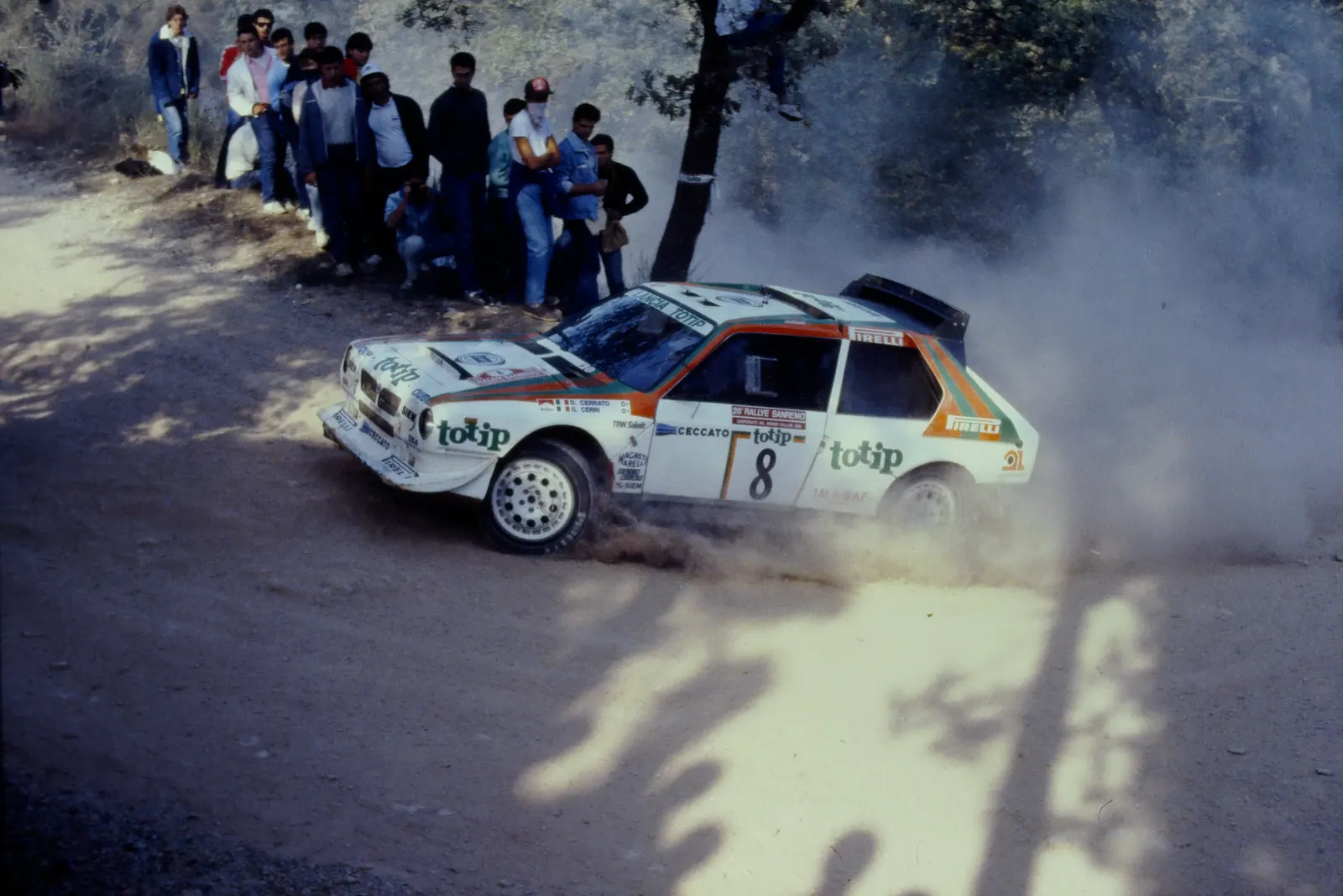
On May 2, 1986, at the Tour de Corse, Henri Toivonen and his co-driver Sergio Cresto die in the crash of their Lancia Delta S4. Toivonen was 29 and was seen as the favorite for the world title. FISA condemns Group B in the wake of it.
A Rulebook That Left the Turbo Unlimited
To compete in a category, a car has to be homologated: its manufacturer must have built a minimum number of road versions. Group B, created in 1982 for grand touring cars by FISA, the sporting arm of the Fédération Internationale de l’Automobile, demands very few: Peugeot only needs to build 200 road cars of its 205 Turbo 16. Once the car is homologated, an improved version, the “evolution,” needs only 20.
| Category | Cars required for homologation |
|---|---|
| Group B (grand touring cars) | 200, then 20 per evolution |
| Group 4 (former grand touring category) | 400 |
| Groups A and N (production touring cars, modified or not) | 5,000 in twelve months |
These easy rules quickly attract manufacturers. With so few cars to sell, they build genuine race cars, on tube-frame chassis rather than on production bodies. And the rulebook doesn’t limit forced induction, that is, the turbo or supercharger that compresses the air fed to the engine so that it makes more power. It merely classes forced-induction engines as if they were 1.4 times bigger: a 1,785 cc turbo engine, about 1.8 liters, competes in the same class as a naturally aspirated 2.5-liter engine.
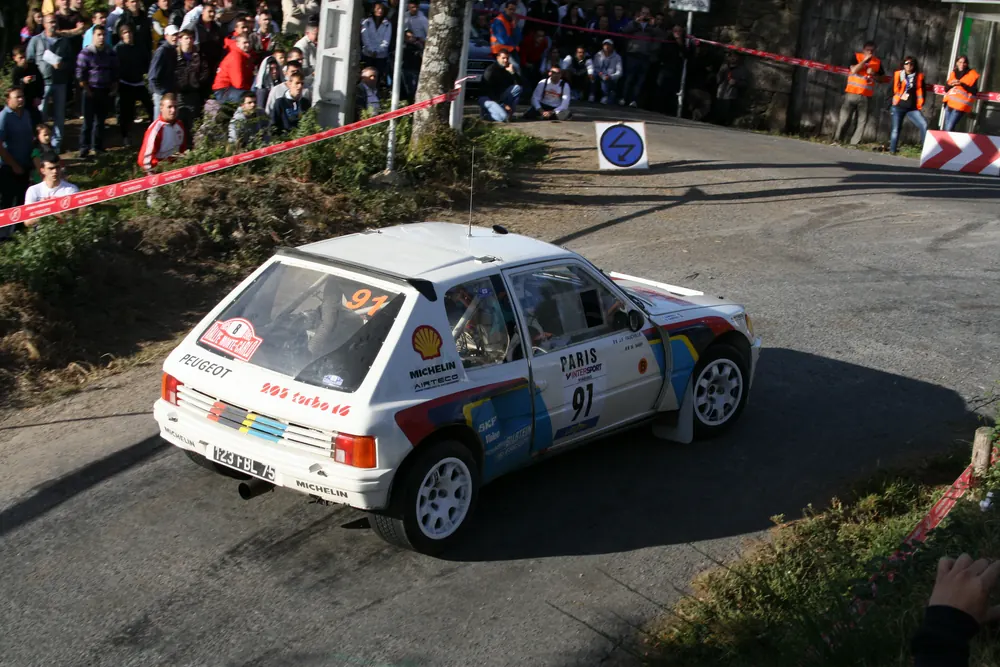
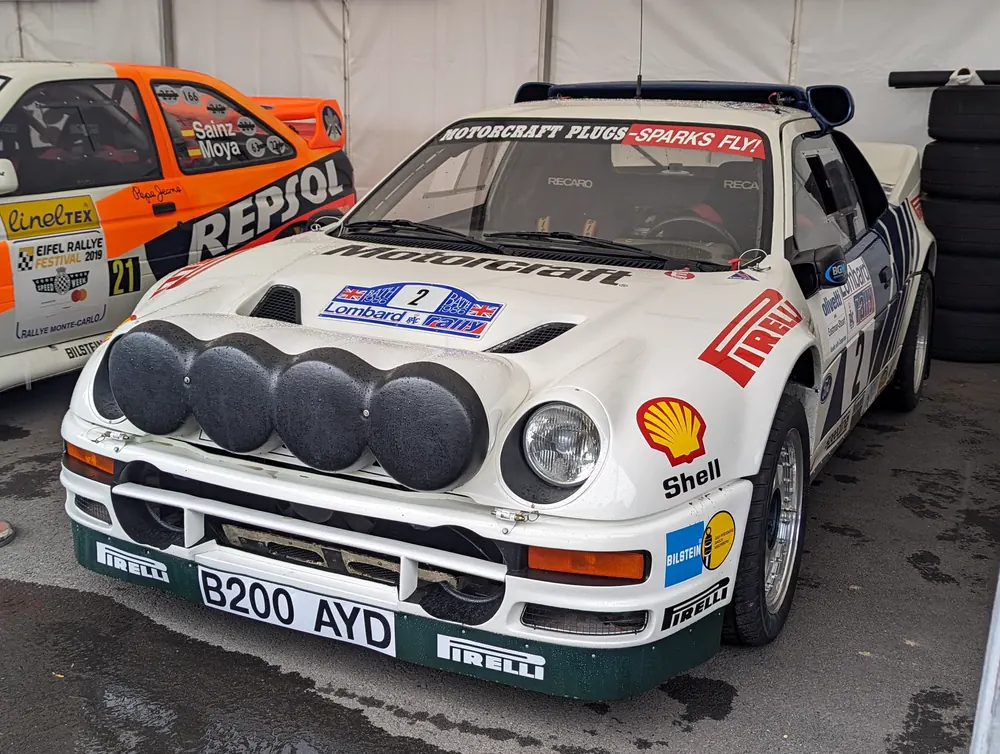
The manufacturers rush through the loophole. Audi competes with the Quattro, a four-wheel-drive car. Peugeot fields the 205 T16, the race version of its small production 205, also four-wheel drive, but smaller and lighter. Lancia replaces its outdated 037 with the Delta S4, which combines a turbo and a supercharger. Ford enters the RS200, and Audi evolves its Quattro all the way to the Sport quattro S1 E2. In 1981, the winning car had 250 horsepower; in 1986, at least two cars exceed 500 horsepower.


| Car | Maximum claimed power |
|---|---|
| Audi Sport quattro S1 E2 | 480 hp officially, more than 500 hp in reality |
| Lancia Delta S4 | 490 hp, 500 hp according to some sources |
| Ford RS200 | 350 to 450 hp |
The Warnings of 1985
Serious accidents multiply. The cars advance unchecked, the routes are criticized and the crowds are not kept under control. In 1985, in Argentina, Finland’s Ari Vatanen, the 1981 world champion, is seriously injured in a violent crash. On May 2, 1985, at the Tour de Corse, Italy’s Attilio Bettega loses control of his Lancia and hits a tree; he dies instantly. His death raises doubts about the safety of Group B cars.
Portugal, March 1986: The Crowd on the Road
At Rally Portugal, March 5 to 8, 1986, the crowd is so dense in places that drivers can barely see the road: spectators stand on the roadway, and Vatanen speaks of a “human corridor.” On the first stage, Portuguese driver Joaquim Santos loses control of his Ford RS200 while trying to avoid spectators, and the car slides into another group: at least three dead and more than thirty injured.
All the manufacturers’ works teams withdraw immediately. In a handwritten statement, the drivers nevertheless refuse to blame the cars:
“The accident on stage one was caused by the driver having to try to avoid spectators that were in the road. It was not due to the type of car or the speed of it.” Drivers’ statement
The rally continues with the amateur crews. The FISA president, Jean-Marie Balestre, takes care to congratulate them, and even confirms by telegram Portugal’s place on the 1987 calendar.
Tour de Corse, May 2, 1986
In Corsica, Toivonen leads by a wide margin. Yet he complains that his Lancia is too fast and too powerful for this rally, and that he has trouble keeping it on the road; other Group B drivers share his worry. In a short interview just before the 18th stage, he says so (remarks reported in English):
“it’s hard to keep up with the speed. So, with a modern car like this, it’s just impossible to race here. It’s physically exhausting and the brains can’t keep up with it anymore.” Henri Toivonen, May 2, 1986
At the seventh kilometer of that stage, in a tight left-hand corner with no guardrail, his Lancia leaves the road, falls into a ravine and ends up on its roof. The aluminum fuel tank under the driver’s seat, pierced by trees, catches fire and explodes. This tank has no protective shield plate: that equipment is mostly used on gravel rallies, and it isn’t fitted on the Tour de Corse, run entirely on asphalt.
Both men die in their seats; Cresto, an American, had also been Bettega’s co-driver. Why the car left the road is unknown: no witness saw the accident up close. It was exactly one year to the day after Bettega’s death, at the same event.
The Decision
A few hours after the accident, FISA decides alone: Group B is banned from the World Championship starting in 1987, except for the least powerful models. Group S, the rulebook planned to succeed it, with cars limited to 300 horsepower and homologated with just ten cars built, is cancelled. The next day, an extraordinary FISA committee adds immediate measures:
- no more new evolutions homologated in Groups A and B;
- a ban, from May 20, 1986, on skirts, the flexible strips that seal the underside of the car to press it to the ground;
- shorter legs, meaning racing days, and mandatory automatic fire extinguishers on Group B cars;
- as of January 1, 1987, a World Championship reserved for Group A.
Group A, reserved for cars derived from a model produced in 5,000 units, becomes the premier category. Audi and Ford withdraw from the championship; the other teams finish the season with their Group B cars. Audi blames the federation for having planned nothing for spectator safety. The 1986 title goes to Finland’s Juha Kankkunen, in a Peugeot; he would win four in all.
The Right Decision?
FISA was criticized from both sides: for recognizing the problem too late, and for overreacting. Before the Santos and Toivonen accidents, many drivers and commentators had warned that these cars were becoming impossible to control. Author and former co-driver John Davenport judged in 2004 that Group B could have been tamed: in his view, it was the fuel system, responsible for Toivonen’s death, and crowd control that needed changing, not the cars.
For the specialist site DirtFish, it took the deaths of Toivonen and Cresto for Balestre to change his mind.
Read also: Why the Dakar Rally left Africa.
FAQ
When was Group B banned?
FISA decided it within hours of Henri Toivonen’s accident, on May 2, 1986. The ban in the World Championship took effect on January 1, 1987.
How many cars did it take to homologate a Group B car?
200, half of what Group 4 accepted. An evolution then needed only 20 cars. Group A, which replaced it at the top of the World Championship in 1987, required 5,000 in twelve months.
How much power did Group B cars make?
The winning car had 250 hp in 1981; in 1986, at least two cars exceeded 500 hp. These are claimed figures: the Audi Sport quattro S1 E2 was officially rated at 480 hp, for more than 500 hp in reality, and the last factory Audis of 1986 are claimed at 600 hp.
Who was the last Group B World Rally champion?
Juha Kankkunen, in a Peugeot 205 T16, in 1986. The title only went to him in December, after the results of the Sanremo Rally were annulled.
Keep exploring
Main sources
- The disaster of Rally Portugal 1986 — DirtFish
- Group B — Wikipédia (en)
- Henri Toivonen — Wikipédia (en)