Why Do MotoGP Riders Drag Their Knee on the Ground?
It doesn’t turn the bike. So what is that knee scraping the asphalt for, and how did Kenny Roberts make it a habit?
Published November 18, 2026 · Facts checked November 18, 2026
In Dallas in 1973, Kenny Roberts, an American rider from the dirt-track scene, starts taping his knees, because he drags them on the asphalt. The trick comes from indoor dirt-track races run on concrete, where riders put tape on their boots so they would slide. When his knee hit the ground, he says, the jolt shook him; but he knew the tape would slide.
One day in the pits, Art Baumann, a rider with a reputation for being crazy, comes over to tell him that he’s the craziest he’s ever seen and that he’s going to get himself killed. Roberts figures that if this guy thinks he’s crazy, he’s done for. Yet he is going to make that knee scraping the track a habit, and Grand Prix riders with him. Why does a rider go looking for the ground with his knee?
What the Rider Is After
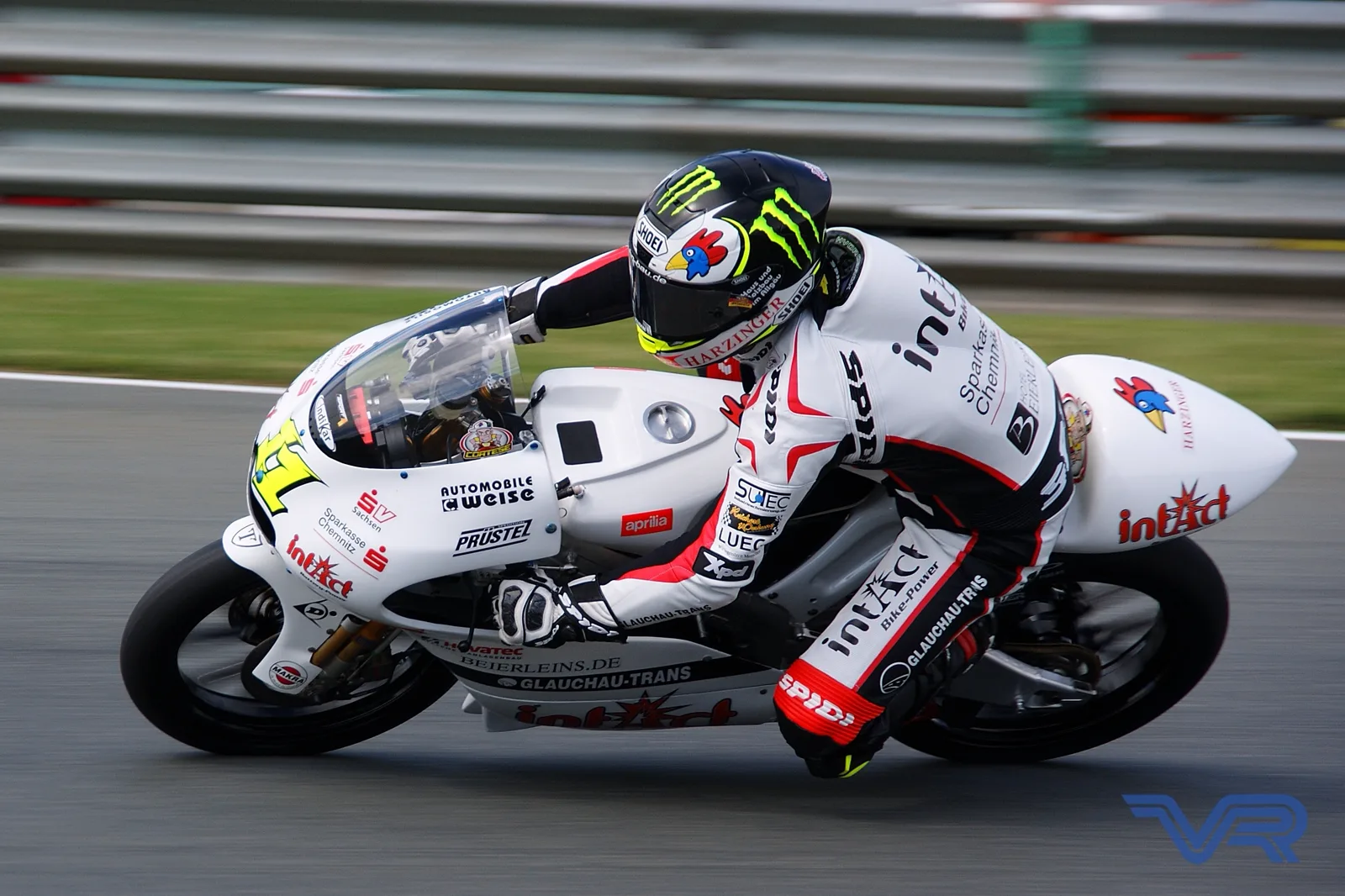
The knee isn’t the goal. The rider slides his body toward the inside of the corner so the bike leans less at the same speed: in English, it’s called hanging off. The inside leg opens up because the body is already out there, and the knee ends up brushing the track. Once there, it serves as a lean-angle reference, and sometimes as a support to hold up the front end when it slides.
Why try to lean the bike less? Cycle World sums it up in 2017:
“Lean angle is risk, and GP-like body position allows us to run less lean angle at the same speed. If you can run less lean angle, you can use more throttle and brake pressure.” Cycle World, April 2017
The same magazine wrote in 2015 that the tire then keeps more rubber in contact with the track and the suspension works better.
A Sensor at the End of the Leg
So why touch down? According to MotoGP.com, the championship’s website, the extended leg acts as a sensor: it tells the rider what angle he’s at, and how much he has left. The same site specifies that the move isn’t meant to speed up through a corner but for balance, and that it is above all not done for show.
What scrapes is the slider: a plastic plate attached to the knee of the suit, made to slide on the asphalt. Simon Crafar, a former rider and Grand Prix winner, explains that everyone uses it in their own way:
“Some force them into the road on every corner, whereas for others, like I did […], the slider just kisses the surface, just feels the road. It’s more like a gauge, but it’s there if the front goes (front tyre loses grip), they can try and hold the front up (prevent a crash).” Simon Crafar, MotoGP.com, December 2025
Before the Knee, the Tips of the Boots
The idea of a sensor predates the knee. Until the 1970s, according to MotoGP.com, riders sit much more upright, their bodies centered on the bike. In the 1960s, when bikes lean as far as 45°, they touch the ground with the tip of their boot to guide themselves through corners.
Briton Mike Hailwood, one of that decade’s riders, uses them like antennae to gauge his angle. Cycle World reported in 1992 that he finished more than one race with blood seeping through the worn holes at the tips of his boots.
From Saarinen to Roberts
Finland’s Jarno Saarinen, the 1972 250cc world champion, had learned on ice, where he already dragged his knee to hold up his sliding bike. On the road, he is one of the first to hang off, his knee pointed at the ground. He only puts it down once in a while.
Roberts says he copied him because he was scared. He told Motor Sport magazine in 2024:
“I started hanging off at Ontario Motor Speedway at the end of 1972. It had this right-hand horseshoe where I felt so uncomfortable, like I was going to crash. Jarno Saarinen […] had come over to race Ontario that year and I watched him. He leaned off the side of the bike with his knee out, so I leaned off in that horseshoe and all of a sudden, I didn’t have that bad feeling.” Kenny Roberts, Motor Sport, November 27, 2024
At Ontario, California, Saarinen crashes in practice and doesn’t start the race, Cycle World wrote in January 1973; according to Wikipedia, citing Cycle News, Roberts watched Saarinen from the edge of the track during a practice session before the race. Motor Sport and Box Repsol, the website of oil company Repsol, a team sponsor, place the scene at Daytona in March 1973, when Saarinen wins the Daytona 200, a 200-mile race, with Roberts watching. MotoGP.com says only that Roberts watched Saarinen “in the USA in the early 1970s.” On May 20, 1973, Saarinen is killed at Monza, in a multi-rider crash on the first lap of the 250cc Nations Grand Prix.
Roberts goes further than his model: he puts his knee down on the asphalt, to stabilize his bike, according to MotoGP.com. Europe discovers the knee-down style in 1978, when he arrives in Grand Prix racing and wins the 500cc title in his very first season. He would hold that title through 1980.

From Duct Tape to the “Porcupine”
Neither skin nor leather can stand up to asphalt. In the 1970s, most riders layer tape over the knees of their suits. Others cut up plastic milk jugs, or shape old helmet visors that they fasten to the tape on the suit.
Italian gear maker Dainese dates its first sliders to 1981, tested with Roberts:
“Dainese tested the first knee sliders with the leading rider, Kenny Roberts. The first products were known as ‘porcupines’ […]” Dainese, “1981-1989” page of its website
The nickname comes from the small spike-shaped cylinders that stuck out of the knee pad each time the knee bent. Motor Sport also puts the first purpose-made sliders at 1981, but describes first soccer cleats, then leather, then plastic. The modern slider arrives, according to Dainese, in the early 1990s, with the suits of Kevin Schwantz, the 1993 500cc world champion.
Today, the part wears out fast. Valentino Rossi, a MotoGP rider, said so in 2015:
“I use a new pair of knee-sliders every practice, every warm-up, every race. I think we use the knee 30 per cent more than we did 15 years ago.” Valentino Rossi, Motor Sport, May 2015
The rulebook, for its part, has taken up the part. On August 9, 2019, at the Red Bull Ring in Austria, the Grand Prix Commission, which decides the championship’s regulations, bans, with immediate effect, any slider whose material, on contact with the track, could obstruct other riders’ vision. A rider, whom it doesn’t name, had just ridden with sliders fitted with metal studs, and the sparks could bother the rider following.
When the Knee Often Stays Tucked In
In tight, slow corners, the bike doesn’t lean far enough for the knee to touch. In the rain, riders sit more upright and lean less; Dainese made a thicker “rain” slider to make contact despite smaller angles.
When it does touch, the position changes with speed, Crafar explains. At lower speeds, the rider pushes the knee out far and for a long time, and the slider scrapes mostly on its front; faster and with more lean, he brings it back against the bike, and it’s the side of the slider that touches.
The Elbow, Then the Shoulder
As angles grew, the knee was no longer enough. In 2013, engineer and journalist Kevin Cameron wrote in Cycle World that with the tire grip of the day, there is no longer room under the bike for the knee put down the old-fashioned way: riders press themselves along their machine, like a man lying on his side to look under a car, the knee against the bike and the elbow very close to the ground.
The knee hasn’t left the track for all that. MotoGP.com sums up the evolution: first the knee, then the elbow, and even the shoulder. It is quite common today, the site writes, to see a rider brush the track with the knee, elbow and shoulder in the same corner.
Read also: How can a MotoGP rider lean over without falling?
FAQ
Who was the first to put a knee down on a motorcycle?
The move is credited to Kenny Roberts, but not with certainty. Common Tread, the blog of retailer RevZilla, concludes it was Roberts, but only until someone sends it an older, authentic photo. The photo often presented as John Surtees, the only world champion in both motorcycle Grand Prix racing and Formula 1, with his knee down on a Vincent, does not show Surtees, and it was staged.
What are knee sliders made of?
Today, high-density plastic or polyurethane with carbon fibers. They are designed to come off and be replaced easily; since the 1980s, they have been attached to the suit with Velcro.
How many sliders does a MotoGP rider go through?
A lot. According to Motorcyclist magazine, Marc Márquez uses dozens a year and changes them almost every time he leaves the pits. In 2015, Valentino Rossi explained that he rode with double-thickness sliders, because a single slider didn’t last a race.
Why did Kenny Roberts race in yellow and black?
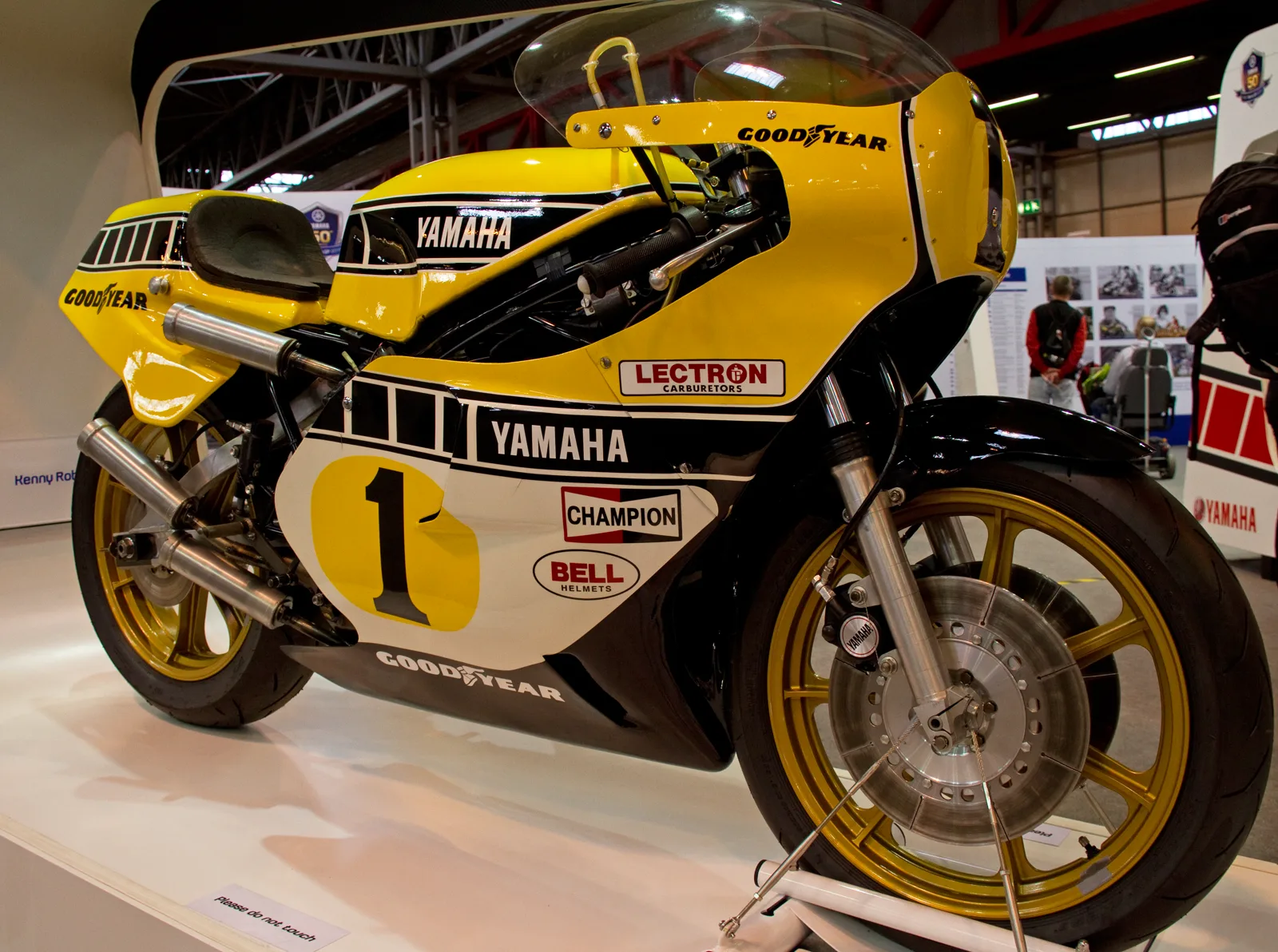
In 1978, he wore the colors of Yamaha USA, yellow, black and white, while other Yamaha riders wore the factory colors, white and red. According to Motor Sport, those colors come from the sound of Yamaha’s two-strokes: American fans thought they buzzed like bees.
Keep exploring
Main sources
- Why Do MotoGP Riders Drag Their Knee? (25 juin 2025) — MotoGP (motogp.com)
- King Kenny: MotoGP’s original and best independent team champion (Mat Oxley, 27 novembre 2024) — Motor Sport
- Toes, knees, elbows... head! (Mat Oxley, mai 2015) — Motor Sport