Why Have Trucks Raced the Dakar Rally Since 1979?
A press truck that rescues other competitors, a Dutch trucking company owner, a Soviet factory: how heavy trucks kept their place at the Dakar.
Published November 18, 2026 · Facts checked November 18, 2026
Paris, Trocadéro, December 26, 1978. The first Paris-Dakar, the rally now known simply as the Dakar, sets off; it will arrive in January 1979, and that is the year it goes into the history books. Among 80 cars and 90 motorcycles rolls a Pinzgauer, an off-road truck with six-wheel drive, number 180. Aboard are two journalists from TF1’s Auto-Moto show and a photographer. On the road to Dakar, the crew rescues many competitors, some of them stuck in Senegal’s river fords. They finish 44th in the standings.
Trucks at the start from the very first edition
The Pinzgauer is not alone. Of the 182 vehicles entered, the organizer’s historical guide counts 12 trucks, and a single classification covers motorcycles, cars, and trucks. The same guide notes that no factory machine is present, and that the point lies elsewhere: “for this initial experience, finish times and rankings did not matter much. Self-discovery, adventure and exceeding one’s own limitations were the essence of the event.”
From the second edition, in 1980, trucks have their own classification: ten at the start, seven at the finish. In 1981 there are 15. Of that edition, the guide writes that “Come together” was the wish of Thierry Sabine, the rally’s founder: “Every type of vehicle was represented at the departure (4x4 vehicles, buggies, side-cars)—even the most unexpected […].” In 1982, 23 trucks start, and a Mercedes crew wins the category two years running.
A Dutch trucker and his DAFs
Jan de Rooy (1943-2024) took over the family trucking company in the Netherlands in 1965 and handed it to his son Gerard in 2010. He had also raced in rallycross, a form of circuit racing run on half asphalt, half dirt, since 1969. In 1982 he makes his Paris-Dakar debut in a truck from DAF, the Dutch manufacturer, and finishes third among the trucks.
With DAF, he dreams up prototype trucks stripped of weight and boosted in power, built to fly over the dunes. In 1985 his DAF leads so comfortably that his crew “looks untouchable,” the organizer’s guide writes. On the last stage, De Rooy, hit by a flat tire, takes a 15-hour penalty, and the win goes to a Mercedes crew.
In 1986, De Rooy fields a DAF with two turbo engines of nearly 500 hp each, with two eight-speed gearboxes shifted at the same time and two driven axles: about 950 hp in all. The guide calls it “of a size to rival the fastest cars.” He retires anyway, with a broken front axle. In 1987 he finally wins the truck category.
1988: 109 trucks at the start, then tragedy
The next edition sets a participation record: 603 vehicles leave Versailles, including 183 motorcycles, 311 cars, and 109 trucks.
On January 9, 1988, another DAF from the De Rooy team, also with two engines, rolls several times in the desert sand. Aboard, the Dutch co-driver Kees van Loevezijn is killed; the other crew members are seriously injured. Jan de Rooy, the defending champion, who was running fifth in his own truck, quits the race, and DAF immediately withdraws all its entries. The manufacturer then stops supporting the team and sells it its equipment.
In its February 1988 issue, the British magazine Motor Sport already counts two deaths. According to the same issue, the French co-driver Patrick Canado is killed the next day when his Range Rover hits a support vehicle. The magazine ties these accidents to the rally’s rise, where enormous factory-built trucks and official works teams are now a common sight:
“Speeds have increased radically, making accidents more severe, and even air-cover cannot guarantee safety. Yet the publicity rewards are huge […]” Motor Sport, February 1988
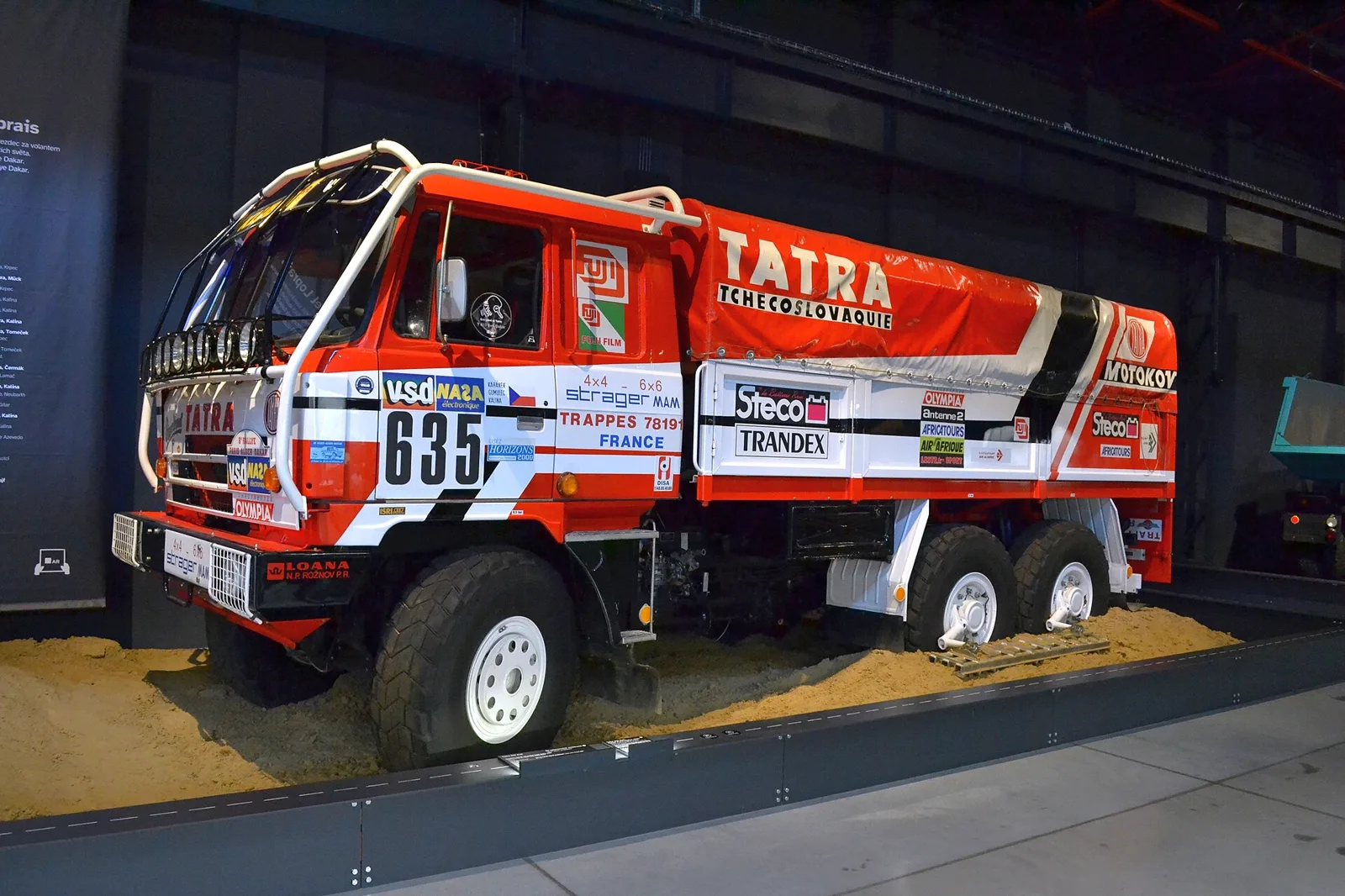
That year, the category goes to the Tatra truck of the Czech driver Karel Loprais.
1989: trucks at the start, but no truck race
The following year, the Dakar has no truck race. The organizer’s guide explains it by “the drama caused by these monsters of the road the previous year.” Trucks do not disappear, though: 77 leave Paris, but as support trucks, serving the competitors. Forty-nine make it to the end.
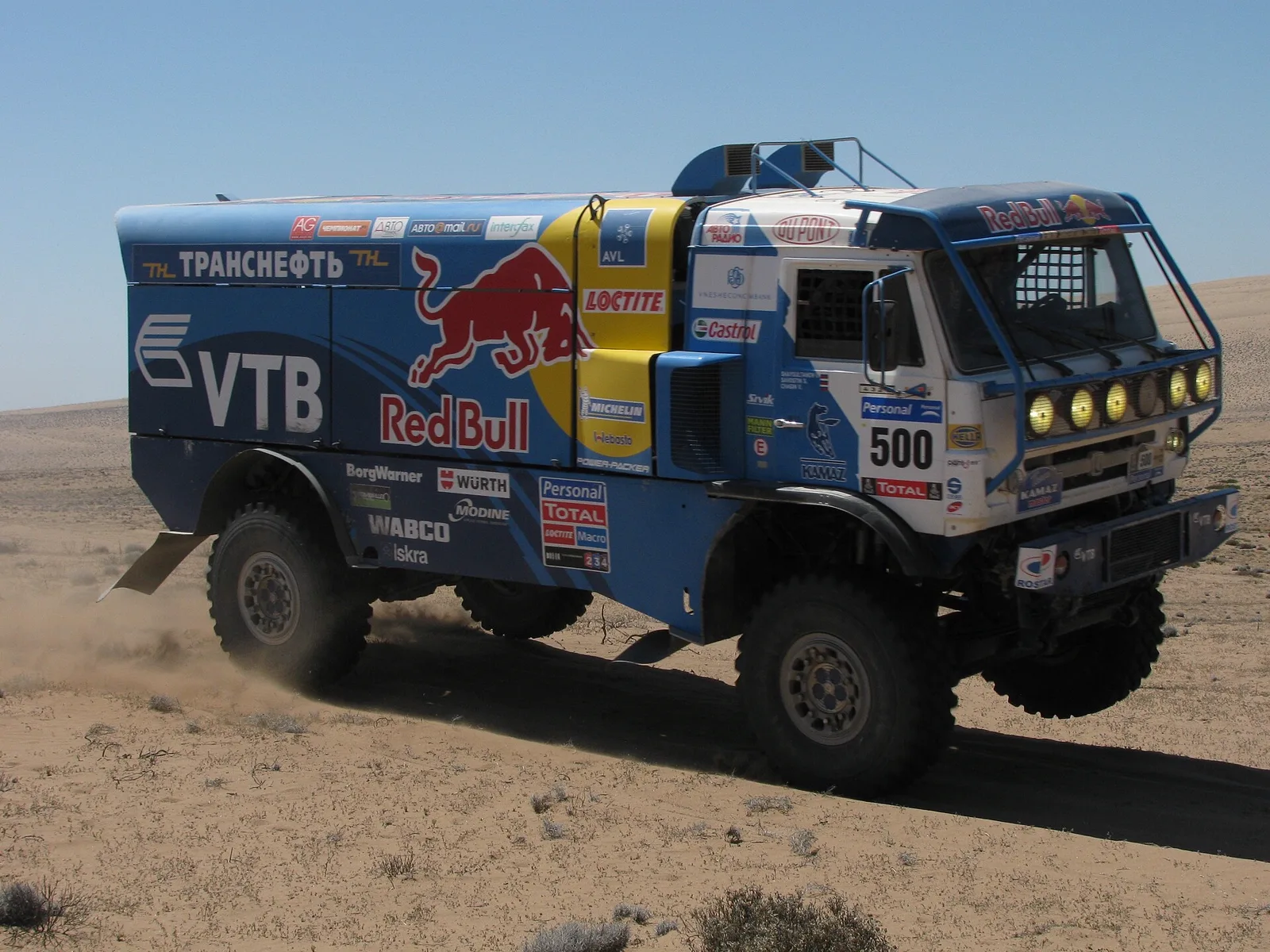
The pause lasts one year. In 1990, trucks return: 93 at the start, 23 at the finish. And for the first time, Soviet drivers are at the wheel of Soviet trucks: Kamaz machines, named for the heavy-truck maker that founded its own racing team, Kamaz-Master, in 1988.
Tatra, then Kamaz
In the 1990s, Loprais wins four times, as many as the Perlini marque. Counting 1988 and 2001, his Tatra has six wins in all.

The idea for the Kamaz team came from Semen Yakubov, later a teammate of Vladimir Chagin, the marque’s star driver: he went to convince the company’s president that a racing team was the way to take on the big truck makers, reports the Spanish site Diariomotor. The rally also serves as a laboratory. The manufacturer says so on its export website:
“rallies are a kind of testing ground for KAMAZ PTC for testing technical novelties and engineering developments, which then go into batch production.” Kamaz, the manufacturer’s export website
Kamaz’s first win comes in January 1996. Then comes Chagin, who wins the category seven times between 2000 and 2011. In 2010, with his sixth title, he joins Loprais; the following year, he passes him.
The son, twenty-five years after the father
Jan de Rooy does not return to the Dakar until 2002, with his son Gerard. Ten years later, in 2012, Gerard wins in turn, in an Iveco, twenty-five years after his father’s victory; he does it again in 2016. In 2023, with Kamaz absent, the De Rooy team wins again, with Janus van Kasteren at the wheel.
Today: over 7,700 lb, 84 mph at most
The 2025 cross-country rally regulations of the Fédération Internationale de l’Automobile (FIA) place vehicles weighing more than 7,700 lb (3,500 kg) fully loaded in the truck group. The same text sets them a top speed of 84 mph (135 km/h), against 106 mph (170 km/h) for the fastest cars.
For the 2025 Dakar, the organizer lowered this limit from 87 to 84 mph (140 to 135 km/h) for safety reasons, according to the website The Checkered Flag. Martin Macík Jr., the 2024 truck winner, responded on the TV Nova channel at the rally’s presentation in Prague:
“We’re racing, we want to be the fastest.” Martin Macík Jr., 2024 (English text as published by The Checkered Flag; originally spoken in Czech)
In his view, the decision comes from the SSVs, light off-roaders capped lower, whose drivers found it dangerous to be passed by trucks on a straight. Macík wins anyway in 2025, for the second year in a row.
In 2026, he goes for a third title. On stage 8, he fails to see Aleš Loprais’s truck at the top of a dune and hits it. The next day, mechanical trouble linked to that impact, according to the site 131 Off-Road, costs him more than three hours: he finishes fourth, more than four and a half hours behind the winner. Victory goes to Vaidotas Žala, ahead of that same Loprais, who bears the name of the six-time winner. Both drive Ivecos from the De Rooy team. Thirty-nine years after Jan’s win, the team that bears his name takes the top two places.
Read also: Why did the Dakar Rally leave Africa?
FAQ
What is a T5.2 truck at the Dakar?
It is a support truck entered in the rally: it carries spare parts and helps the teams fighting for the win. The 2025 FIA regulations limit it to 78 mph (125 km/h), against 84 mph (135 km/h) for the other trucks. The website The Checkered Flag explains that these trucks are not built to compete.
By how much did Jan de Rooy win in 1987?
By more than 14 hours over the runner-up, according to the organizer’s historical guide. He also finished 11th in the overall standings, all categories combined.
Why didn’t Kamaz race the 2023 Dakar?
In September 2022, the Kamaz-Master team refused to sign the driver commitment the FIA required for entry, a text that, in the team’s words, condemns Russian military action in Ukraine. Its press office called the document “political.”
How many support trucks started the Dakar, and how many raced in the T5.2 class?
The numbers have varied a lot. At the start of the 2001 Dakar, the organizer counted 49 support trucks; in 2005, 120, alongside 69 race trucks. Thirteen crews raced in the T5.2 class at the 2024 Dakar.
Keep exploring
Main sources
- Guide historique du Dakar — ASO (Amaury Sport Organisation)
- Around and about (février 1988) — Motor Sport
- Règlement sportif des rallyes tout-terrain 2025 — FIA